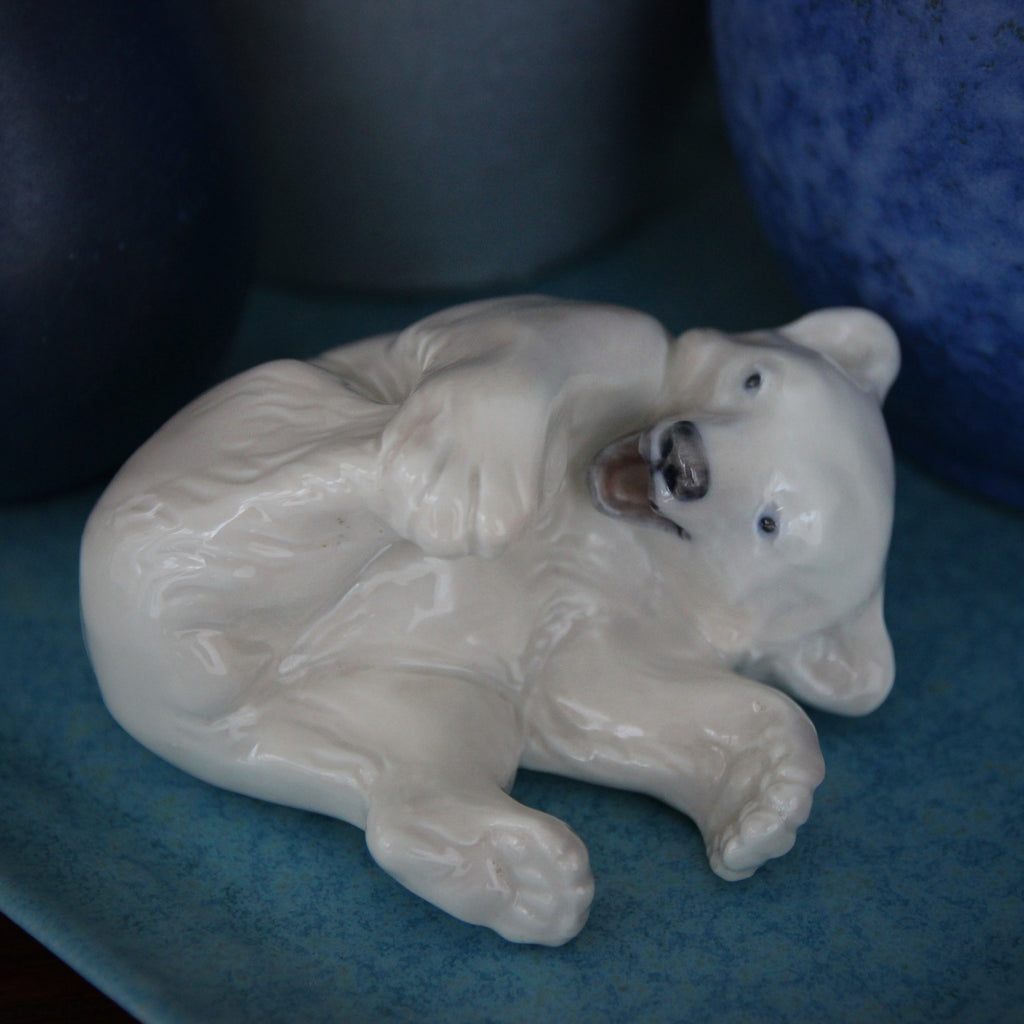
Polar Bears, those fascinating hunters of the Arctic Circle sea ice, have suffered the devastating effects of global warming and ice melt in the last couple of decades. Because they hunt on sea ice, they are classified as "marine mammals." Their favorite food is fresh seal—whose ample fatty blubber helps the bears survive the lean times between meals. In recent years, the image of a mother polar bear and cubs, balancing upon a too-small chunk of melting ice, has become the heartbreaking symbol of a world where rising temperatures spell destruction for the vulnerable creatures who live next to (and exist upon) the sea. This Mid-Century Modernist sculpture captures a polar bear in happier times—rolling on the ice. It was made in...
Some things never get old. Or, perhaps a better way of phrasing this is, "Some things are so old, they are now timeless."
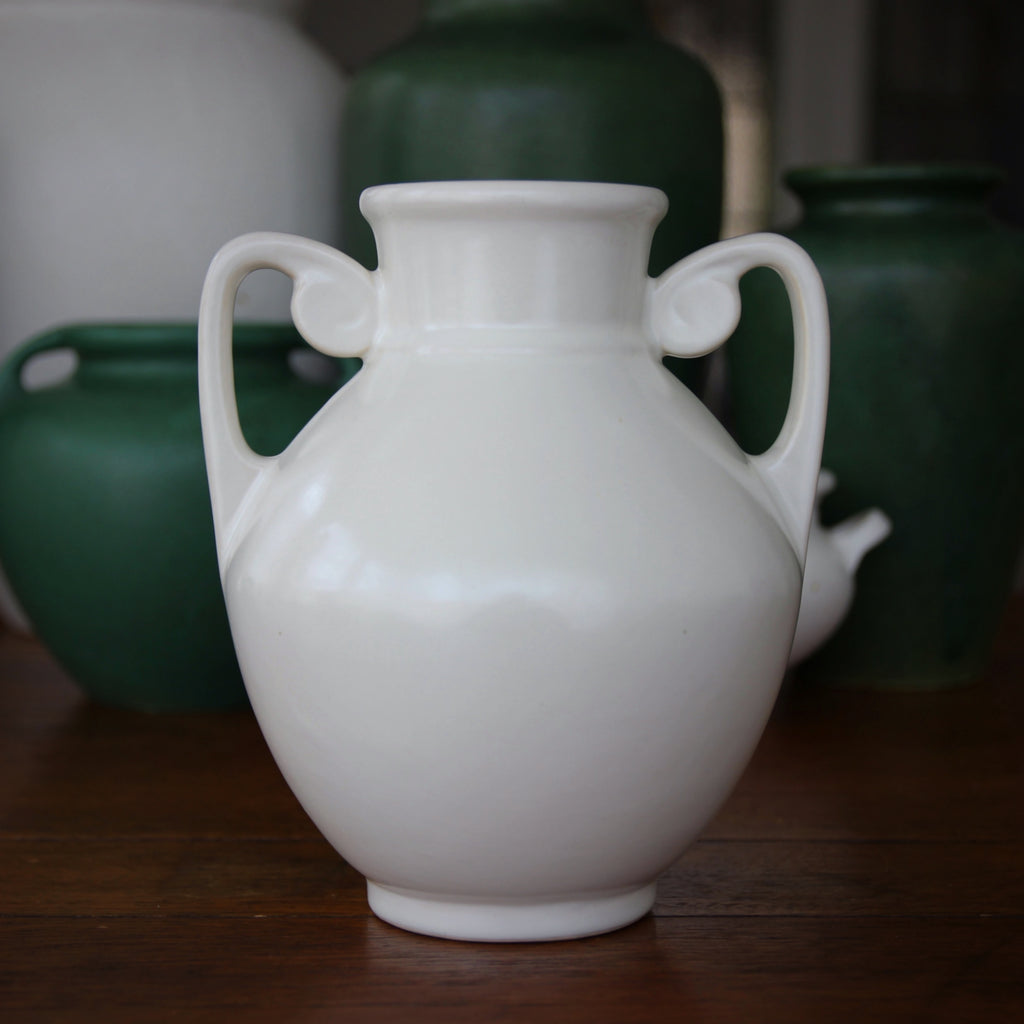
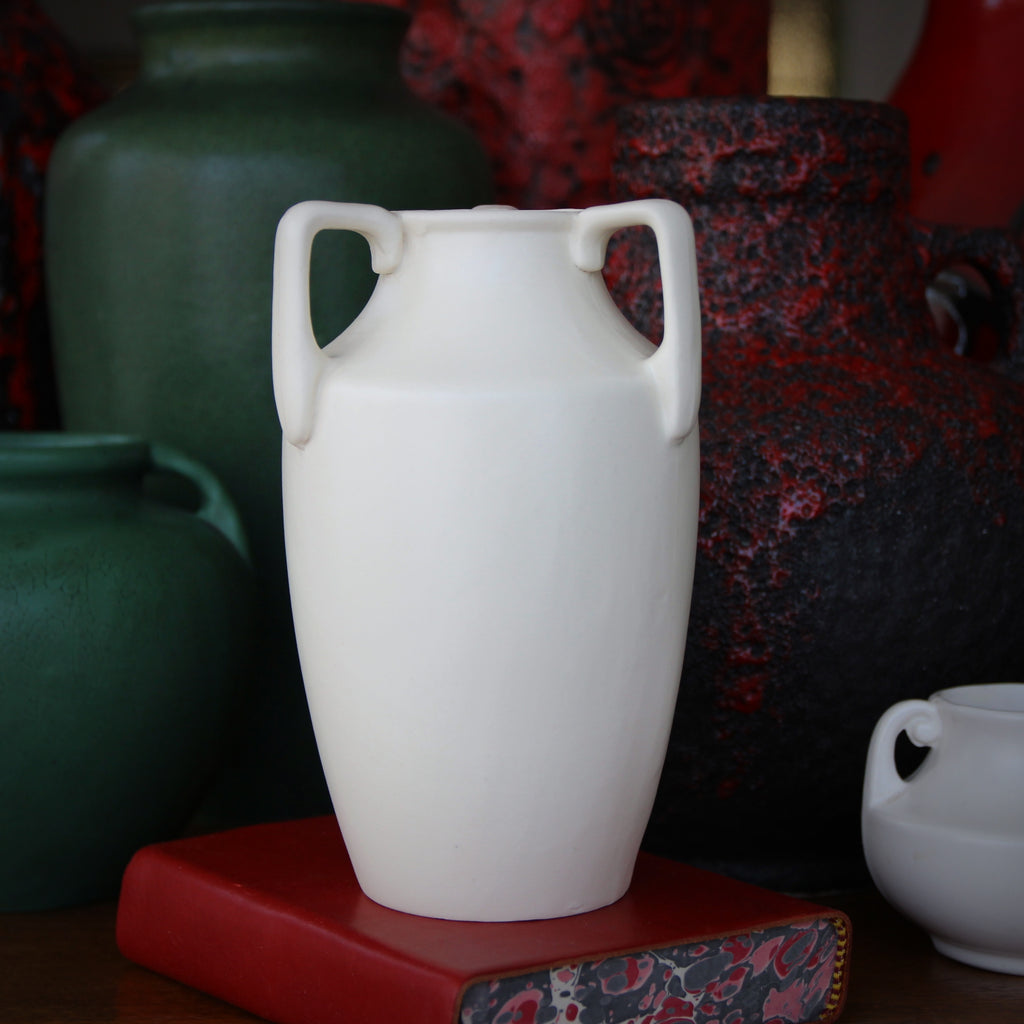
Amphorae are the narrow-necked ceramic vessels—with two vertical handles—which were used in ancient times to store and transport foodstuffs like wine or oil. The name "amphora" derives from the Mycenaean Greek, meaning "to be carried on both sides." The oldest existing amphorae are Phoenician, from the Eastern rim of the Mediterranean, dating from 3,500 years BC. The Greeks later used amphorae (or the amphora form) for highly decorated artistic ceramics—and the Etruscans and the Romans did likewise, later.
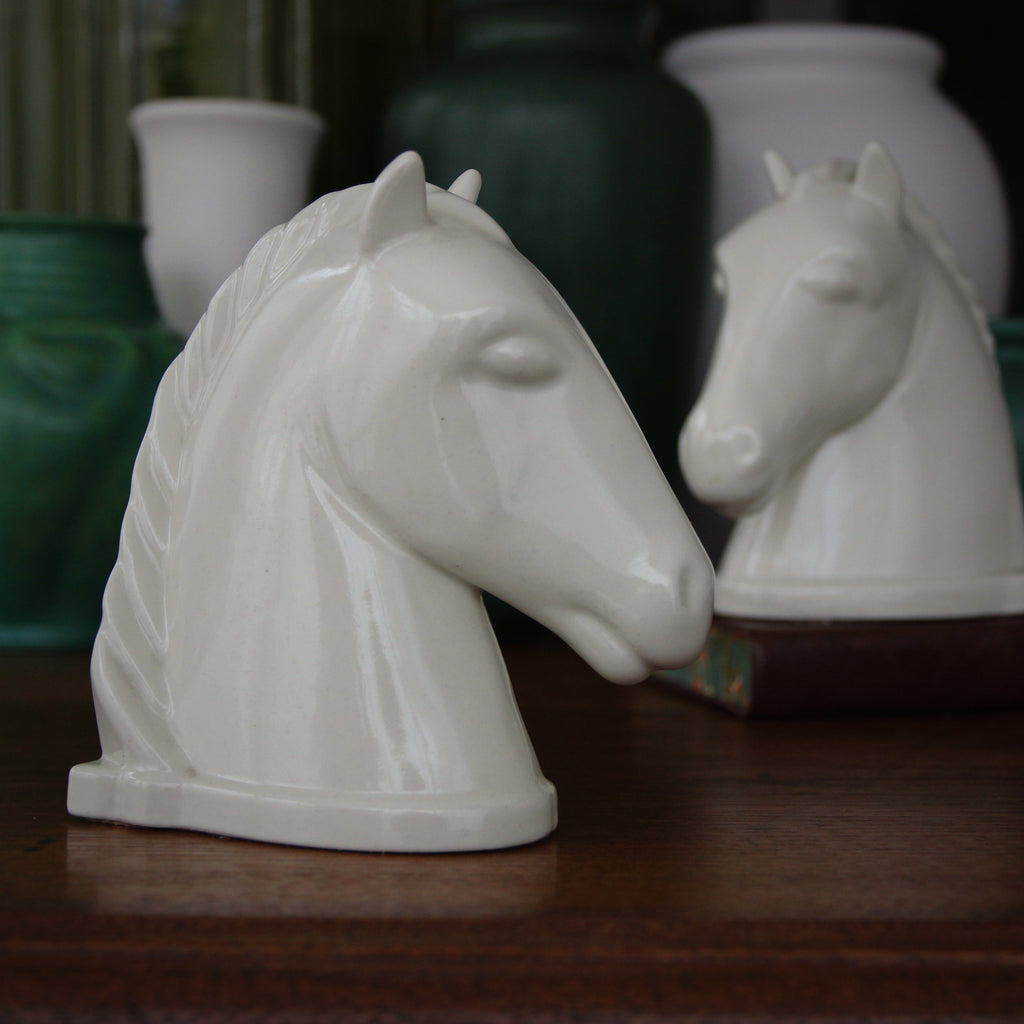
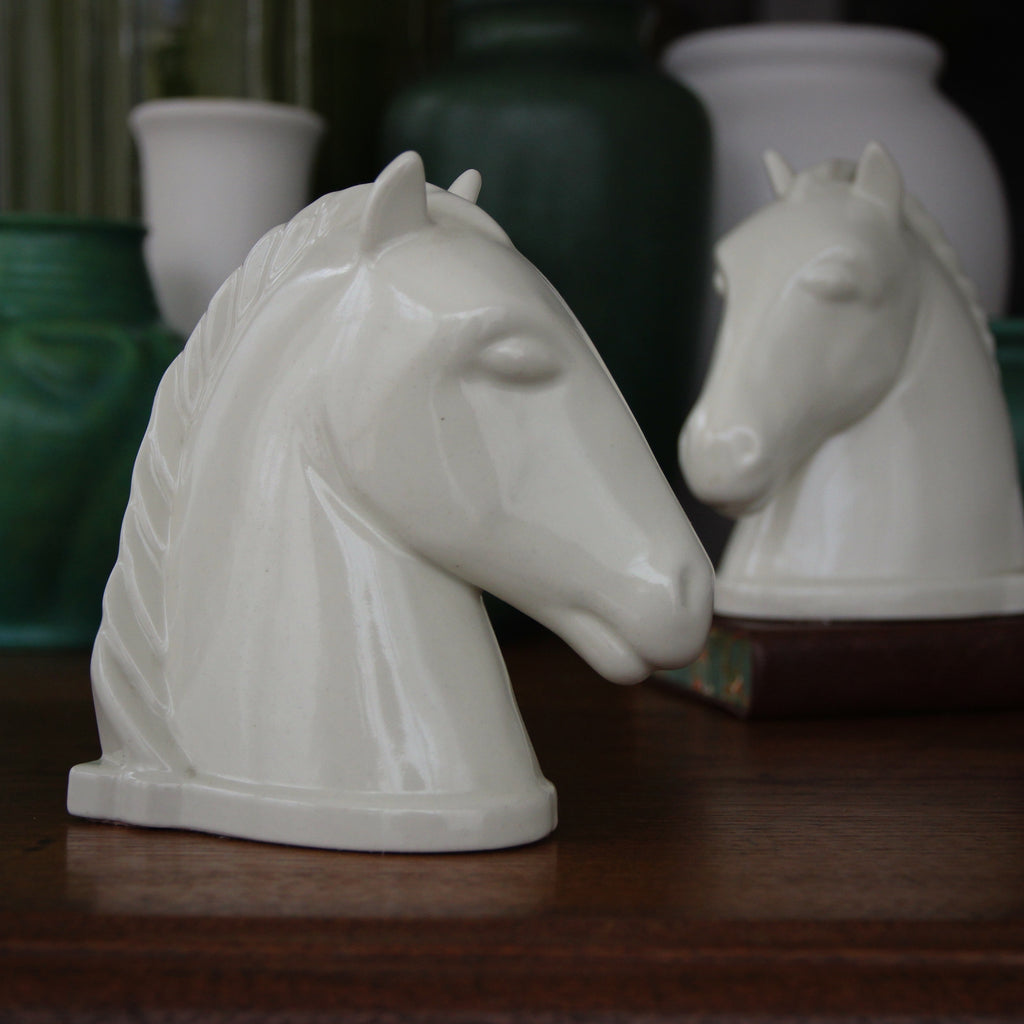
Four of my favorite things come together in this one sensational Handsome Gift: bookends, sculpture, horses and white pottery! Abingdon Pottery (Knoxville, Illinois) was founded in 1908 and quickly made its name as a premier manufacturer of plumbing fixtures and other "sanitary ware." They used very high quality clay—some of it imported from England—which was fired into "vitreous china" with exceptional durability and uncommon attention to finishing detail. The Great Depression devastated Abingdon's incoming orders, so they began making smaller, decorative gift items (using the same clay) to keep the business afloat from 1934 to 1950. During this short period, Abingdon made vases, bowls, bookends and other decorative household items which were discontinued when the demand for plumbing fixtures returned....
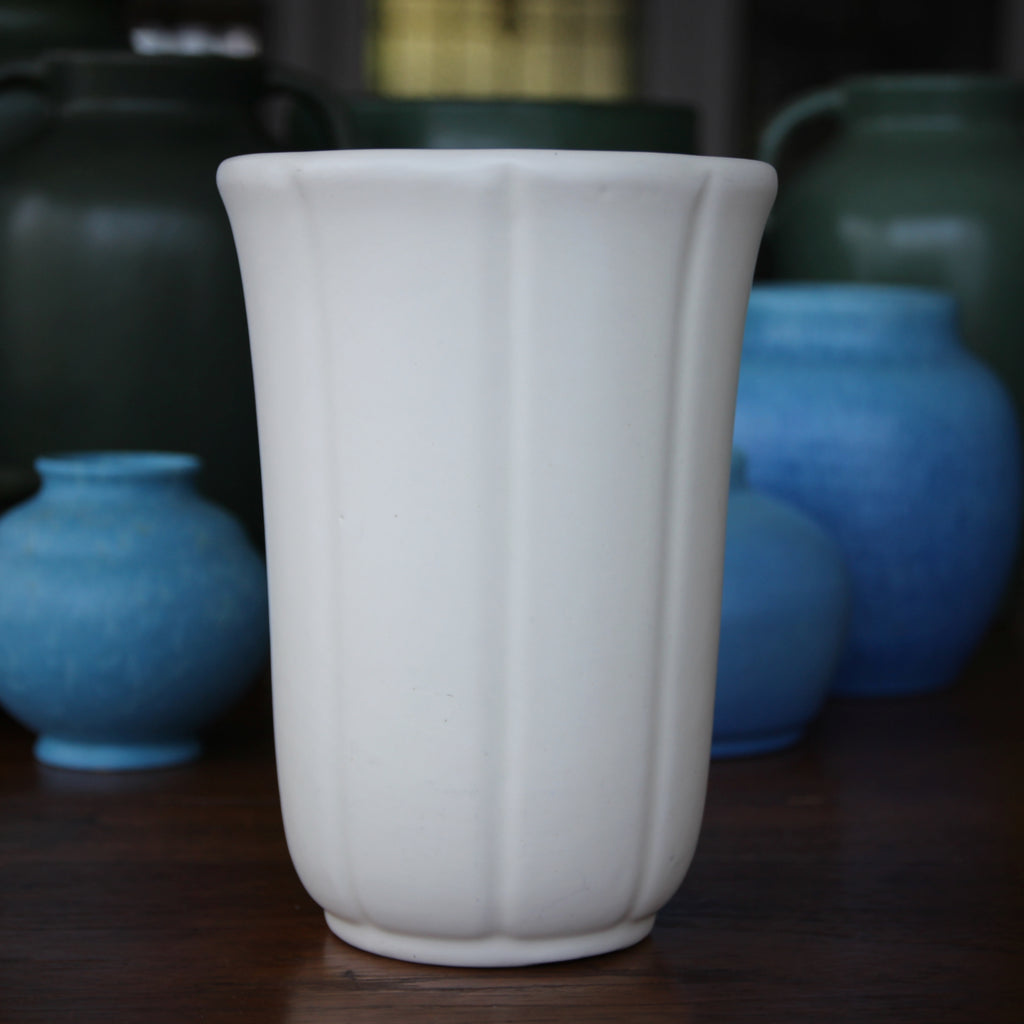
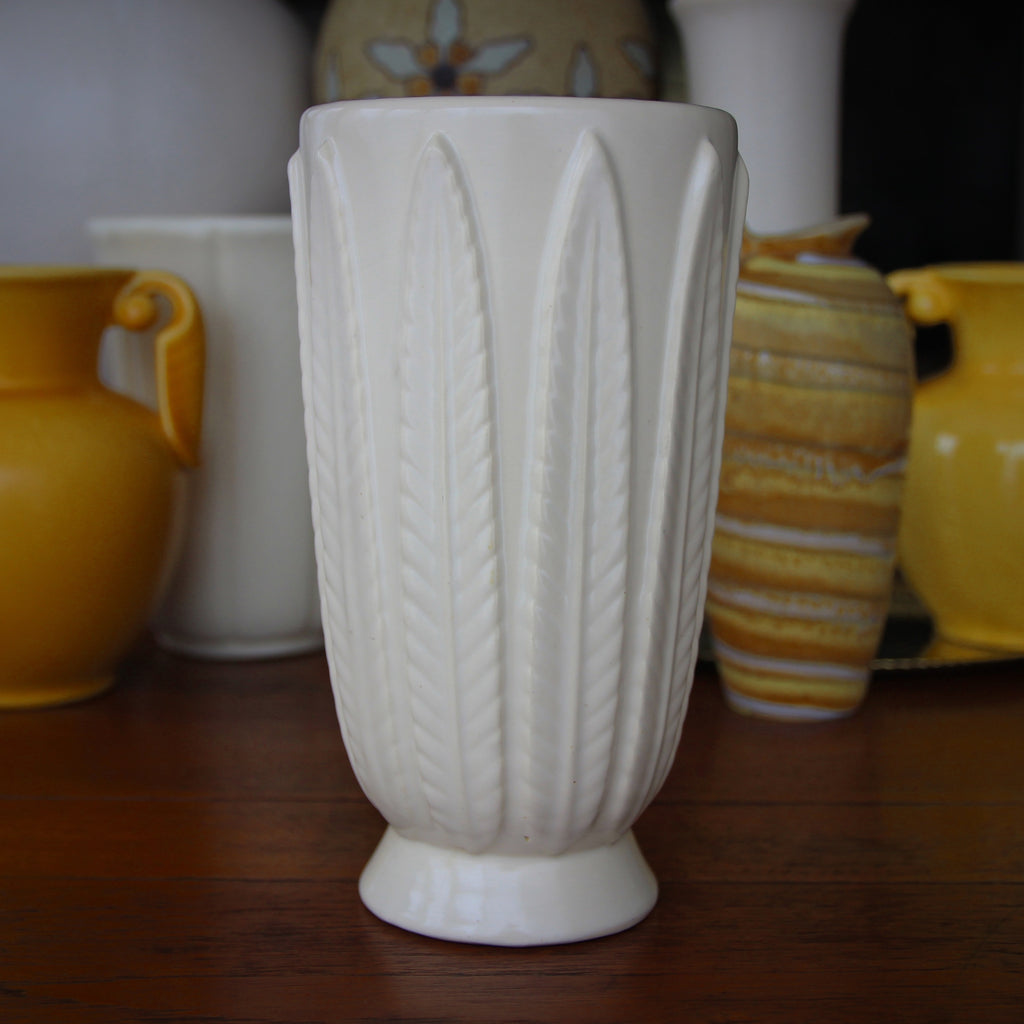
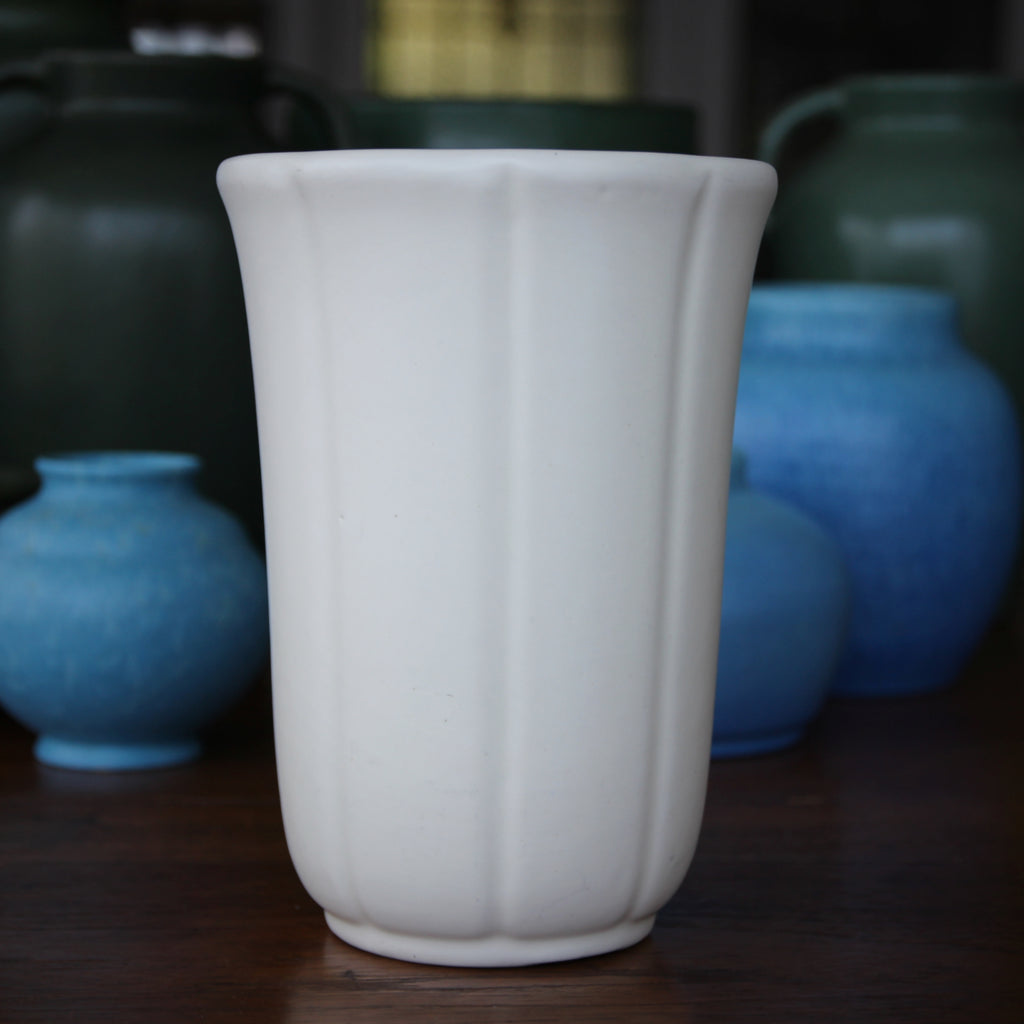
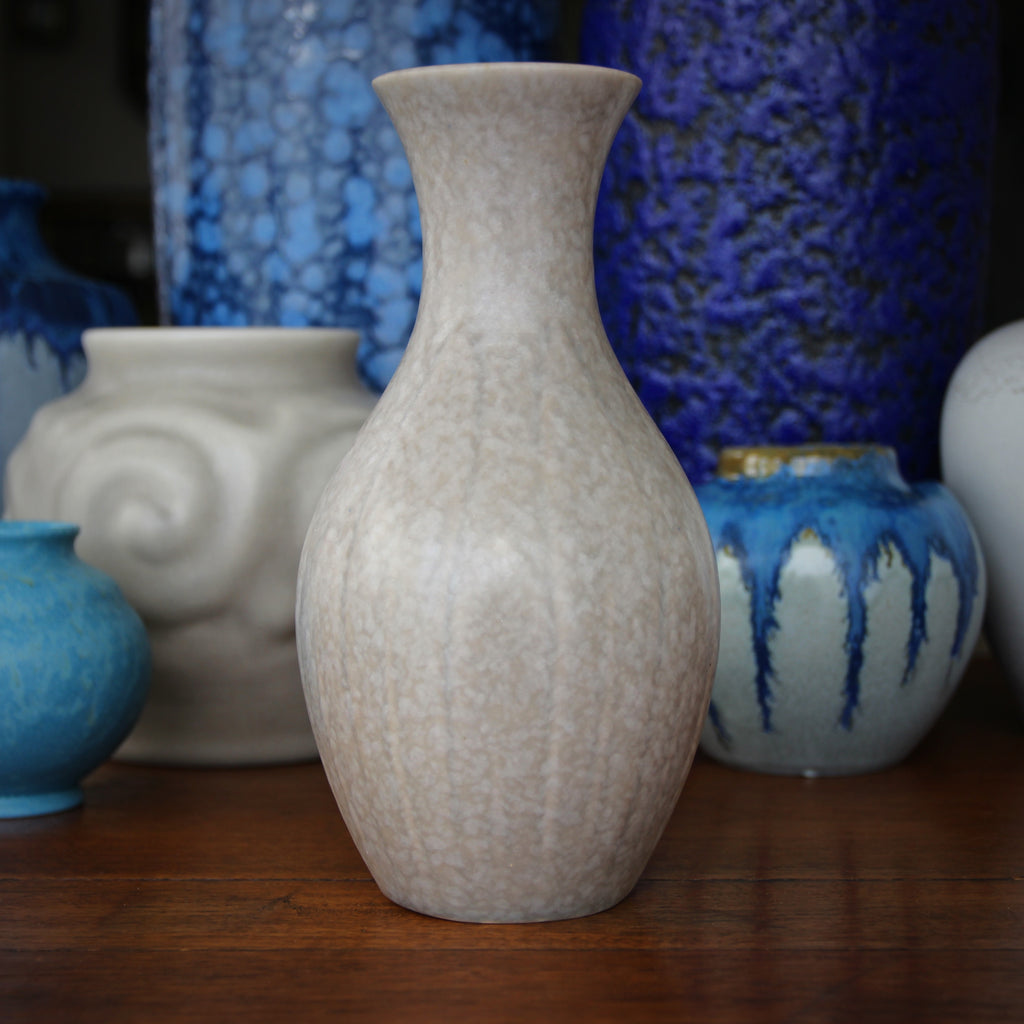
With the Holidays behind us, it's nice to embrace the "clean start" of the New Year and the Winter Season which comes with it. This simple vase features a sophisticated (though subtle) flair at the rim and vertical ribbing which suggests the stems of the flowers which will fill it. A fresh, matte white glaze further enhances an immaculate aesthetic.
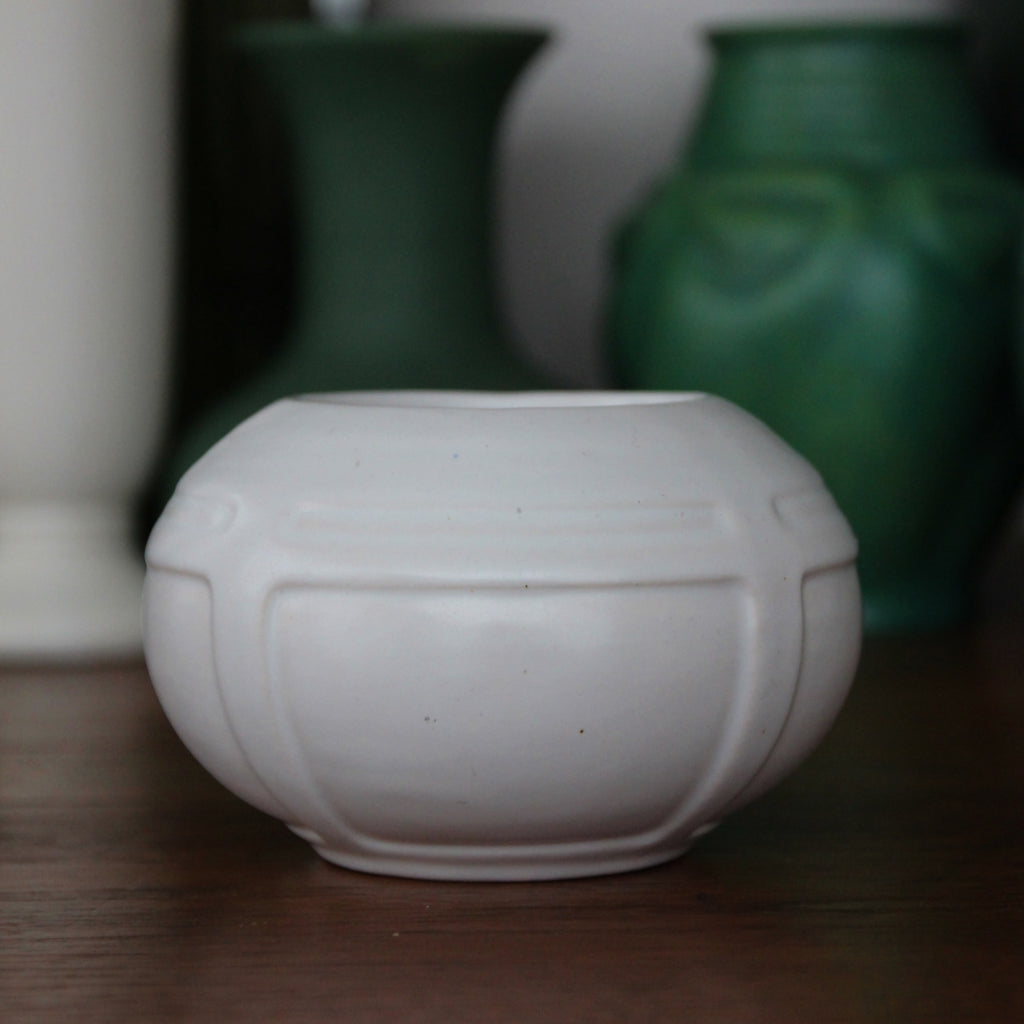
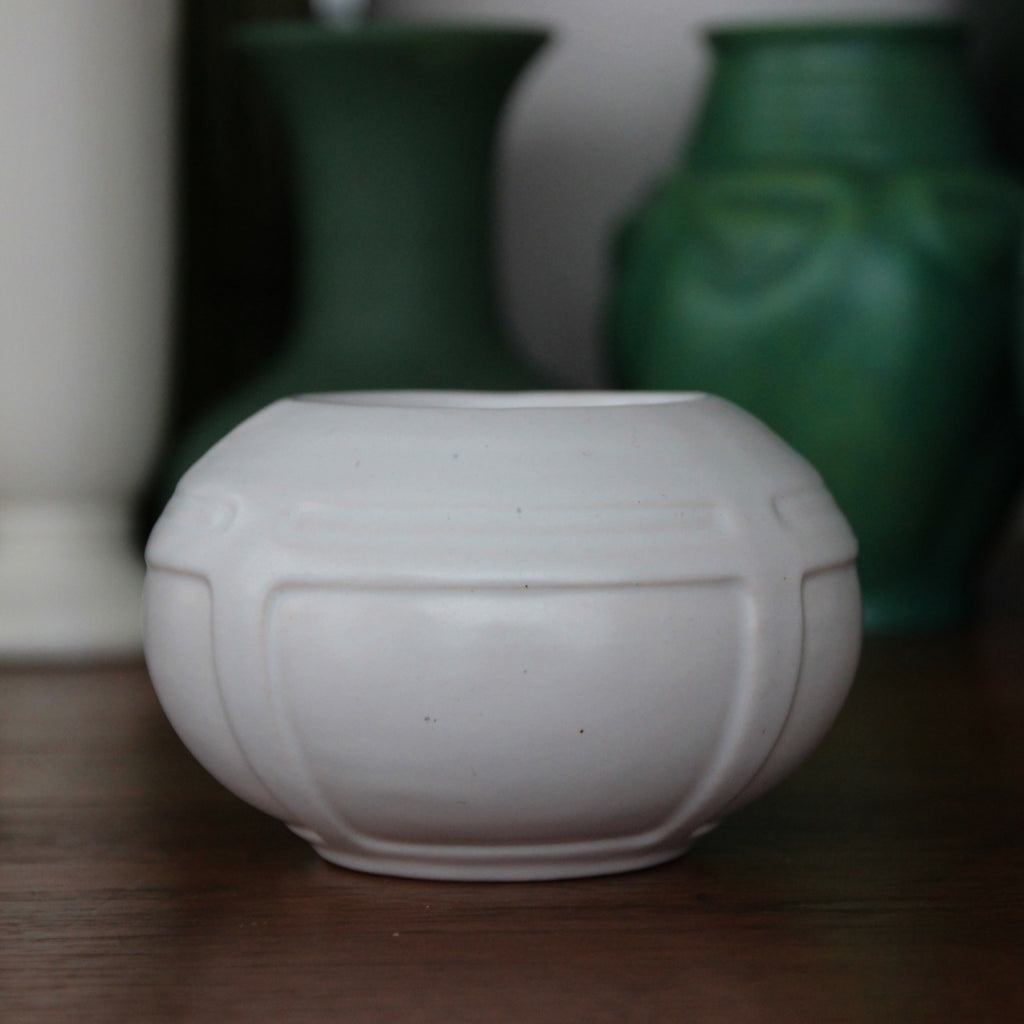
It's becoming an annual refrain. With each passing year, I release a wearied sigh and proclaim with great relief: "Well, I'm glad that year is over!" To paraphrase The Queen, it's been a "Lustrum Horribilis"! Half a decade of horror! But Hope springs eternal—especially amongst retailers, who always believe, deep-in-their-bones, that Good Times are just around the corner. "This will be the year!" While I await the abundance, I also appreciate an aesthetic "cleansing of the palette"—a fresh, pure start to the New Year. What could look cleaner, fresher, and newer than a collection of matte white vases bowls and plates? This Art Deco bowl, by Roseville, is trussed in an attractive architectural scaffolding. Finished with a satin white, it provides...
Before I started my professional retail career in 1985, I had never heard the term "Winter White." Why would I have? I grew-up in Hawaii—where white was blithely worn 365 days year (whether the temperature was 75° or 78°). Now, beginning my professional work life in a department store in chilly Hartford, Connecticut, I was expected to get behind the Big Company Push of Winter White!
It wasn't hard to do. Actually, I rather liked the color. And I had only just absorbed the whole "White Pants-Labor Day-Memorial Day" rule. But the name, "Winter White," struck me as having been coined by a salesman—by someone scratching to find something new to sell.
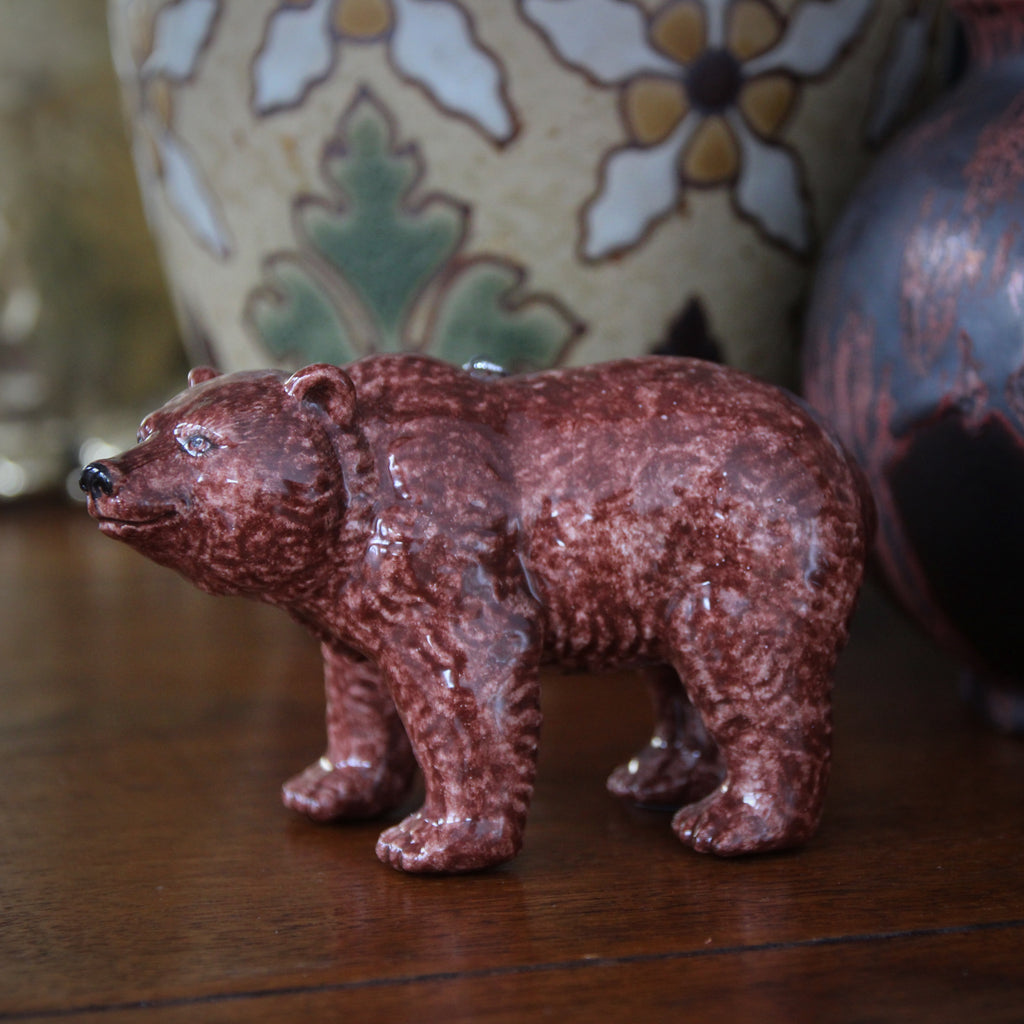
There is an old story in my family about attending any holiday party: invitations were always issued with the reminder, "Ring the doorbell with your elbow!" It was (supposedly) an exhortation to never show-up empty handed. Now, I myself never heard any family member make this stipulation; the account has always been fourth-person hearsay. And, from what I know of my elders, it seems out of character for them to have suggested such a requirement. I'm guessing that one person said it one time—after which, like so many family tales, the story gathered momentum and embellishment. It is a good story! This ceramic bear, made and hand-painted in Russia, is a lovely "hostess gift" (should one be required or desired). He has a little...
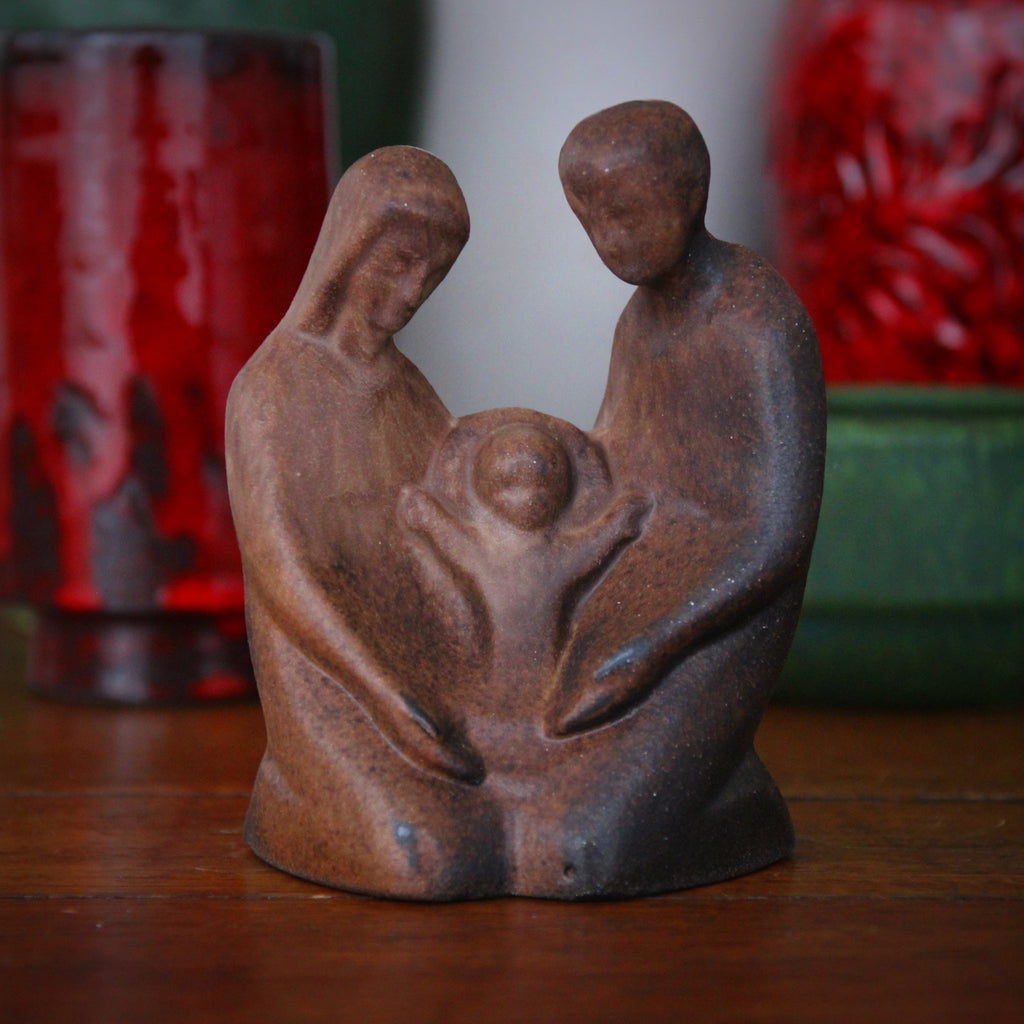
Today is the Feast of the Immaculate Conception, one of the great solemnities of the Roman Catholic Church. But there is significant popular misunderstanding of the theology. Many people—even some Catholics—don't understand that it refers to the immaculate conception of Mary, not Jesus.
Christian theology includes the concept of "Original Sin," which is basically the "fall from grace" that all humans experienced as a result of Adam & Eve's decision to break with God (in Genesis). It is an inherited state which, Christians believe, can be rectified with baptism. Roman Catholics believe that baptism is the essential, redeeming sacrament through which people are "born again" into a life with Christ.
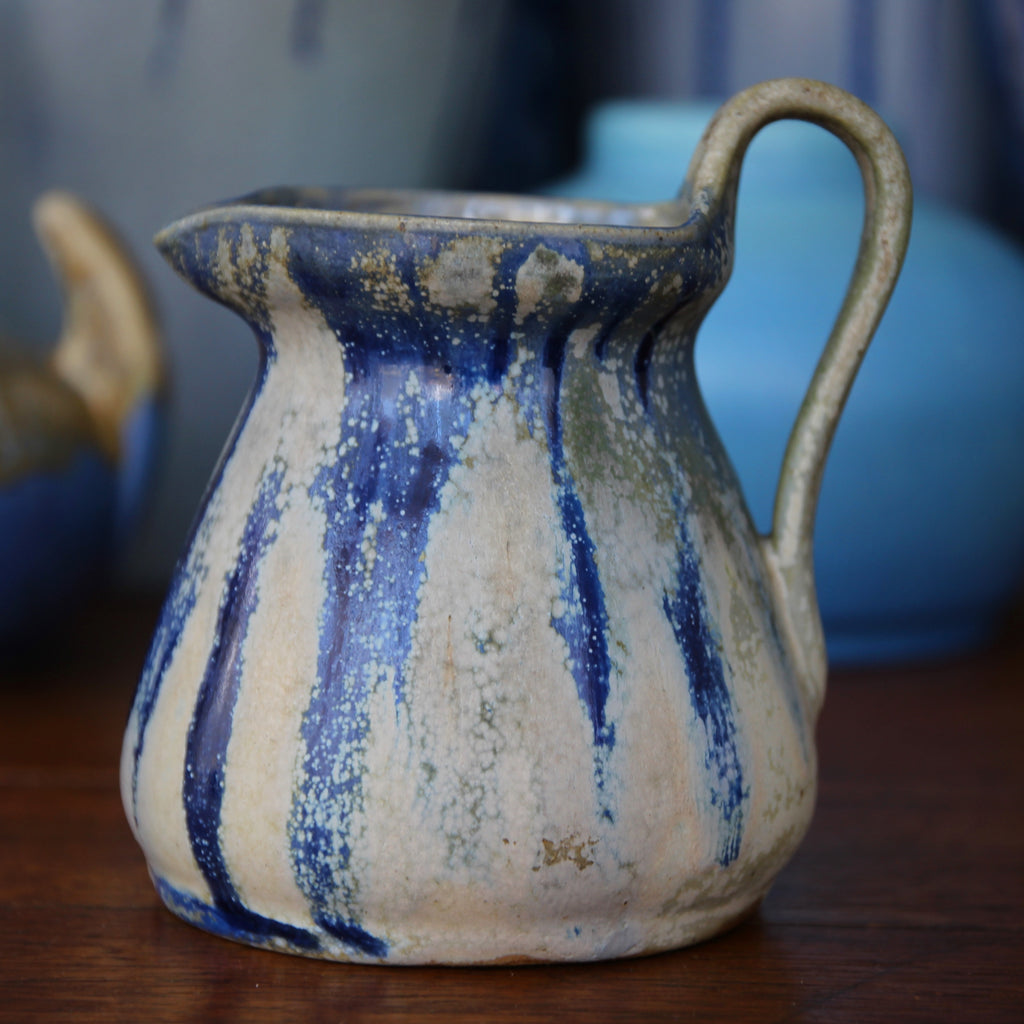
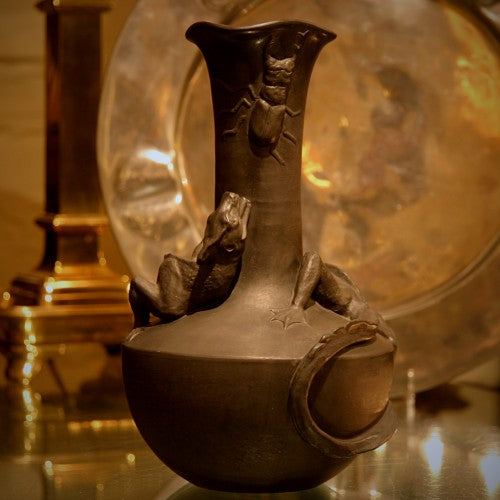
In France, where wine is a common part of daily life, it was once customary to serve vin in a little jug like the one above—just a glass (or two) of a typical, cheap and utterly delicious table wine, often purchased from a basket on the floor of the neighborhood "Maman et Papa" grocery store. I have always admired those cultures which do not attempt to exalt wine beyond its humble status. No fuss. No pretension. No multitude of differently-shaped wine glasses (one for each specific "varietal"). Rather, I applaud those who pass the little wine jug along with a tumbler and a shrug. "What's the big deal?" This Art Nouveau wine pitcher, made in Turn-of-the-Century France, is signed Charles Gréber (1853-1935). In...
December is here! The final lap of 2021! Experience the Winter's chill, the Holiday bustle, and the sublime Turquoise—the birthstone for the month of December.
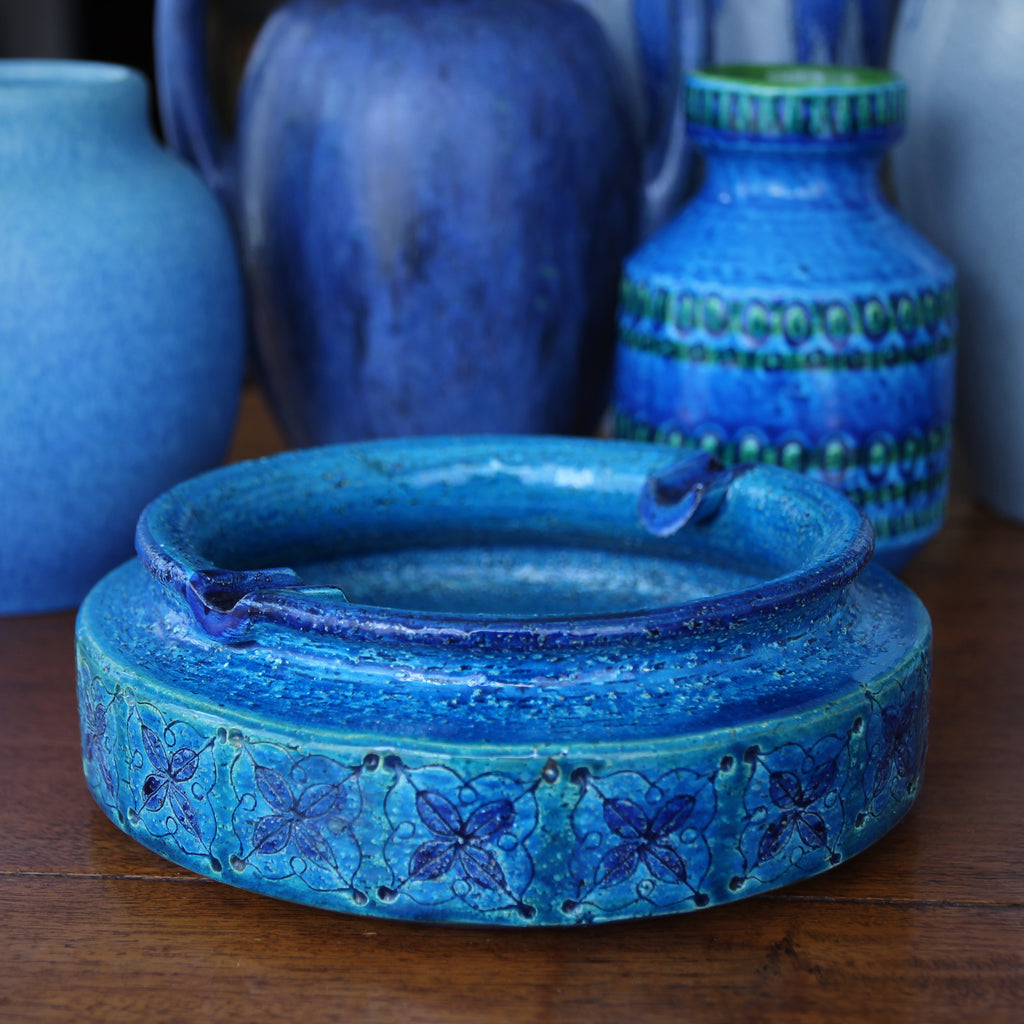
Ancient civilizations in Egypt, China, Persia and North America have been mining, collecting and using turquoise for millennia. In the American Southwest, turquoise has been used in jewelry-making and other decorative arts for centuries—and continues to be popular to this day. The name derives from the French word for "Turks"—for it was through Turkey that the first turquoise came to Europe from Persian (Iranian) mines. The Persians used the stone for important decoration in architecture and other objets. They created celebrated ceramics and tilework glazed in a glorious "Persian Turquoise" hue, a color which represented "Heaven on Earth."
Though I have been working in retail since high school, Black Friday only became an annual milestone in my professional life during the autumn of 1985. I had recently graduated from college and was working in my first grown-up job, as an "Executive Trainee" at the May Company Department Stores. It was my first Christmas and I was posted in Hartford, Connecticut at (what was then) G. Fox, Westfarms Mall. I was the Department Manager in the Women's Department: dresses, sweaters and blouses. After weeks of pre-holiday anticipation, racks-and-racks of garments, mountains of cartons from Asia, and brutal incursions from the (perpetually unhappy) buyers in the main office, Thanksgiving was almost here! My final task on Wednesday night, Thanksgiving Eve, before leaving for the holiday: to...
This pretty bird has little to worry about. Thanksgiving is for turkeys.
We at LEO Design wish all of our customers, vendors and friends a Happy Thanksgiving and a joyful Holiday Season.
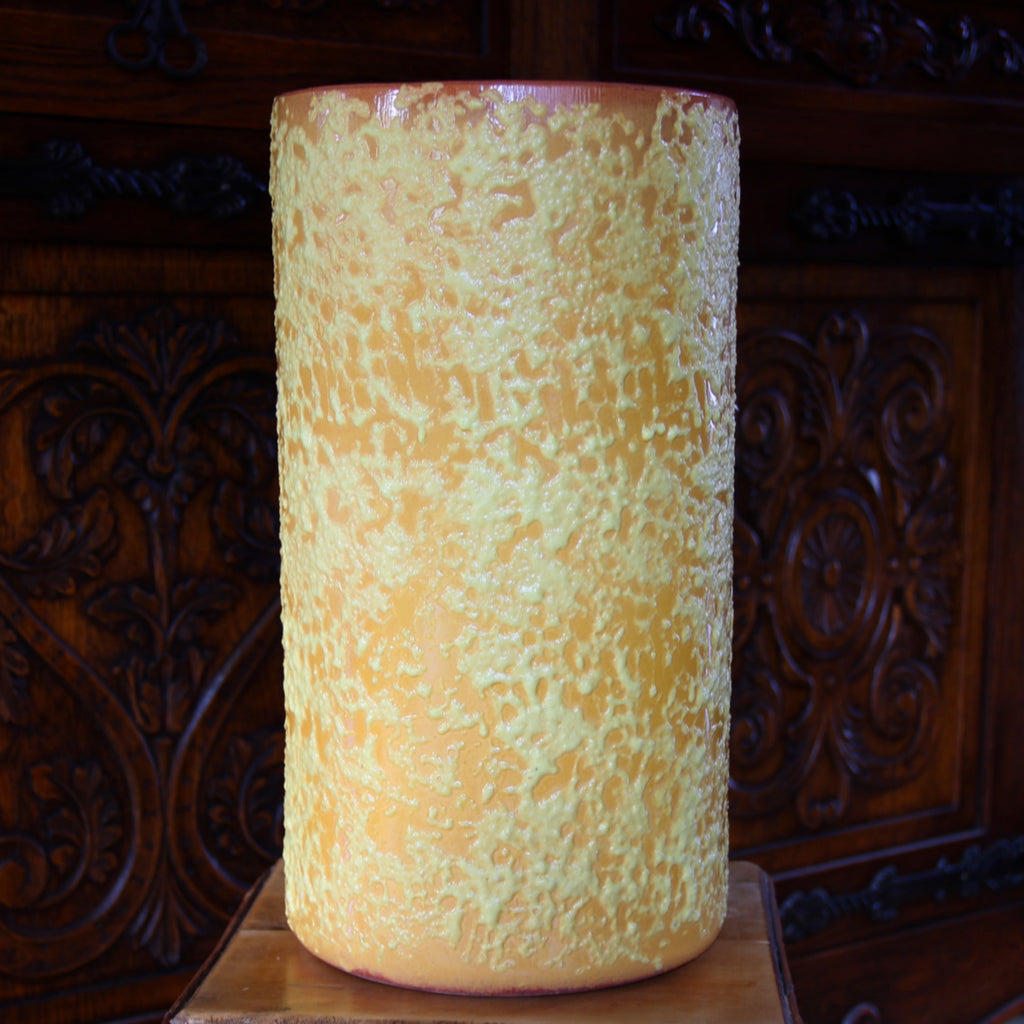
The Summer's light is fading, just as the Holiday guests are arriving. Give them a place to stash their umbrellas (in style!) while bringing-back a touch of the Summer Sun into your home. While this heavy ceramic umbrella stand is up-to-the-job, it's not oversized; it's just the right size to fit into that tricky corner by the door. And the highly-textured, "splattered" glaze—a combination of frothy lemon cream over rich, golden marigold—will certainly remind you of sunny days in warmer climes. The piece likely is either West German or Eastern European, certainly from the 1960's or 1970's. Its Modernist design will quietly brighten that corner of your room during the coming frosty months ahead.
The "Full Beaver Moon" this morning will also enjoy a near-total lunar eclipse—and at 3.5 hours long, it will be the longest lunar eclipse in nearly 600 years. The last time an eclipse lasted this long was back in the year 1440; the next eclipse of this duration will occur in 2669. The actual length of the eclipse will be 6 hours and 2 minutes—but a person observing from a fixed geographic point will only experience 3.5 hours of it. The eclipse will begin at 2:18 am Eastern Time, lasting until 5:47 am. The "peak eclipse" (97.4%) will occur around 4:02 am Eastern Time. This full moon is called a "Beaver Moon" because this is the time of year when beaver...
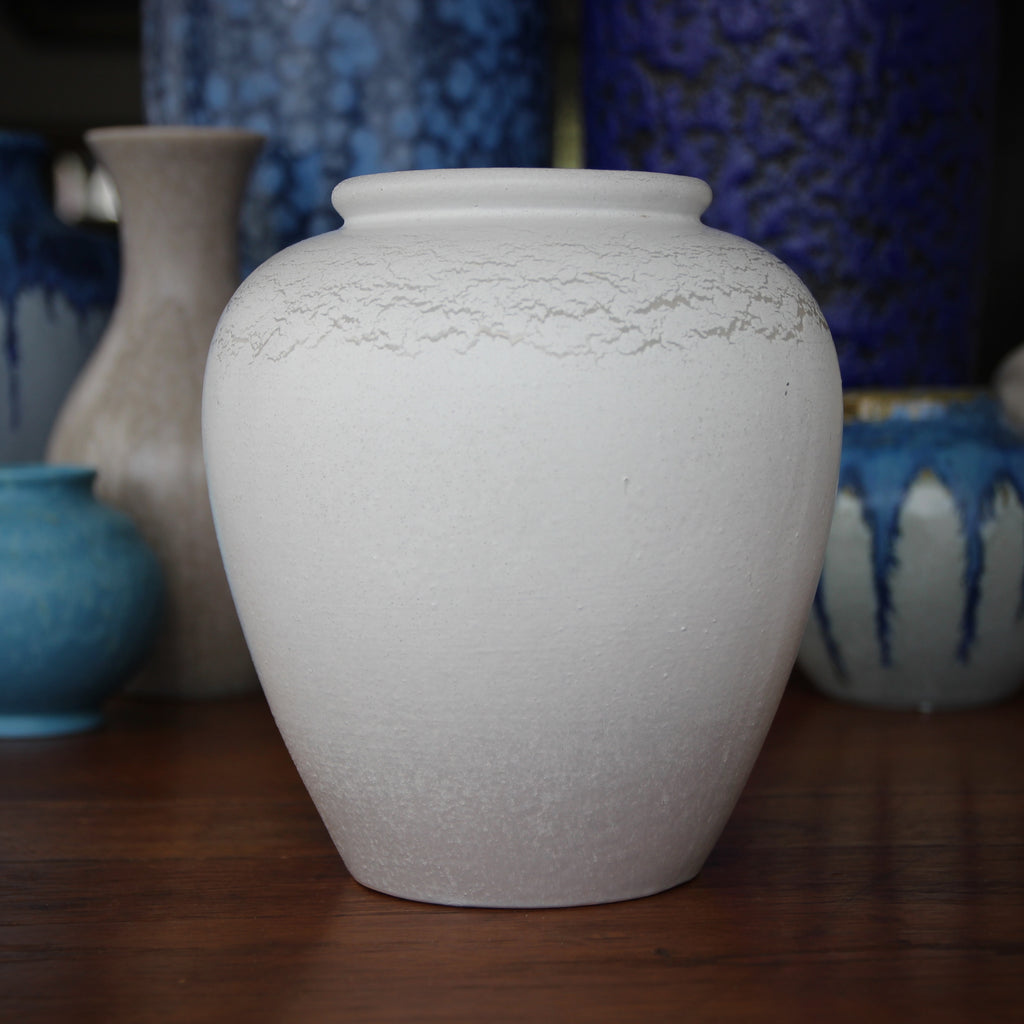
Even during the tumultuous years of the Czechoslovakian Nation, the art and craft of the Bohemian people was still appreciated by—and exported to—the rest of an eagerly awaiting world. This Art Deco matte white vase is one such little treasure. Czechoslovakia was established as an independent, democratic republic in 1918, two days after the collapse of the Austro-Hungarian Empire. Twenty years later, the Nazis invaded, claiming a healthy portion of its land for themselves—while Hungary and Poland took territory for themselves, too. Shortly thereafter (1939), Slovakia declared its independence from the still-young (and struggling) nation. After World War II, Czechoslovakia largely returned to its original size and shape (minus a portion which remained with the Ukraine), however, the whole country...
Royal Doulton is one of the great British commercial ceramics makers of the Nineteenth and Twentieth Centuries. It was founded in 1815 in London, with factories in Vauxhall and Lambeth. In 1882, the company moved from London to Staffordshire, specifically to the town of Burslem, one of the six towns that make-up Stoke-on-Trent (a powerhouse of 19th Century British ceramics production). Here, with space to grow, Royal Doulton expanded production significantly. 1882 was also the year that artist William Rowe joined the firm, a company which would employ him for six decades (until 1945). William Rowe, a painter, designed ceramic works of all sorts for Royal Doulton pieces—vases, bowls, plates—in a wide range of styles, from the Aesthetic Movement to...
It's the First of November: "All Hallows' Day" and the day when the Citrine struts to centerstage, front-and-center amongst its fellow birthstones.
Citrine is a pale yellow variety of quartz. It's lemony color is thanks to the iron content within the chemical structure of the gemstone. The Greeks first began to use the stone around 300 BC, believing that the sunny gemstone could help to alleviate depression. In Ancient times, citrines were still very rare, thus expensive and luxurious. But, as larger deposits were later discovered (notably in Brazil), the gemstone became more common and affordable for more admirers.
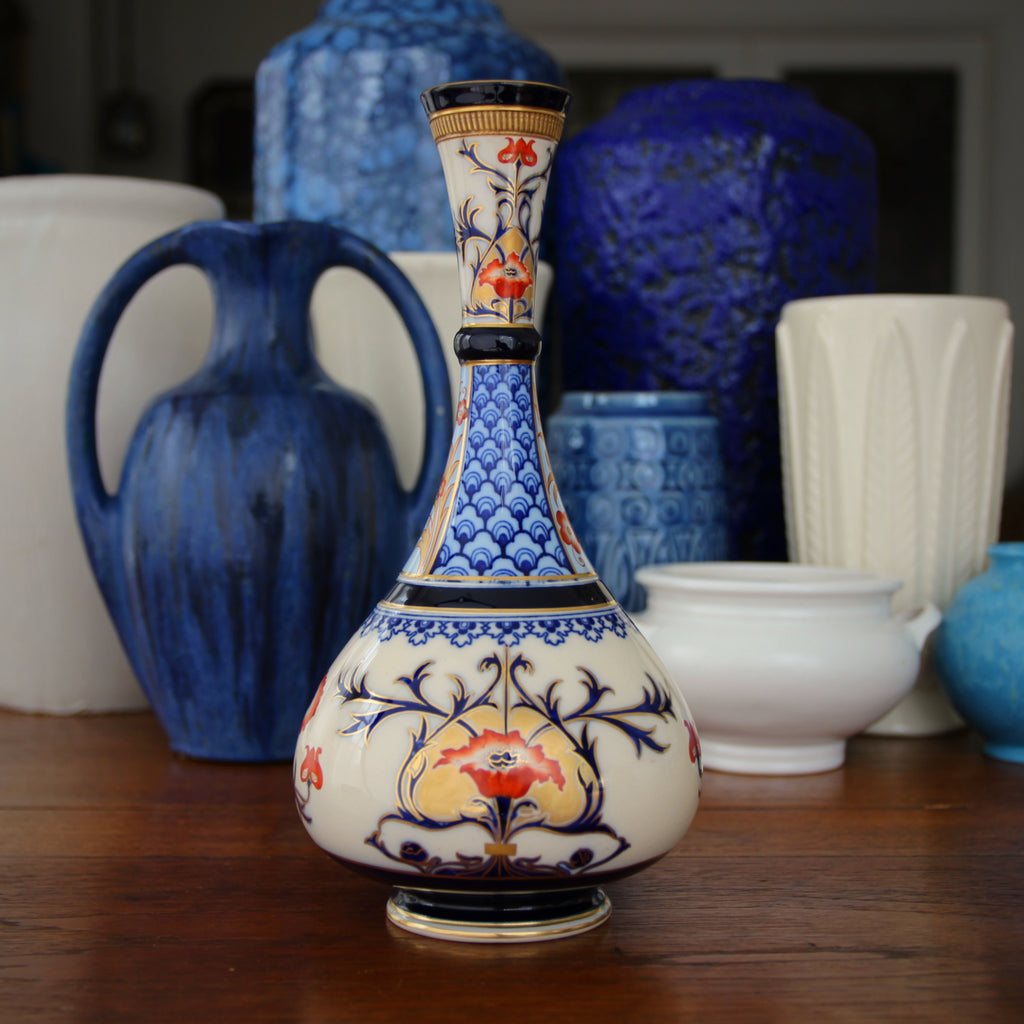
William Moorcroft (1872-1945) was one of the great English potters of the early Twentieth Century. Fortuitously, he was born in Burslem, Staffordshire—"ground zero" of the British commercial ceramics industry. After studying in London and Paris, he returned to Burslem at the age of 24, where he was hired to work as a designer for the James MacIntyre & Company pottery factory. He set-about designing the company's "Aurelian Ware" line of decorative porcelain in 1897 and was promoted to chief designer for the entire art pottery division within a year. The Aurelian Ware line was inspired by the Aesthetic Movement with an exotic Orientalist spin. Porcelain vessels were decorated with Asian-inspired transfer designs, a bit of hand-painted decoration, and applied gold embellishment....
Designers are constantly searching for inspiration. In truth, completely novel design is rare (and, in fact, often overrated). Throughout human history, most design (including good design) has been an adaptation of an earlier idea, object or aesthetic. Ancient Egyptian design has been an evergreen source of inspiration for Western artists and designers for at least 200 years. Napoleon Bonaparte, before he crowned himself Emperor of France (and Italy, and Germany), lead an army to Egypt (1798-1801). His intention was to foil the British (whom he could not defeat at sea) by blocking their Egyptian route to India (and its lucrative trade). Additionally, France sought to "claim" Egypt as a French colonial possession. In short order, Napoleon was defeated and sent...
Let us greet October—now the tenth, but once the eighth month of the year!
During the Early Roman Empire, October was the eighth month of the year (as demonstrated by the "Octo-" prefix, which indicates "eight." Back in those days (which started with Romulus, first King of Rome, circa 700 BC), there were 10 months, many of them named with prefixes indicating the month's numerical order: September (seven), October (eight), November (nine), and December (ten). The second King of Rome, Numa Pompilius, added two new months (January and February), thus lengthening the year by 60-ish days—in order to better approximate (though not perfectly) the Earth's annual orbit around the Sun. Even today, in France, October is sometimes abbreviated as "8bre."
I cannot have too many nice, matte white vases. The simplicity of the coloration really focuses the eye upon the form—and the form, good or bad, has nowhere to hide. A collection of matte white vases always makes a strong, clean impact. And the utility of the vessels is another plus. I have a grouping of matte white vases on the wide window ledge behind my kitchen sink; I am often grabbing a vase to suit a large or small handful of roses clipped from our garden. Every time I add a new piece to the window ledge, a re-shuffle is required (which gives me a good excuse to wipe-down the quartz slab).
Today—at 3:20 pm Eastern—we experience the Autumnal Equinox, that moment when the Earth's "tilt" toward the Sun is dead-even with the Equator. As a result, the night and day will be equally long today. As we move forward into the Autumn and Winter, the Northern Hemisphere of the Earth (where the U. S. is located) will tilt further and further from the Sun. The days in the North will be shorter and the temperatures will be colder (since that hemisphere is further from the heat of the Sun). Conversely, people in the Southern Hemisphere will enjoy longer days and shorter nights as their part of the World spends more time closer to the Sun.
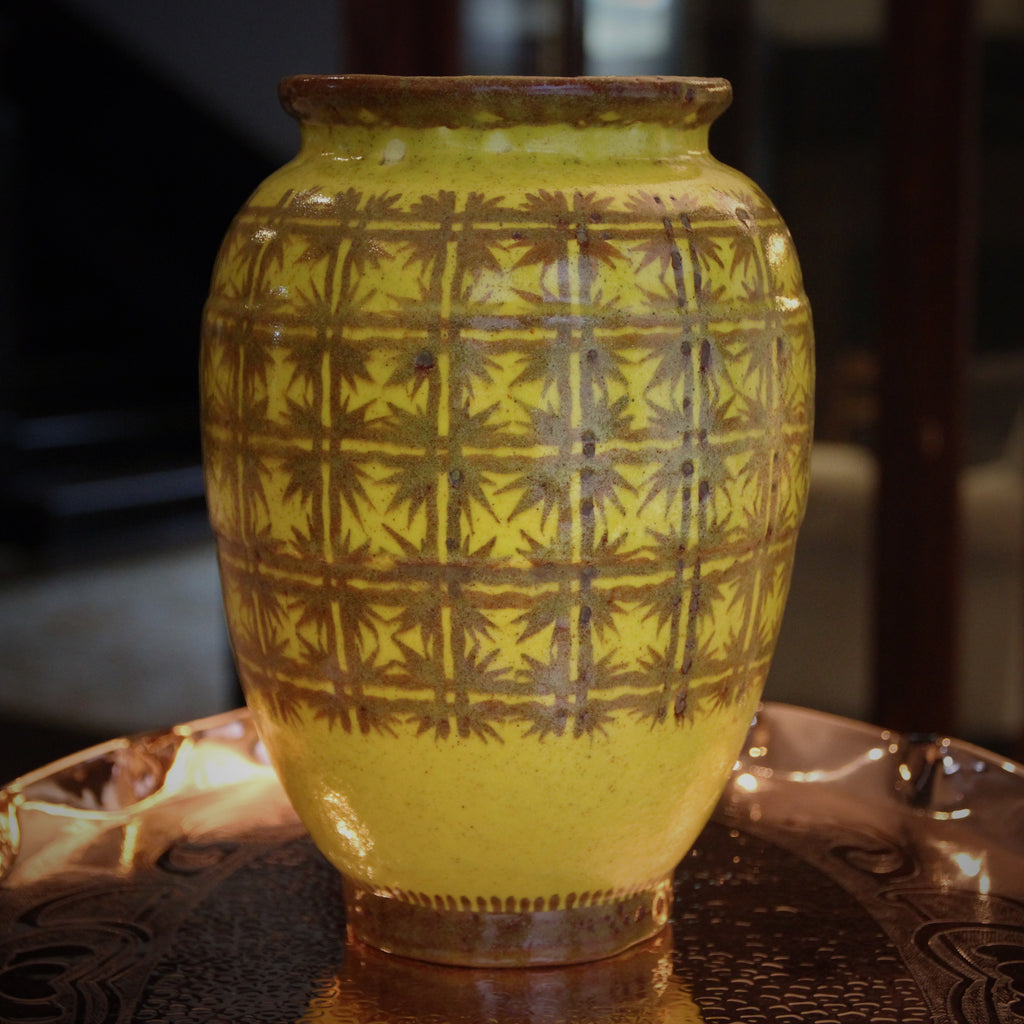
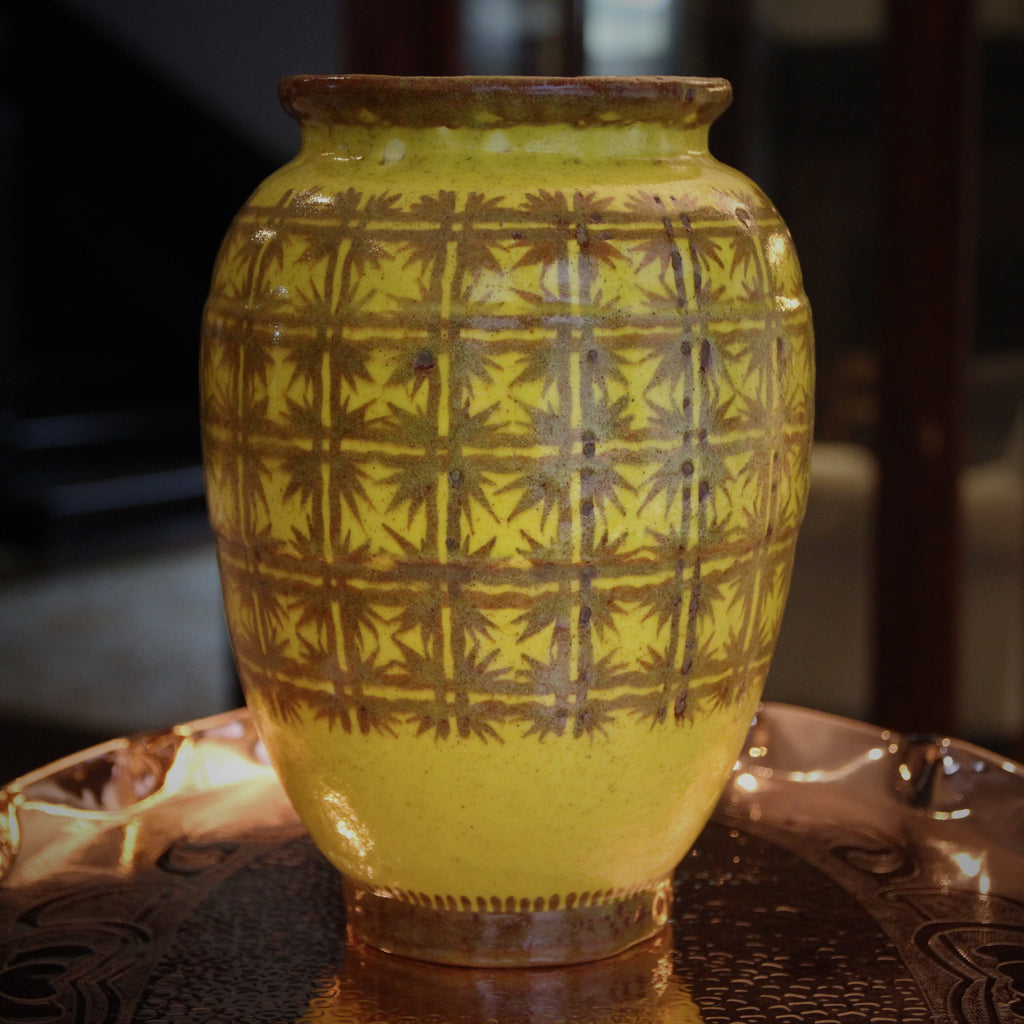
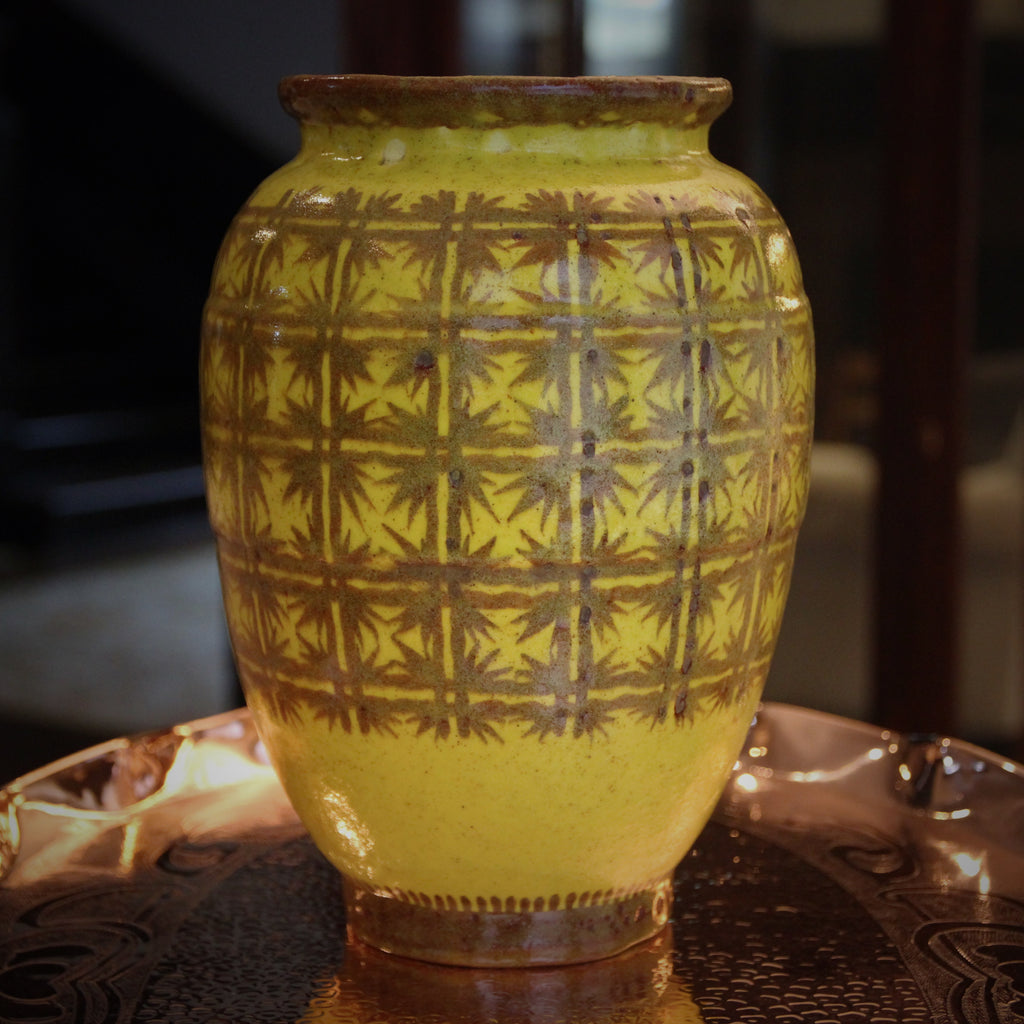
Relish this final day of Summer, for Autumn begins tomorrow afternoon. After tomorrow, the nights will be longer than the days. Temperatures will begin to drop. And the trees, plants and animals will prepare for their winter hibernations. We know that summer will return—eventually—but it does seem like a long, cold, dark winter. Cheer yourself through the winter gloom with this sunny "remembrance of Summers past." This hand-thrown Lachanal French vase is glazed in lemon yellow and decorated with a hand-painted, caramel-colored "grid iron." The form and surface of the ceramic body even suggest the shape and texture of a summer-fresh lemon. It is signed "Piece Unique," indicating that it was a "one-off" creation—not part of an established line of designs by the Lanchanal...
A "Full Moon" describes that period of time—usually a day or two—when the Earth is directly between the Moon and the Sun (which illuminates the moon), thus making the moon appear perfectly round. Technically, any Full Moon only lasts a moment—which, this month, is at 7:54 pm today (Eastern). But that moment of "total fullness" is not distinguishable to most naked, laymans' eyes. Instead, the moon appears to be full all night long (or sometimes for a couple of nights). This month's Full Moon is also called the "Harvest Moon," which is always the Full Moon closest to the Autumnal Equinox (which, this year, is in two days). Traditionally, it was during this period that many farmers were hustling to...
Summer is drawing to a close and—if you are planning on going to the seaside—you'd better do it soon! Luckily, I have a handful of special items which immediately take-me-back, at least in my mind, to pleasant summers in favorite holiday locales. And, in the months to come, as the snow piles up under my windows, a quick glance at one of these beauties will whisk me to the turquoise waters of a remote Greek island, the tiled Gaudi masterpieces of Barcelona, or the gently-arid Tuscan or French countrysides.
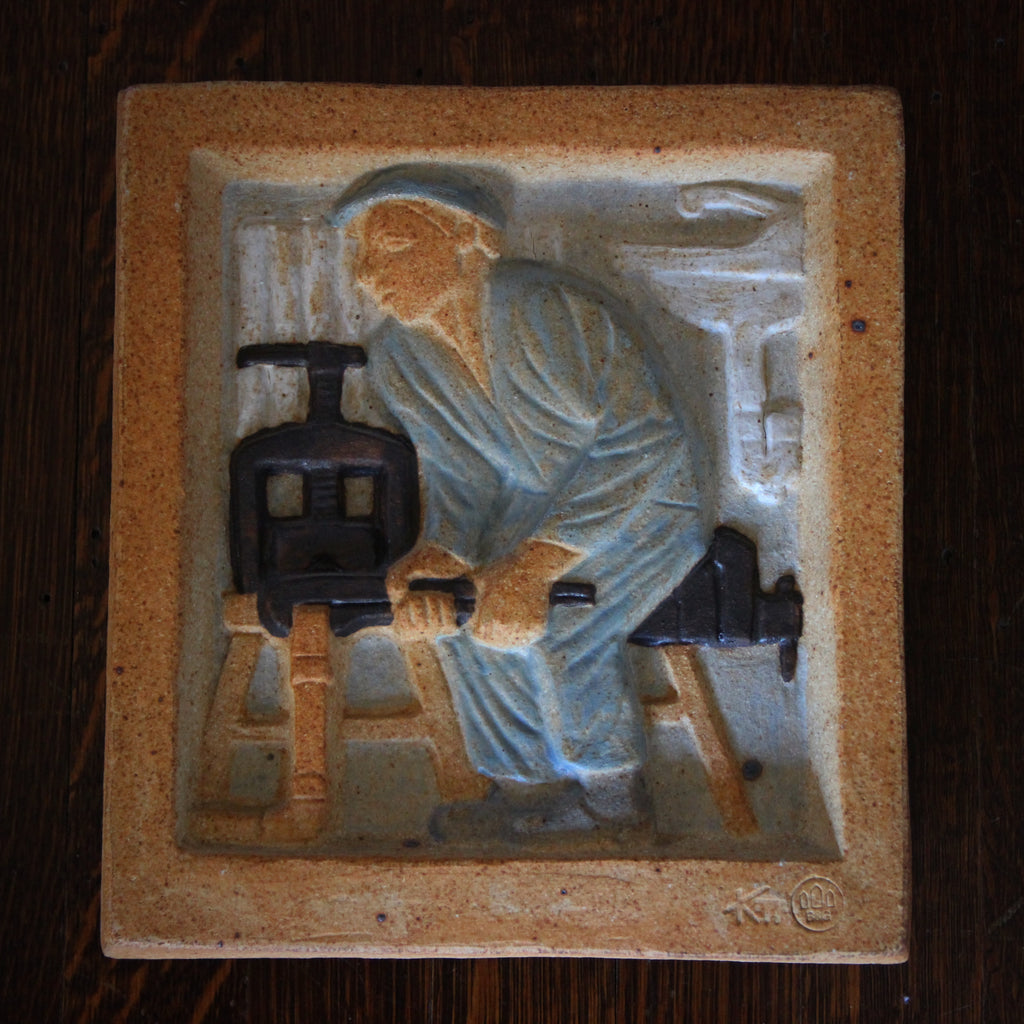
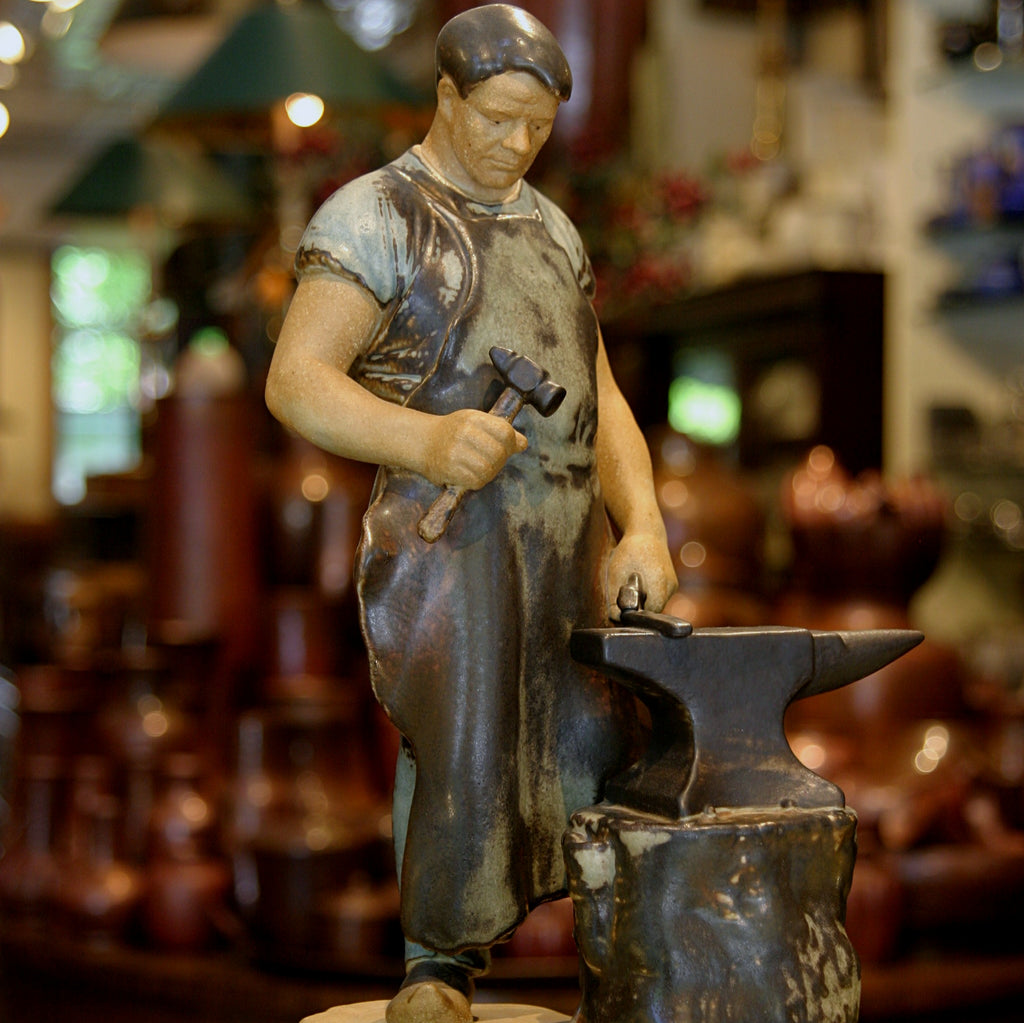
America was built with the power of human muscle. Some of this labor was purchased by-the-hour (often cheaply), some of this labor was expected "as a condition of family life," and some of this labor was taken outright. It's important to remember and honor those who have used—and those who continue to use—their bodies, sweat and strain to build the future and make things better for the rest of us. The term "labor" is subject to varying definitions. And, in America, people tend to reveal a reflexive reaction to the word—sometimes positive, other times negative. The plight of "Labor" in America is a challenging one. Over the decades, increasingly-educated Americans have developed a growing disdain for the notion that they might have to work with...
This morning, at 8:02 am (Eastern), the August full moon reached its peak size and illumination. Full moons during August are traditionally called a "Sturgeon Moon" because—during this mid-summer month—fishermen on the Great Lakes found the sturgeon easiest to catch. Sturgeon are a remarkable creature, and, sadly, increasingly rare today due to overfishing since the Nineteenth Century. Fossil records of sturgeons can be found from 136 million years ago (showing the fish largely unchanged through today) and the fish can live to be 150 years old! Females reach sexual maturity at 20 and reproduce every four years. They can grow to six feet in length and weigh over 200 pounds. Because the creatures grow and reproduce so slowly, their populations have great difficulty surviving overfishing. Their...
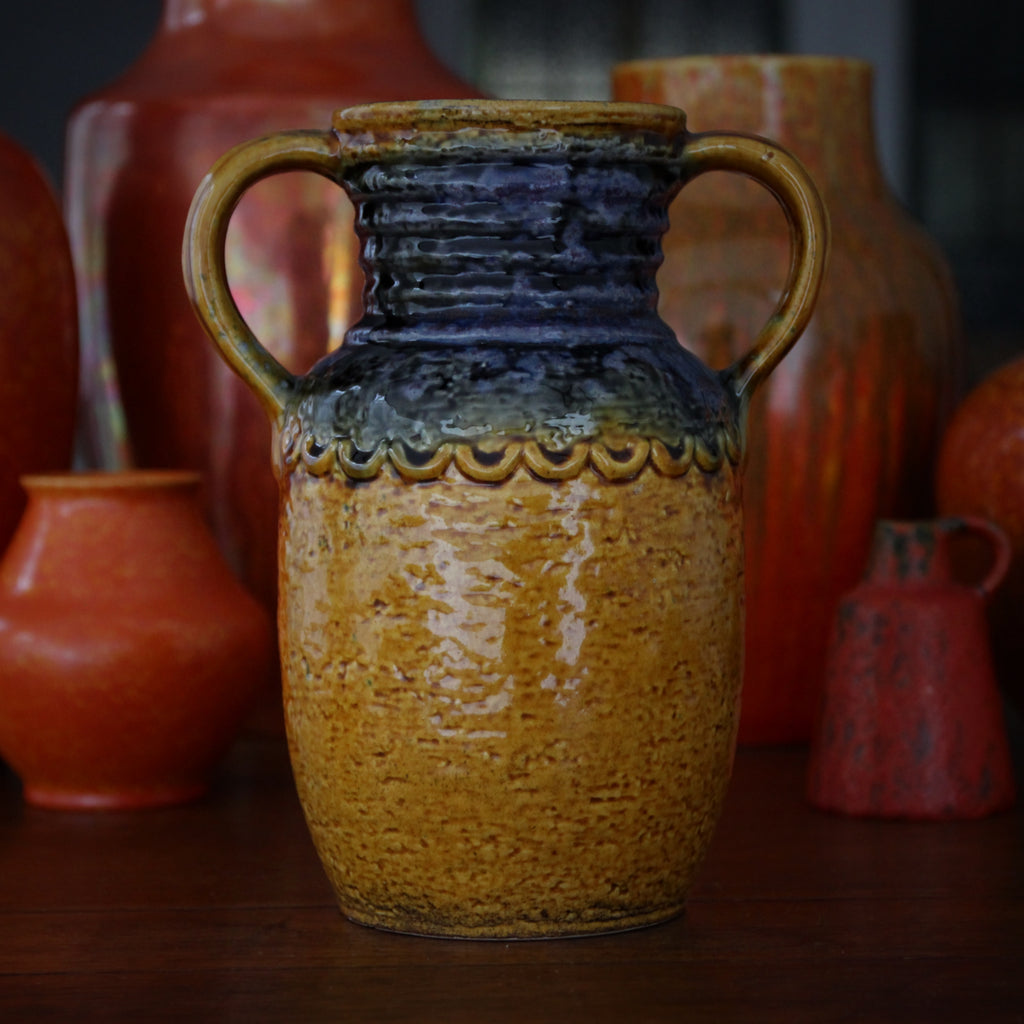
If the lazy days of summer carry your imagination to the French or Italian countryside, well, let's go! The handcrafted simplicity of a country village—the fences, signs, streets, buildings—can be a delicious respite from the high-tech, go-go world back home. And that celebration of handcraft manifests itself in the useful objects of everyday life. In a modern world which demands a constant technical scramble—and planned obsolescence is no longer challenged—isn't it nice to handle and use something that will never change? An object which will work exactly as designed, and work just as well, a hundred years from now? When I look at the vase above, I cannot help but think of the French countryside. The deep mustard, eggplant and moss...
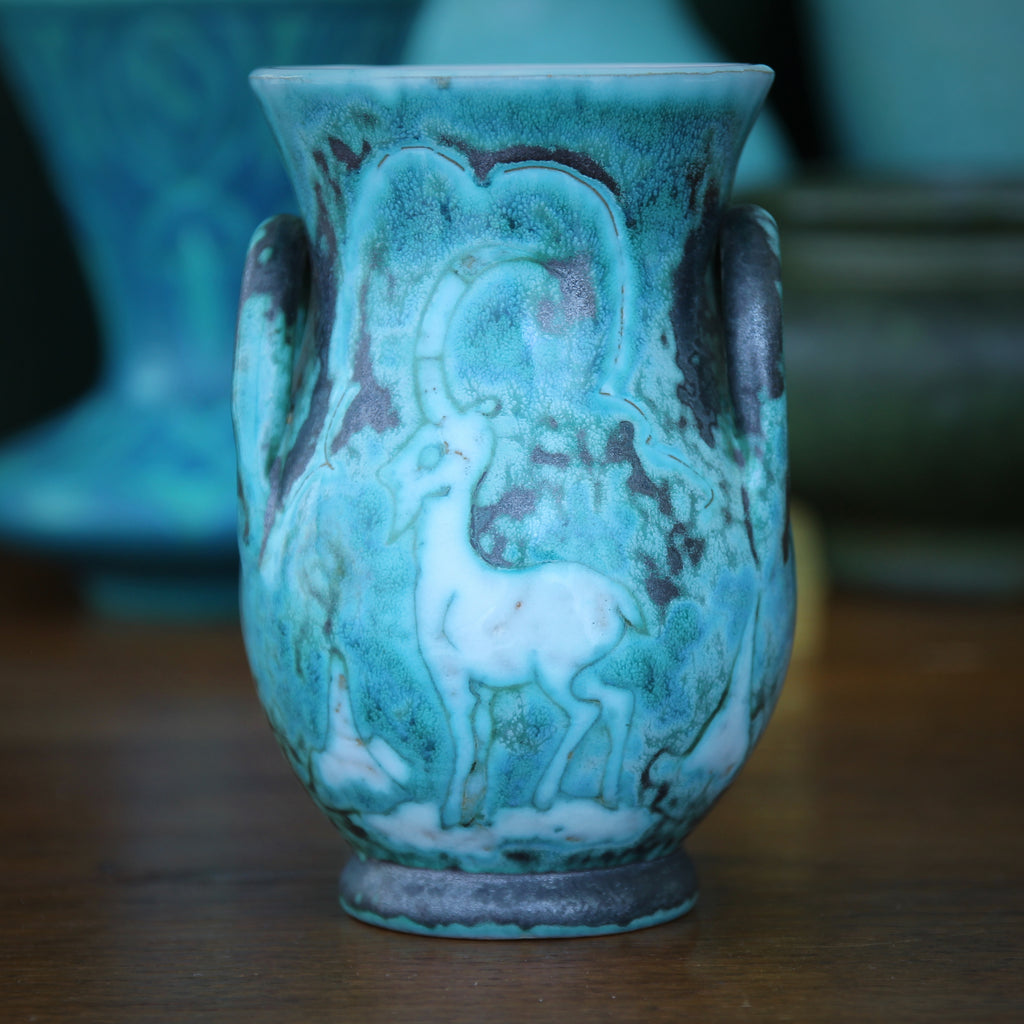
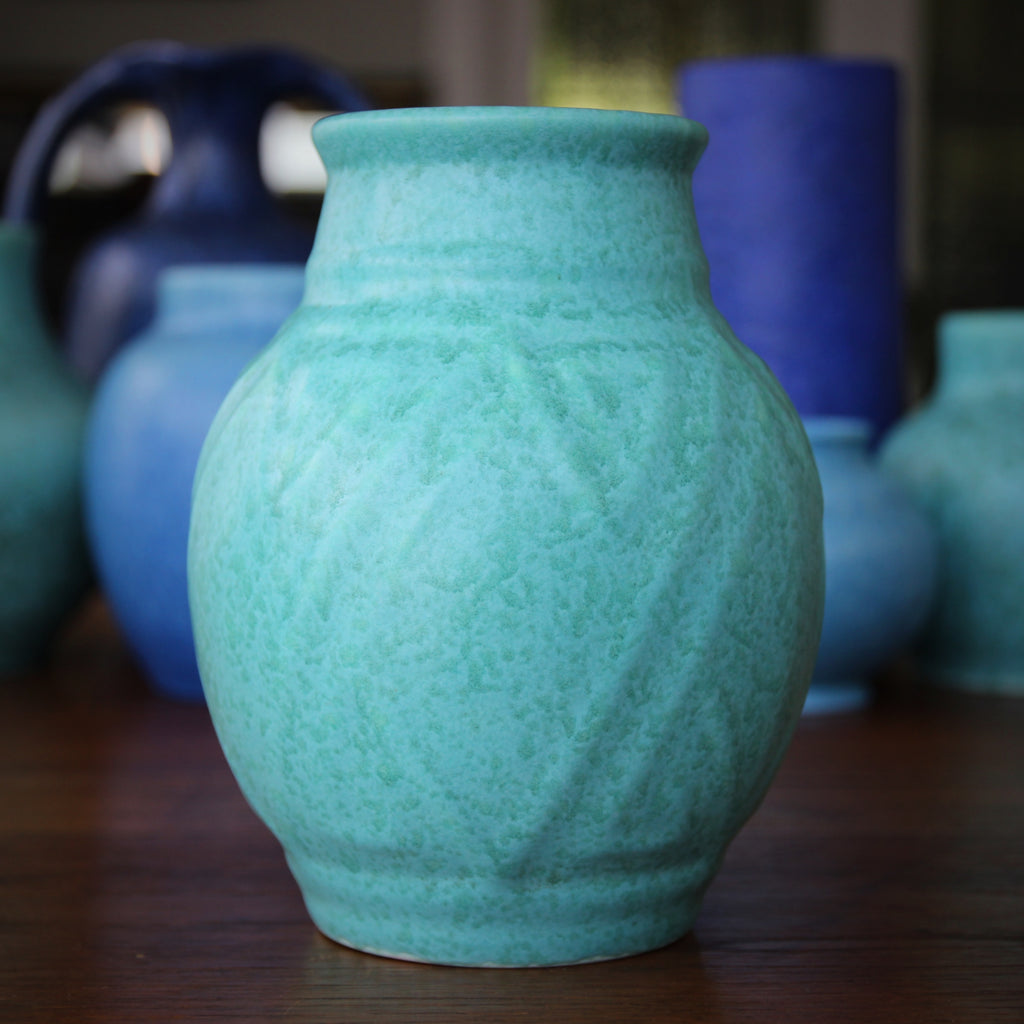
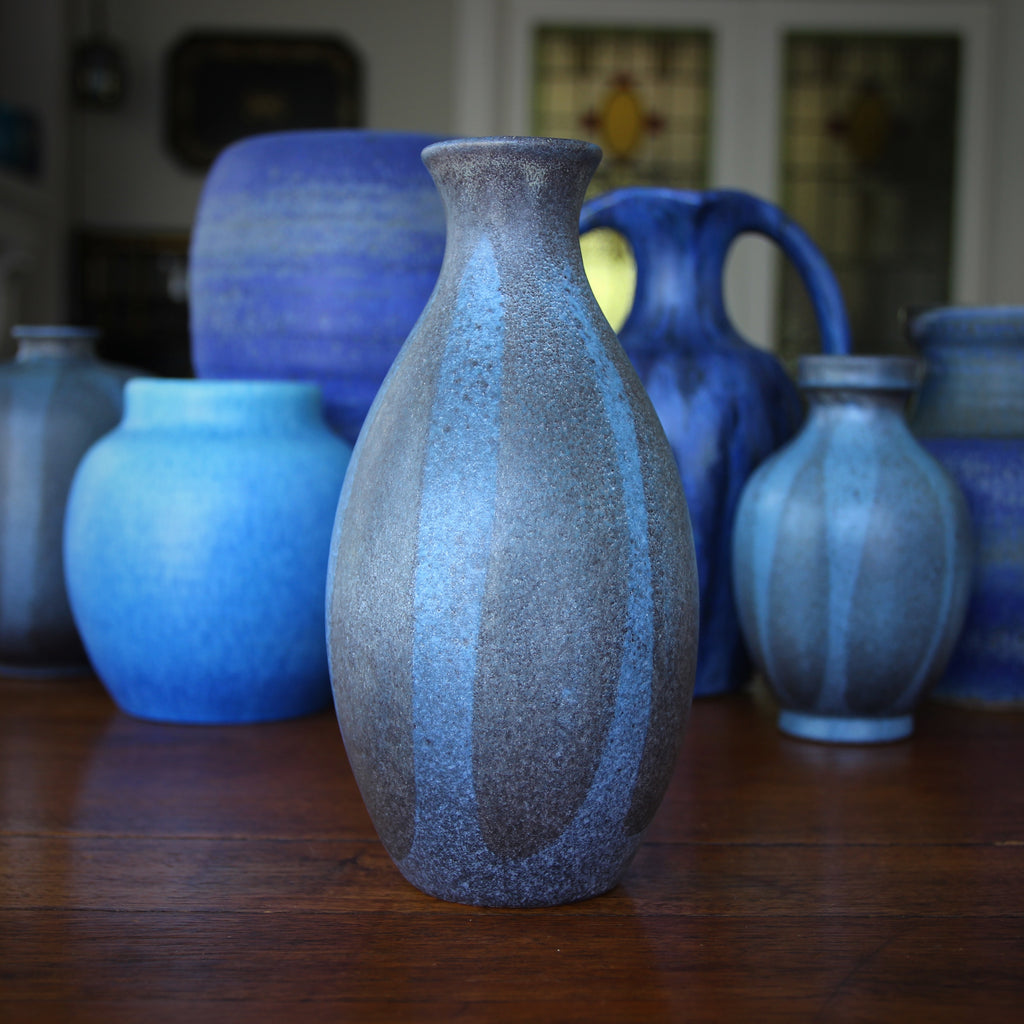
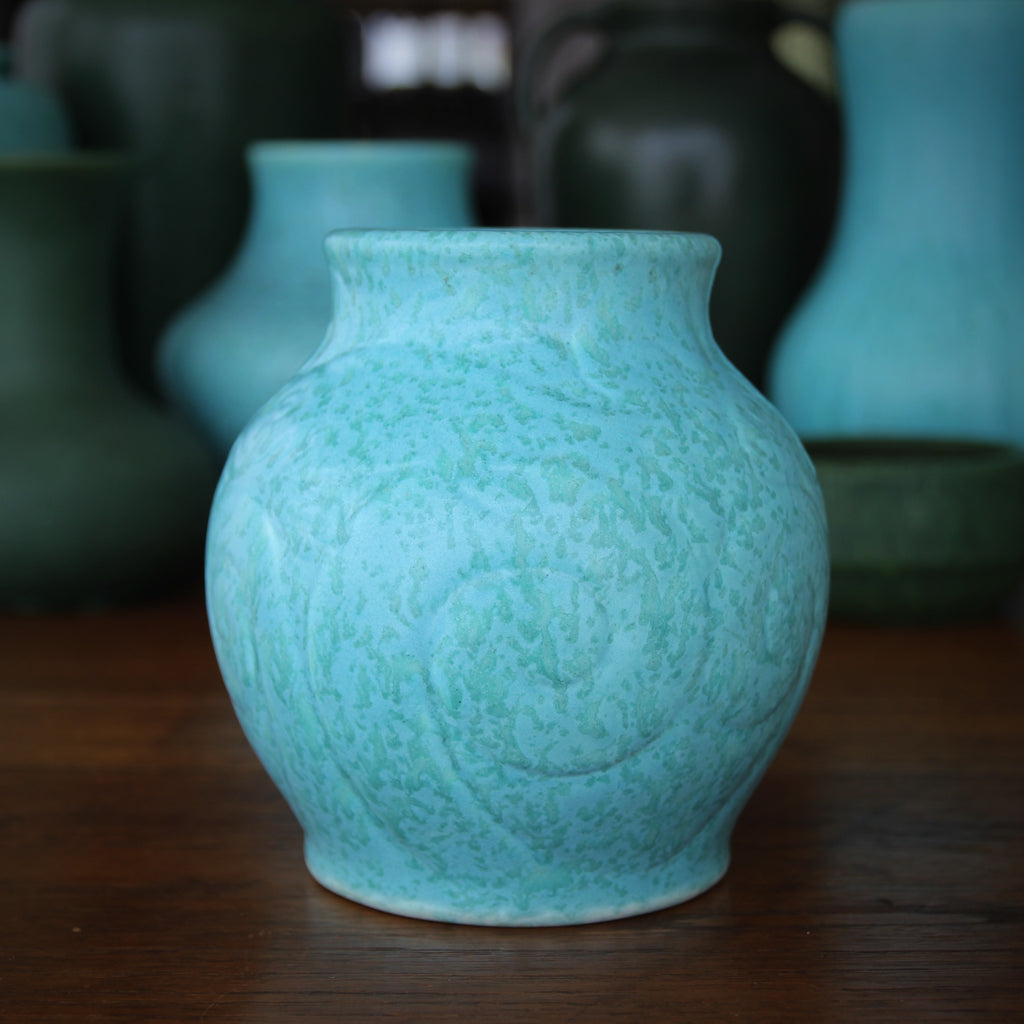
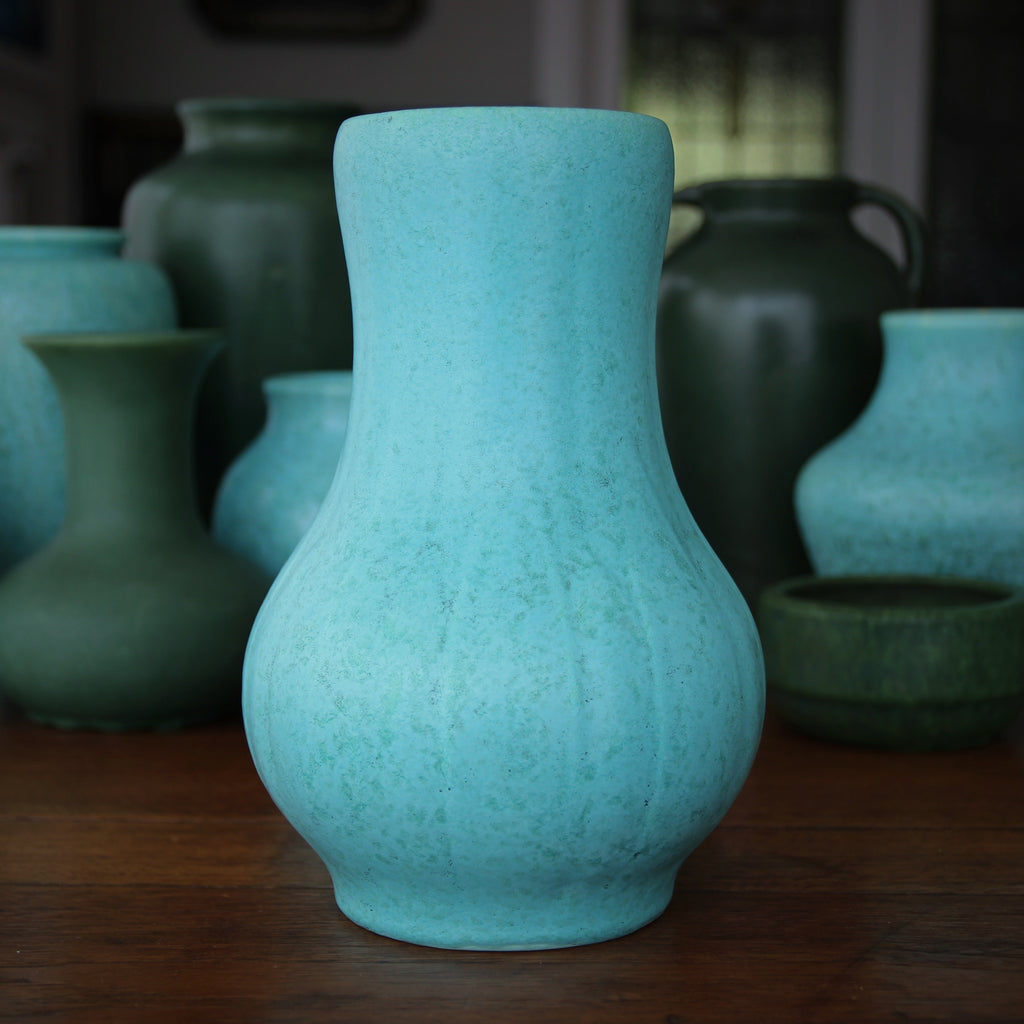
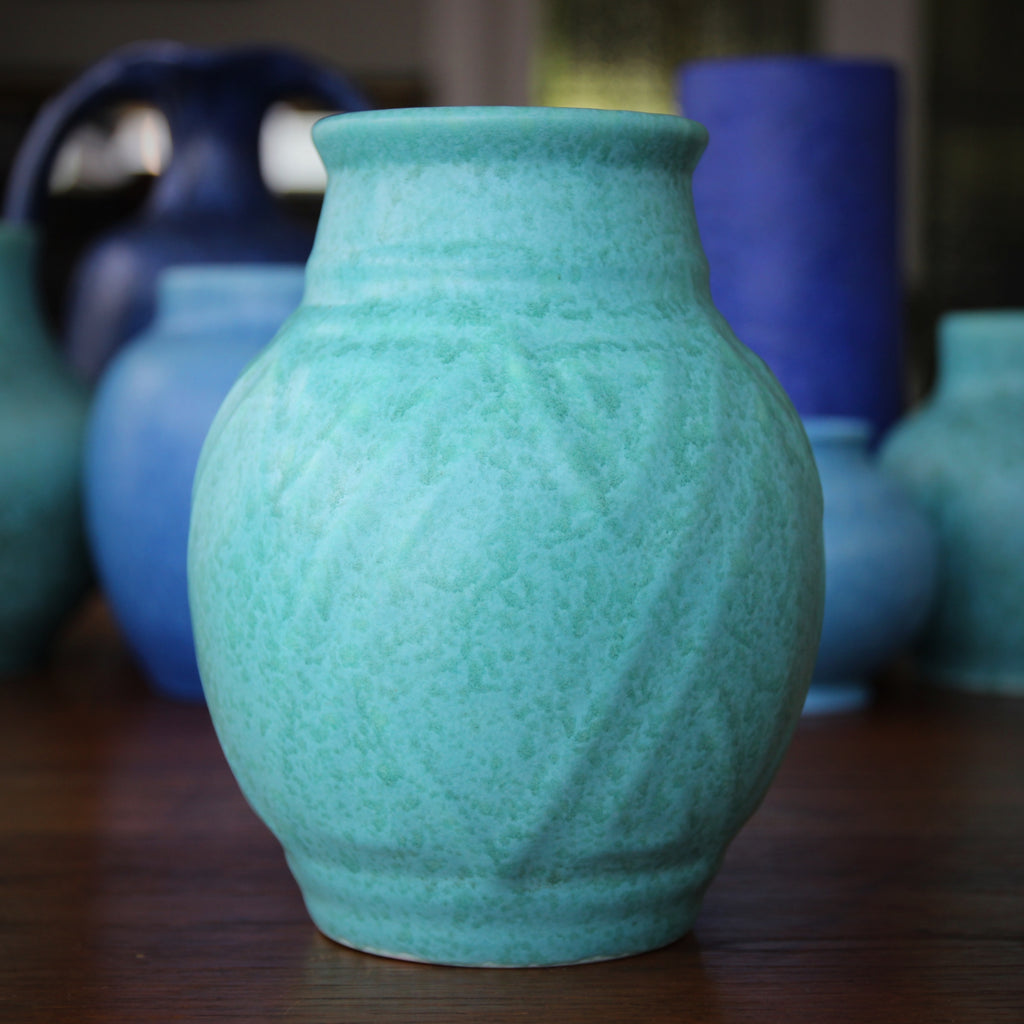
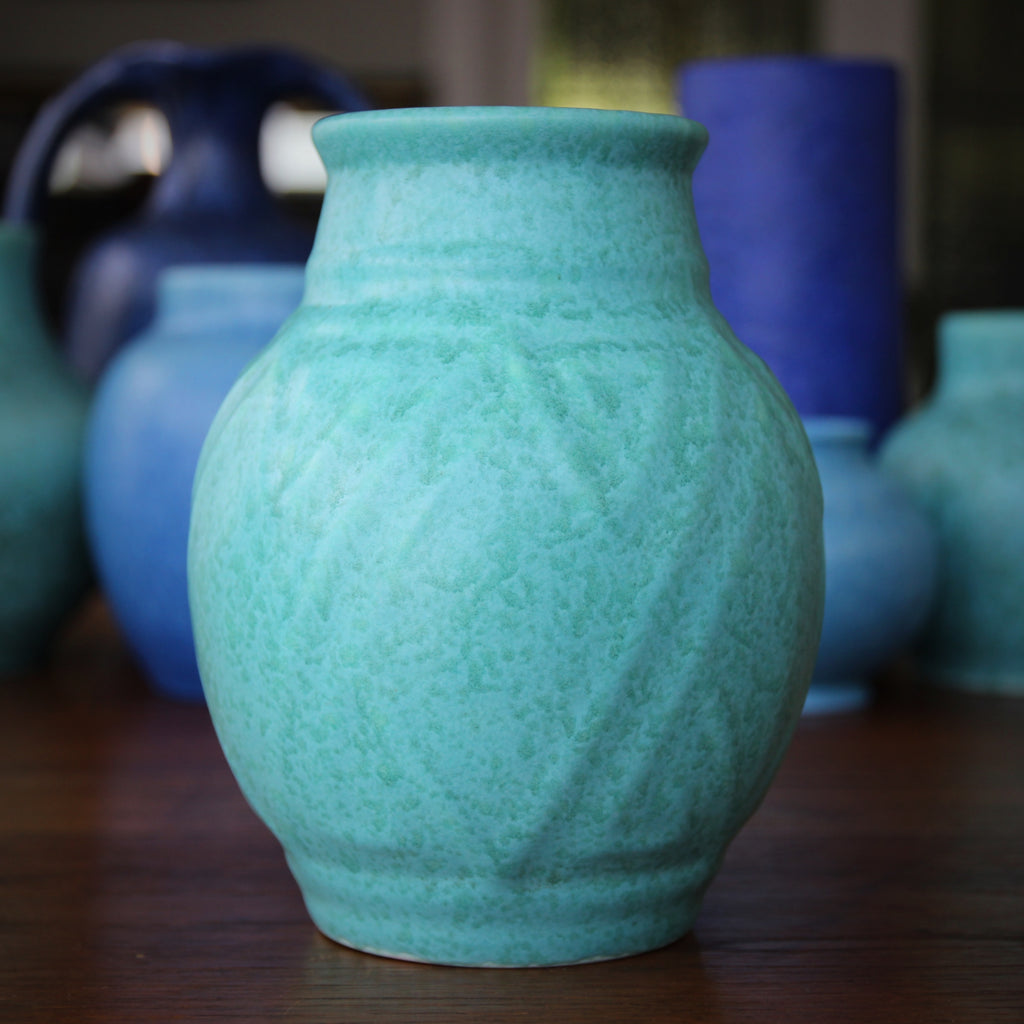
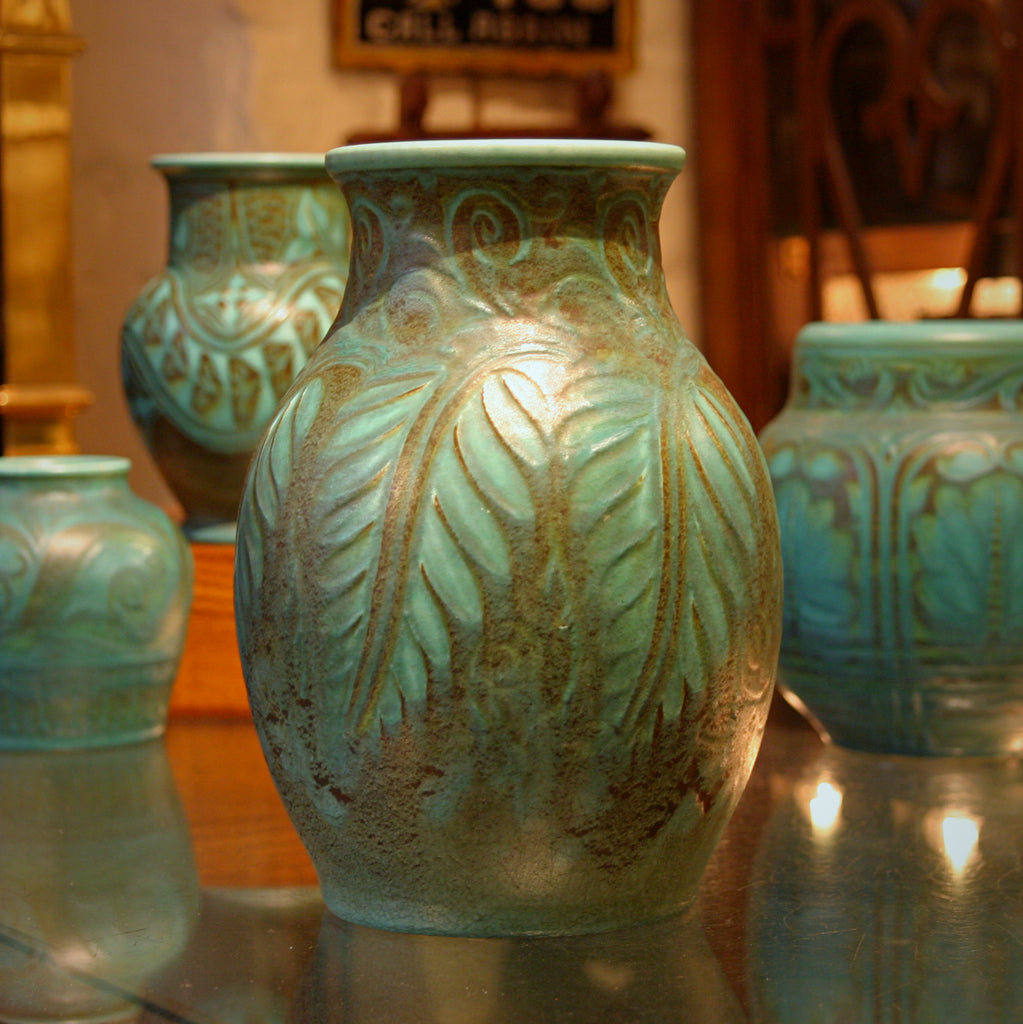
If you're dreaming of turquoise waters—entering them, not just thinking about them—the time is now to take that dip. Before long, the waters will have chilled and beach days will be behind us. Of course, this handsome English Art Deco vase will bring you a remembrance of beaches past—all year long. Made by Pilkington Royal Lancastrian in the 1920's or 1930's, it is finished with a luxurious jade-specked turquoise glaze—reminiscent of Persian Turquoise. The bas relief diamond under-pattern adds energy and structure to the form.
"Summer afternoon—summer afternoon; to me these have always been the two most beautiful words in the English language." -Henry James (1843-1916) What a beautiful summer we're having, at least here in my new home of Pittsburgh. Sunny, dry, and topping-out around 78º. Nights in the mid-Sixties are heavenly, indeed! When Henry James penned these insightful words, there was no air conditioning and "beachwear" was only worn at the beach (and it was still woolen). Yet, he captured the relaxed (and lazy) feeling just right—at least for those who could afford to relax on a summer afternoon. The vase above, glazed in a cheery, sunny yellow glaze, is sure to bring a spot of summer sunshine into your home—whatever the...
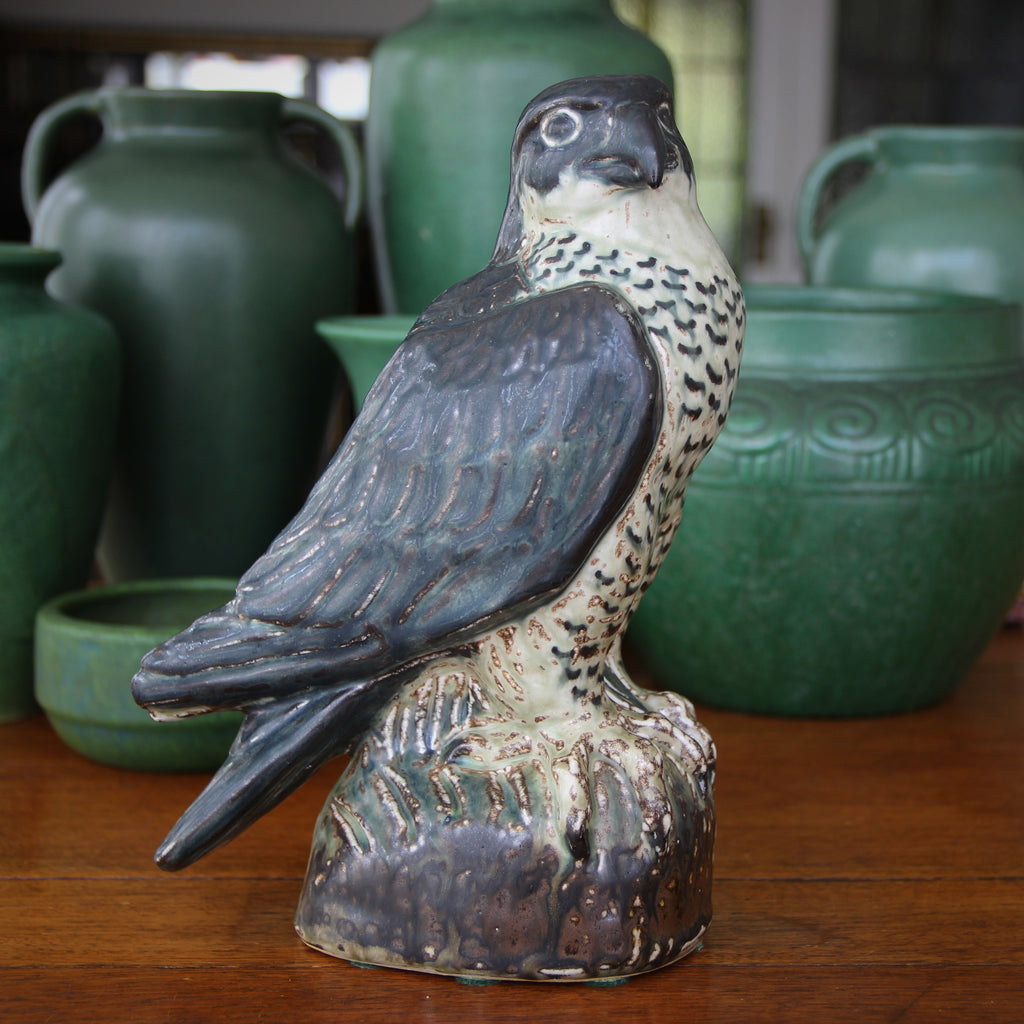
The Peregrine Falcon has been capturing mankind's imagination for millennia. The Ancient Egyptians depicted their sun god, Ra, as having the body of a man and the head of the peregrine. And, for at least 3,000 years, people have been practicing falconry—the sport of training domesticated falcons to capture prey and return to their master. Peregrine Falcons are superb hunters. They are eager, agile, adaptable and oh-so-fast. Peregrines have been clocked at speeds of 242 mph while in "dive mode"—making them the fastest animal on Earth. First they fly to an altitude over 3,500 feet, after which they rocket downwards toward their prey. They tuck-in their heads, pull-in their wings, and contort their bodies for maximum aerodynamics. Even at these speeds,...
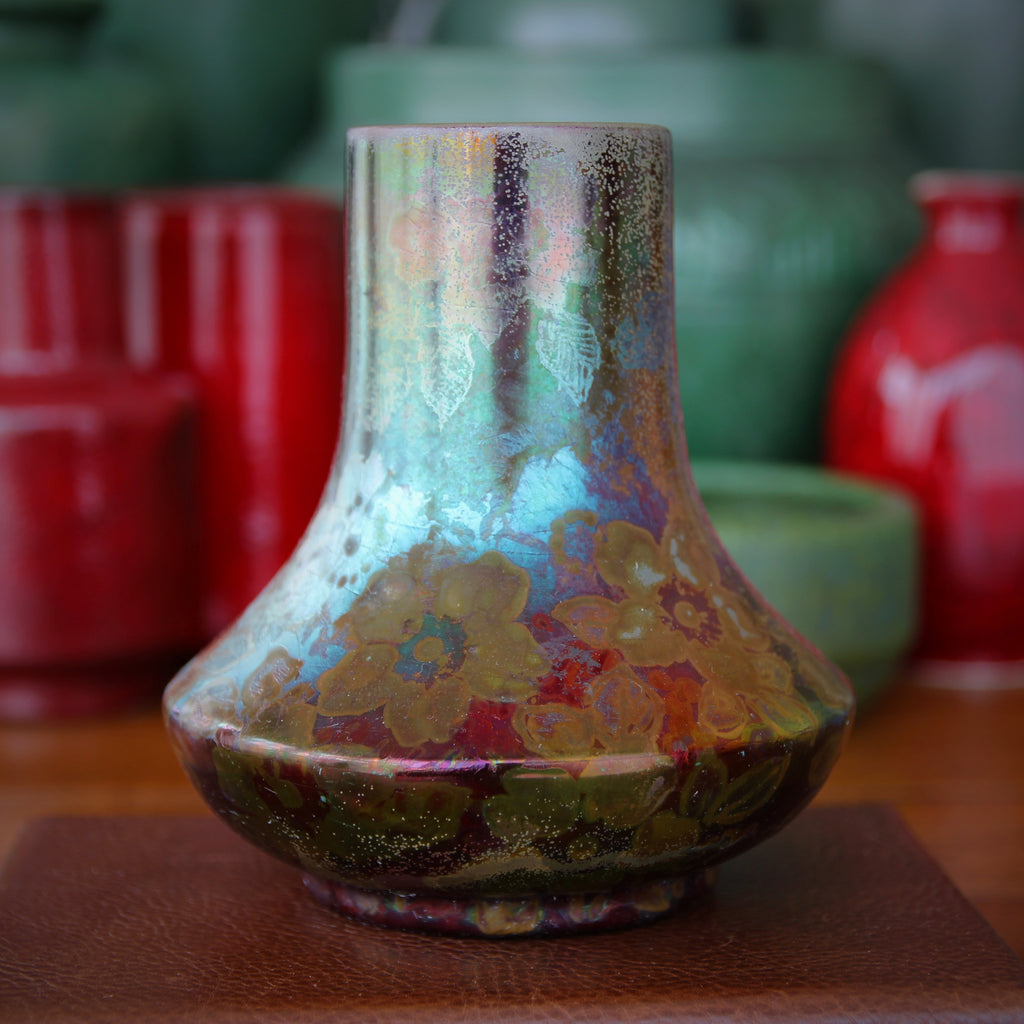
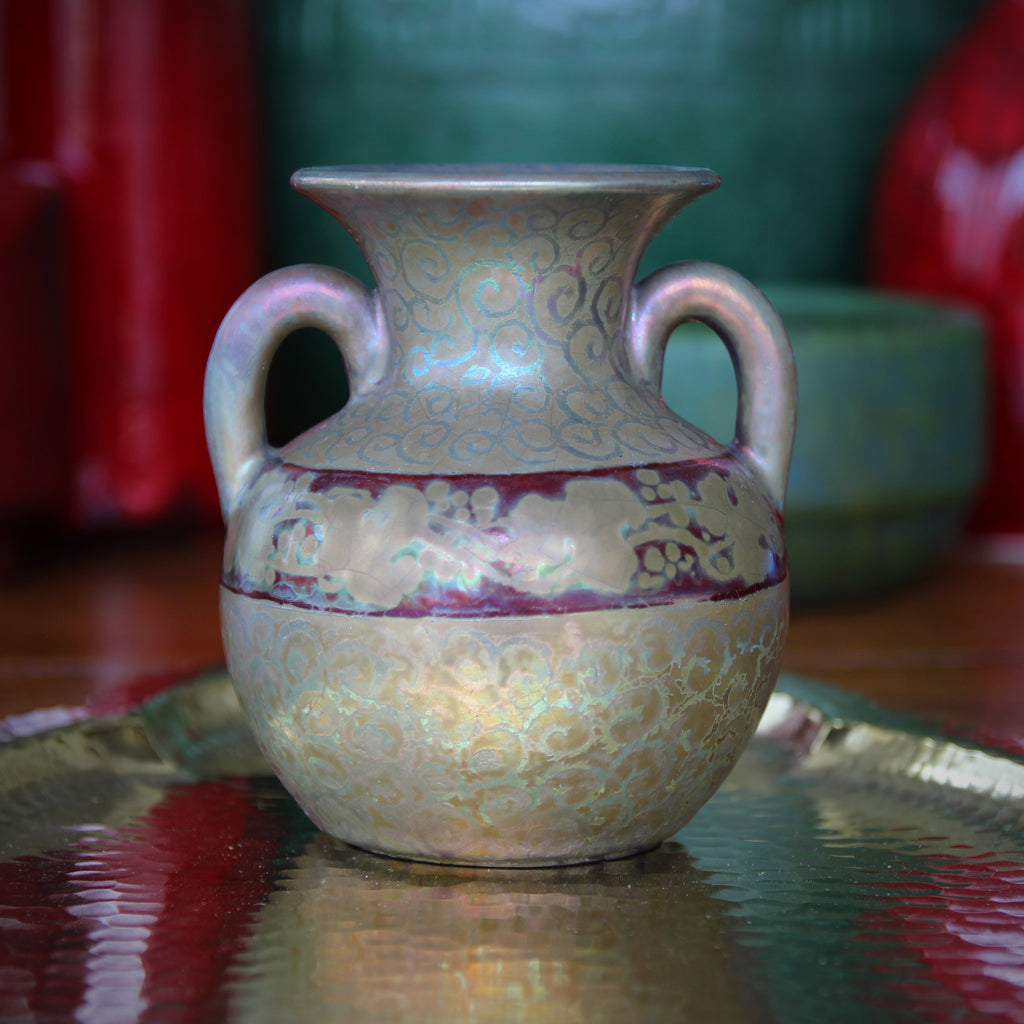
Yesterday we discussed the pioneering glaze developments of Clément Massier, céremiste extraordinaire and icon of the Art Nouveau movement. Along with talented teammates, Massier invented new glazing techniques which were inspired by Iberian, Islamic, Chinese and Ancient ceramics works from Egypt, Greece and Rome. His signature was metallic lustre glazes—iridescent finishes using copper, silver and gold. These pieces were first glazed and fired at the normal (high) temperature (twice). Next, a solution of copper- (or silver- or gold-) oxide (and other metallic chemicals) was applied and the piece endured a third (low temperature) firing in a low-oxygen kiln. After firing, the pieces might be inscribed with an "over pattern" or embellished with a cold-paint design. Such "organic" glazing techniques produced unpredictable, unrepeatable...
Clément Massier (1845-1917), born into a family of French potters, was destined to be a ceramicist. But it was he himself—while tapping the skills of a handful of brilliant colleagues—that redefined ceramics-making in the period before and after the Turn-of-the-Century. He is considered one of the pioneering artists who developed lustrous metallic glazes and his impact on the Art Nouveau movement is profound. His work is found in the collections of the world's most important museums, like the Musée d'Orsay and the Metropolitan Museum of Art. His legacy also includes contributions to iconic Art Nouveau spaces like Maxim's de Paris. Massier's family had been producing ceramics in Vallauris, in the South of France, since the early 1700's. Like most clay works, the...
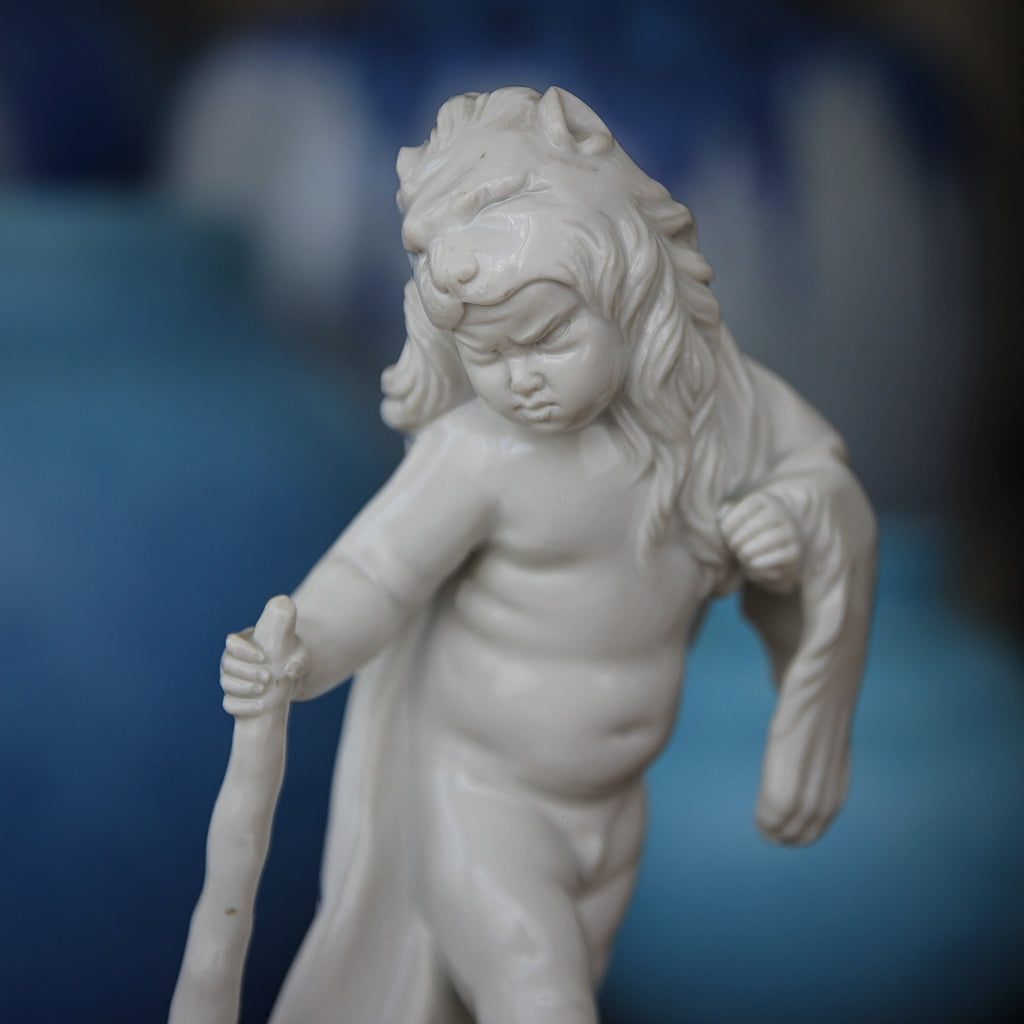
In Ancient Greece, about 20 miles southwest of Corinth, a fearsome monster—the Nemean Lion—prowled the village of Nemea, killing and eating the villagers. King Eurystheus ordered his cousin, Heracles, to combat and kill the Nemean Lion—the first assignment of The Twelve Labors of Heracles. (The Greek name, Heracles, is often translated to its Roman version, Hercules.) Heracles attempted to kill the Nemean Lion with his bow and arrows. But the lion was endowed with a Golden Fleece, impervious to weaponry. The arrows simply bounced-off his sides. So Heracles needed a different approach. He took a club and entered a cave with two entrances. One entrance he blocked-off. Through the other entrance, he lured the powerful lion. He clubbed the lion, stunning it, and strangled the...
I love visiting the Mediterranean during the Summer. Greece, Italy, Spain or the South of France—it doesn't matter—I love the warm, dry weather and the sapphire blue waters of that ancient sea (and the cultures which surround it). Summer is always that much better when it includes a bit of time on (or near) the Mediterranean Sea. In the handsome city of Monte Carlo, they built a large pier—to both protect the small (expensive) boats inside the harbor and to allow large ships to dock on the outer side. On the sea-facing side of the pier, a large cement structure (called "Solarium Beach") has been designed as a series of gigantic "steps" leading to the water. They allow bathers...
July is here—with its summer weather, its beach vacations and (on the 23rd) its leonine sunsign. July also brings its birthstone, the ruby. Rubies are amongst the "cardinal" gemstones, the most precious, important, and expensive: diamonds, sapphires, emeralds and rubies.
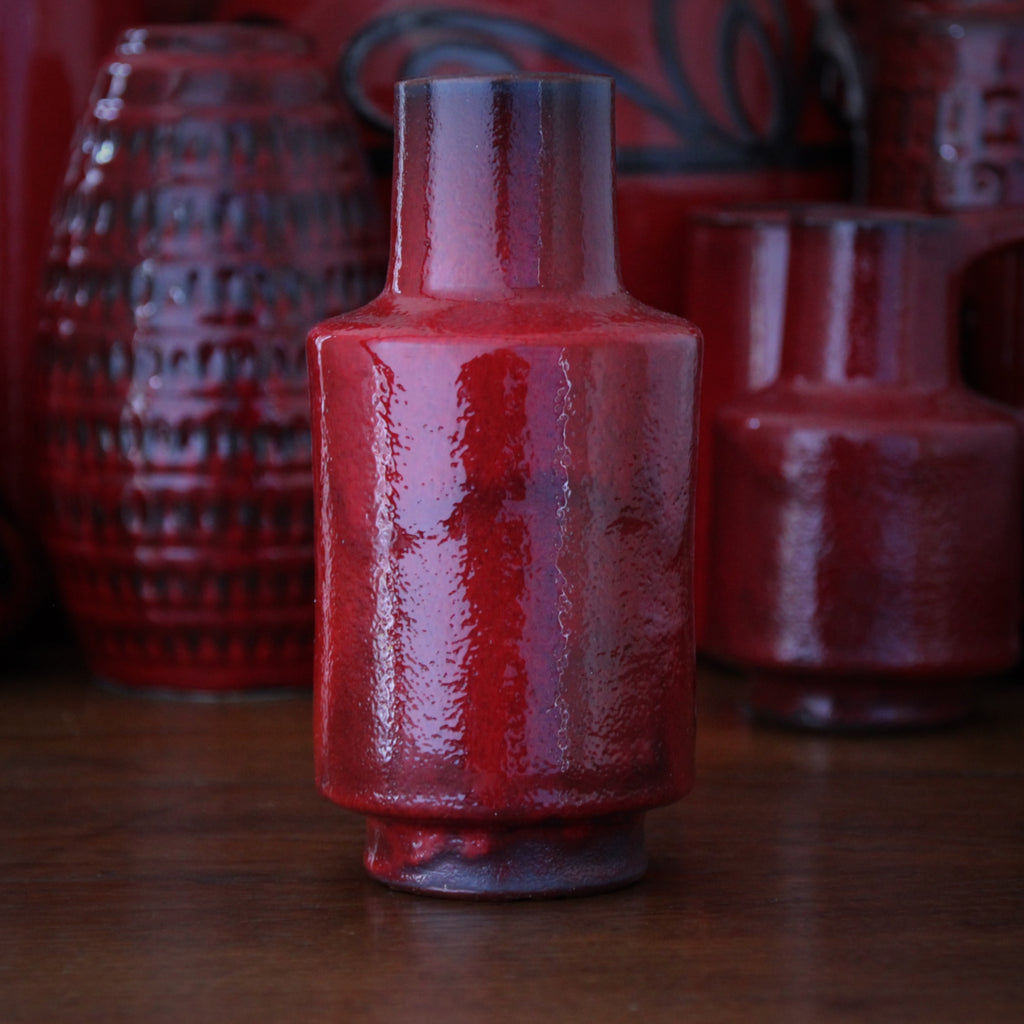
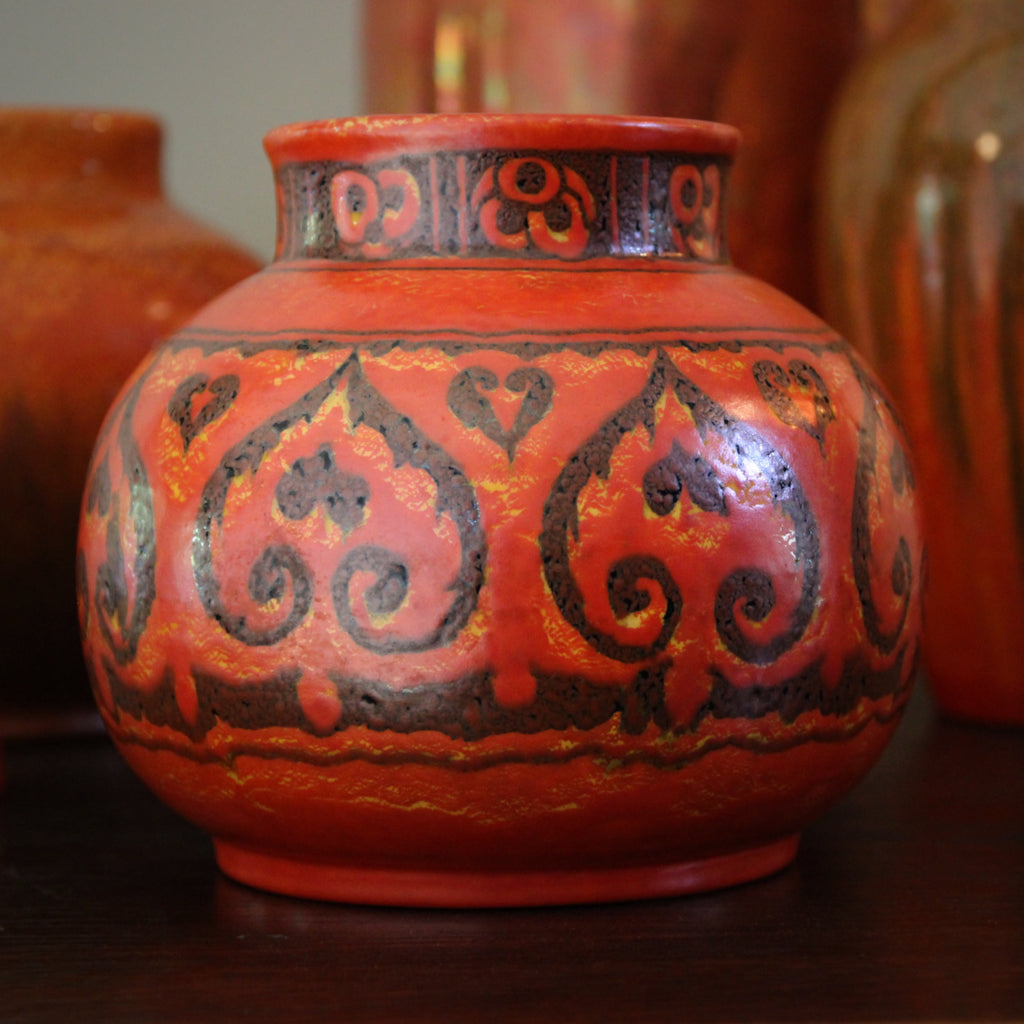
This West German footed vase, made in the 1960's or 1970's, is not made of rubies. But its deep, regal red glaze is reminiscent of the July birthstone. It was made in the rather small ceramics workshop, Hoy Hey. The dark brown stoneware clay provides a rich juxtaposition to the sensuous, dripping red glaze.
My "Aesthetic Heart" lies firmly in the Mid-Nineteenth to Early Twentieth Centuries—a 100 year period including the Gothic Revival, the Aesthetic Movement, the Art Nouveau (including the various Arts & Crafts movements) and ending with the Art Deco movement between the wars. High-end Art Deco can be sublime, every bit as craft-intensive as the earlier movements. But what gave the Art Deco movement traction, making it so widespread, was the fact that it was well-suited to modern mass production methods—which allowed large quantities of goods to be manufactured quickly, with reduced human handcraft. A growing Middle Class in the Twentieth Century had disposable income for the first time and they wanted to buy a few nice things (as long as they...
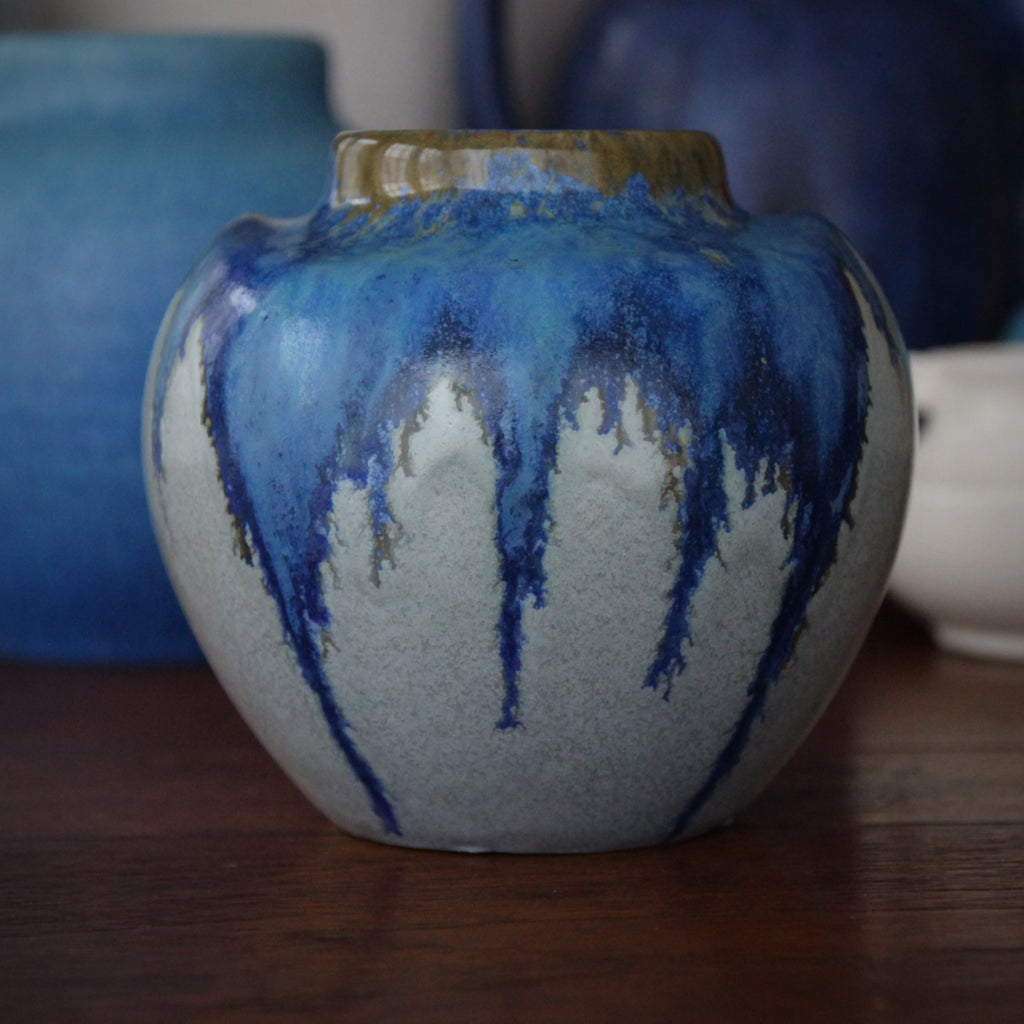
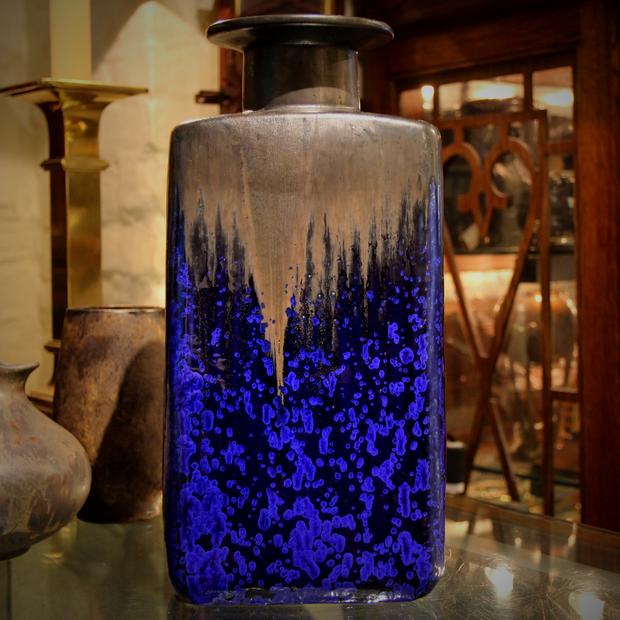
Here's the final piece—one of the trio of pieces I'm offering for sale from my private collection of this West German pattern. It was made by Fridegart Glatzle for Karlsruher Majolica in the 1970's. The form of the vessel is inspired by a classical shape, though it is energized with a Modernist "slightly-inflated" tension. But it's the glaze which I love best: an organic, dripping glaze, reminiscent of works from the earlier Jugendstil period. For several years, I have been collecting this line of works, mostly in Europe, occasionally in the States. But my grouping has grown large enough that I can "deaccession" the duplicate pieces, like the one shown here.
Here's another piece made by Fridegart Glatzle for Karlsruher Majolica in the 1970's. Though the shape is one of a classic ceramics vessel, it features a Modernist energy with its artful "tension"—like one might see with a slightly-overinflated balloon. The glaze, however, "leans back" into an earlier period—with the dripping glazes of the Jugendstil period. This is one of a trio of similar pieces which I am offering from my Private Collection—a deaccessioning of duplicate pieces in my collection of this West German pattern.
As an antiques dealer, I'm traveling all the time, on the hunt for new acquisitions for the shop. While on-the-prowl, I cannot help but unearth the occasional tempting object (or collection) which I decide to purchase myself (rather than buy for the shop). Truthfully, I need to rein-in such indulgences—keep it in moderation. But, over the years, I've collected a number of "extra-curricular enticements"—my "Private Collection"—which is not usually offered for sale. The piece above was made in the 1970's by ceramicist Fridegart Glatzle for Karlsruher Majoilika. She was one of the lead artists for the German ceramics workshop, starting in the 1950's, after World War Two. She designed many "lines" of ceramics for the company including the piece shown above (from the...
Very late last night—at 11:32 pm New York Time—the North Pole was at its closest annual tilt toward the Sun; yesterday, the Sun encircled the Earth along its most-northern track for the year (along the imaginary line called the Tropic of Cancer). Thus, in the Northern Hemisphere, yesterday was the longest day of the year—and Summer began at 11:32 pm. If you were at the North Pole, the sun would not have set at all. On the other hand, if you were in the Southern Hemisphere, it would have been the shortest day of the year for you—and the South Pole may have had no sunrise at all. Life on Earth is dependent upon the Sun. But we need a...
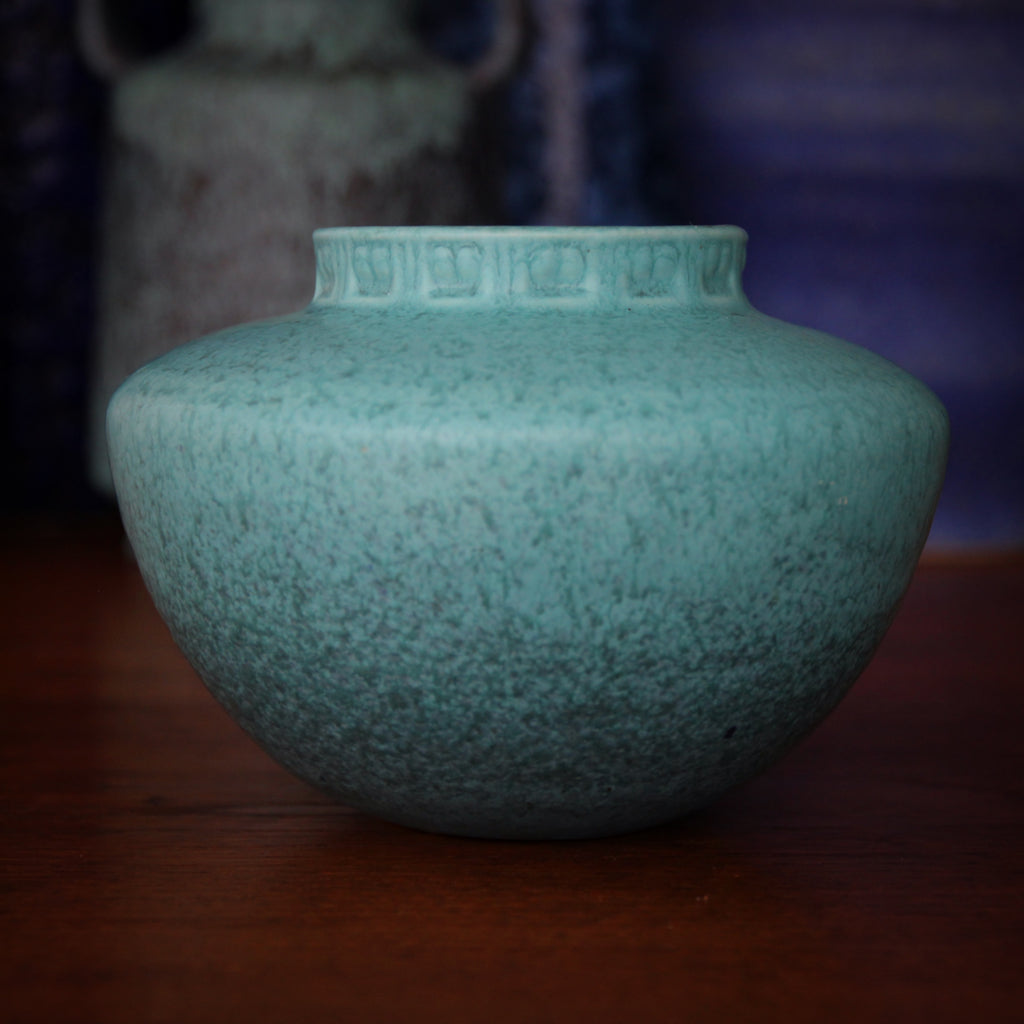
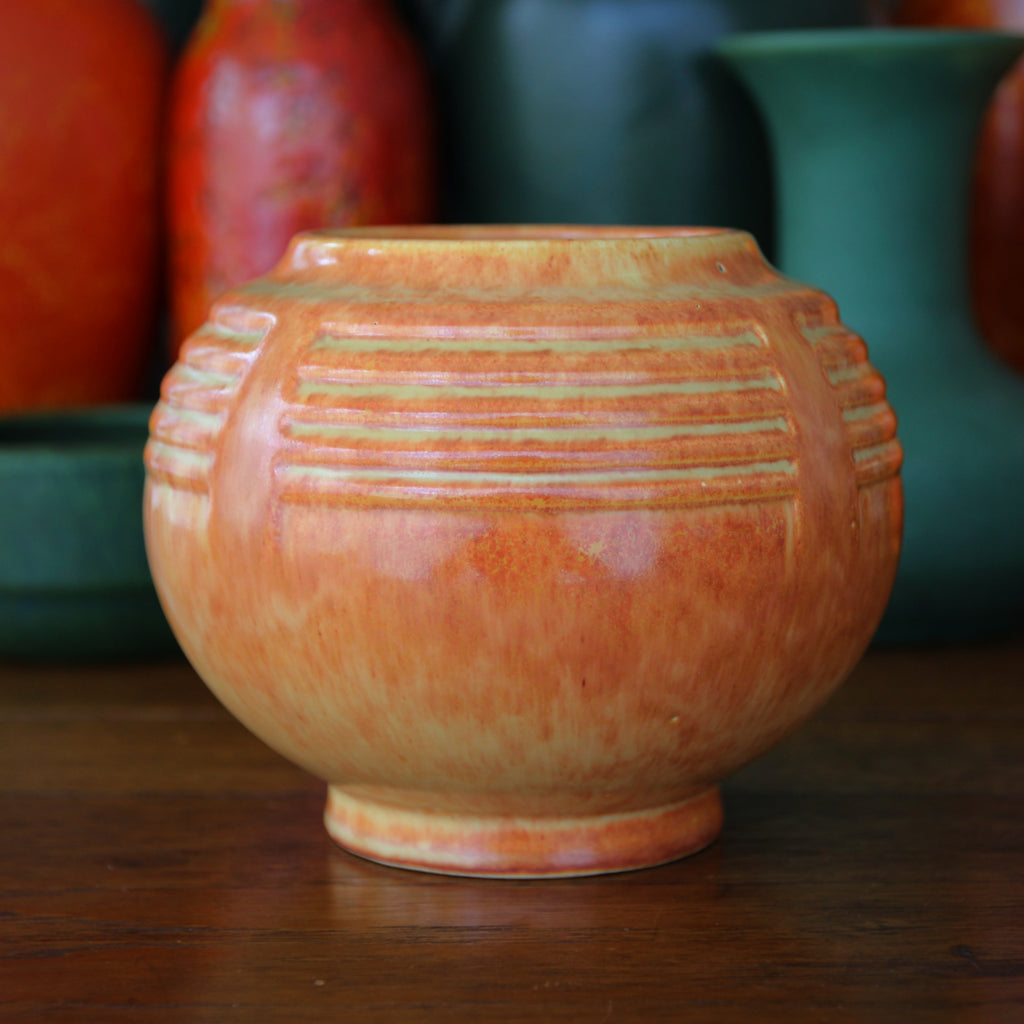
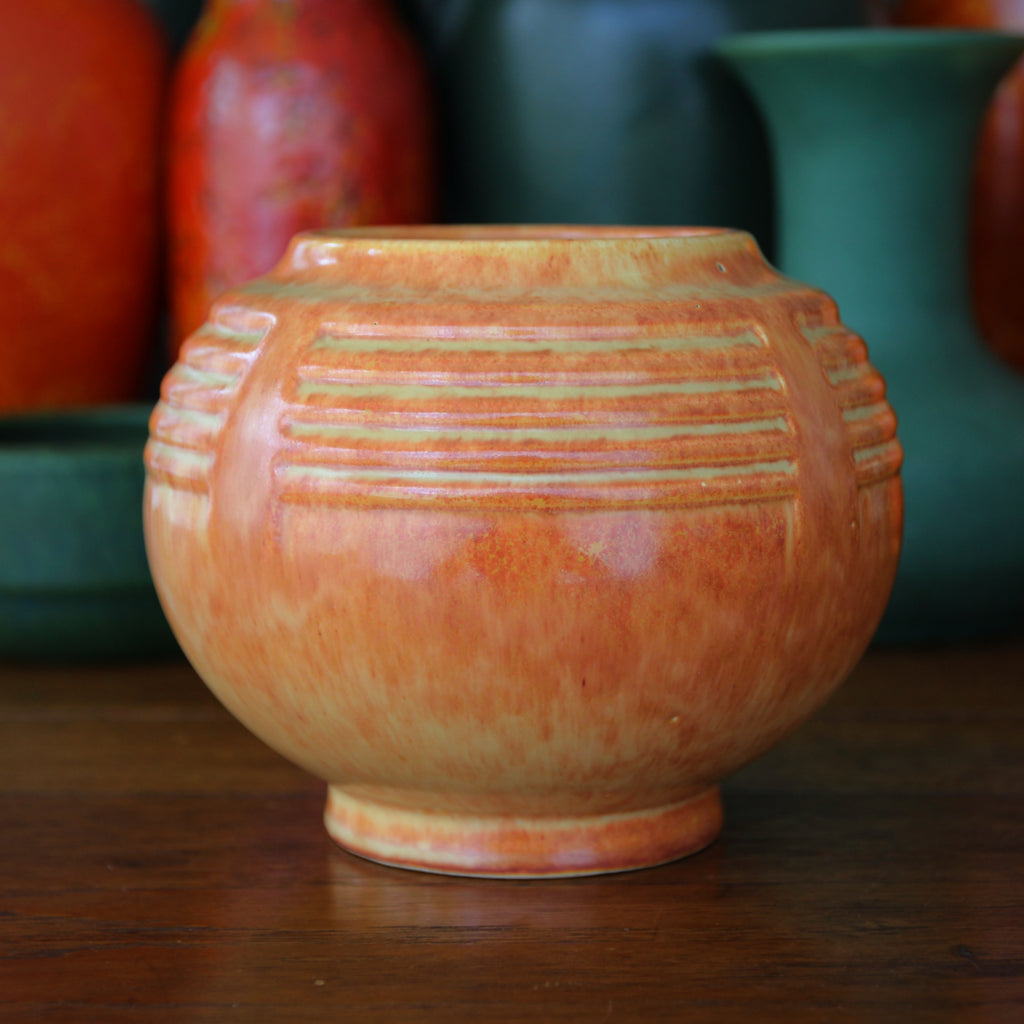
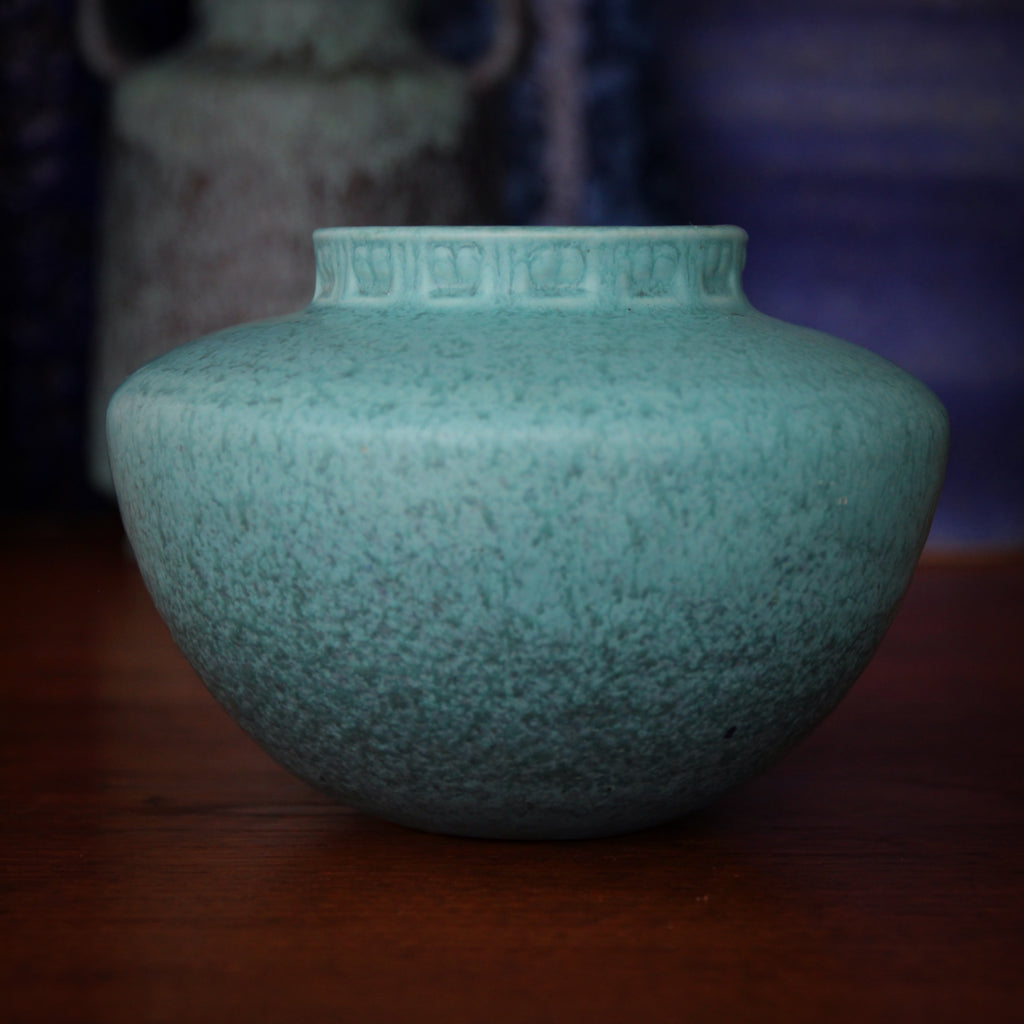
Art will sometimes present interesting contradictions. Sometimes the viewer catches the inconsistencies and sometimes the viewer just enjoys the piece for its aesthetic pleasance. This Art Deco rosebowl, made by Roseville in the 1930's, juxtaposes two opposing forces: hard structure and organic spontaneity. The ceramic structure of the bowl itself is a crisp and intentional form—precise, architectural, disciplined. One could almost imagine the bas relief shoulder design inspiring the utilitarian venting within the vast inner shaft of the Star Wars Death Star. On top of this "hard" form, however, is a random and impromptu and very soft glazing effect—mottled glazing (in a warm, gentle color) applied in an irregular (and seemingly unplanned) way. The juxtaposition of hard vs. soft, deliberate vs. random, gives the...
Here's another English Art Deco vase made by Pilkington Royal Lancastrian in the 1920's or 1930's. It has an incised, scrolling design across the body and is glazed with a handsome turquoise glaze—freckled with jade green confetti. Click on the photo above to learn more about it.
Ancient Egypt has long been a source of fascination for the West. Western artists, architects and designers have been appropriating Egyptian design motifs since the Renaissance—as Europeans looked to ancient civilizations for beauty, culture and enlightenment. When Napoleon conquered Egypt, he instructed teams of artists to thoroughly record the art, architecture and aesthetics of Egypt, both ancient and modern. These engraved plates were published in installments called Description de l'Égypte from 1809 to 1826 which were wildly popular and had a tremendous influence on early 19th Century taste and design—paintings, architecture, furniture, graphics, jewelry, ceramics, metalware, lighting and other decorative arts.
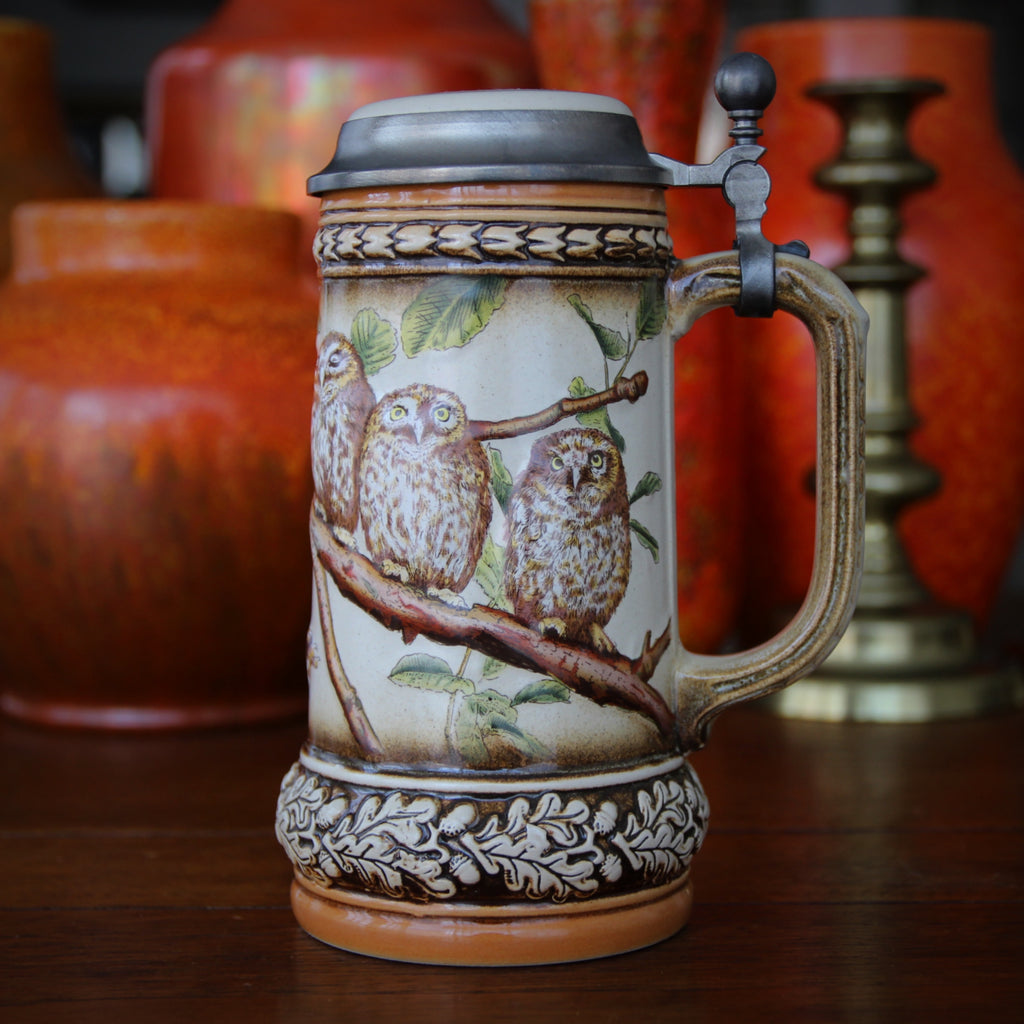
People have always found owls mysterious. They hunt by night, fly in complete silence, and appear to study intently (and contemplate) everything that happens before them. Those big eyes seem to see everything. Thousands of years ago, the Ancient Greeks associated owls with knowledge; Athena, the Goddess of Wisdom, was often depicted with an owl who would whisper the truth to her. In later centuries, Athena's Roman counterpart, Minerva, continued to be shown with a a wise owl. The "secretiveness" of owls has sometimes earned them an association with death. An owl flying into (and out of) a room conveys the poetic symbolism of the passing of human life from Earth to the Hereafter.
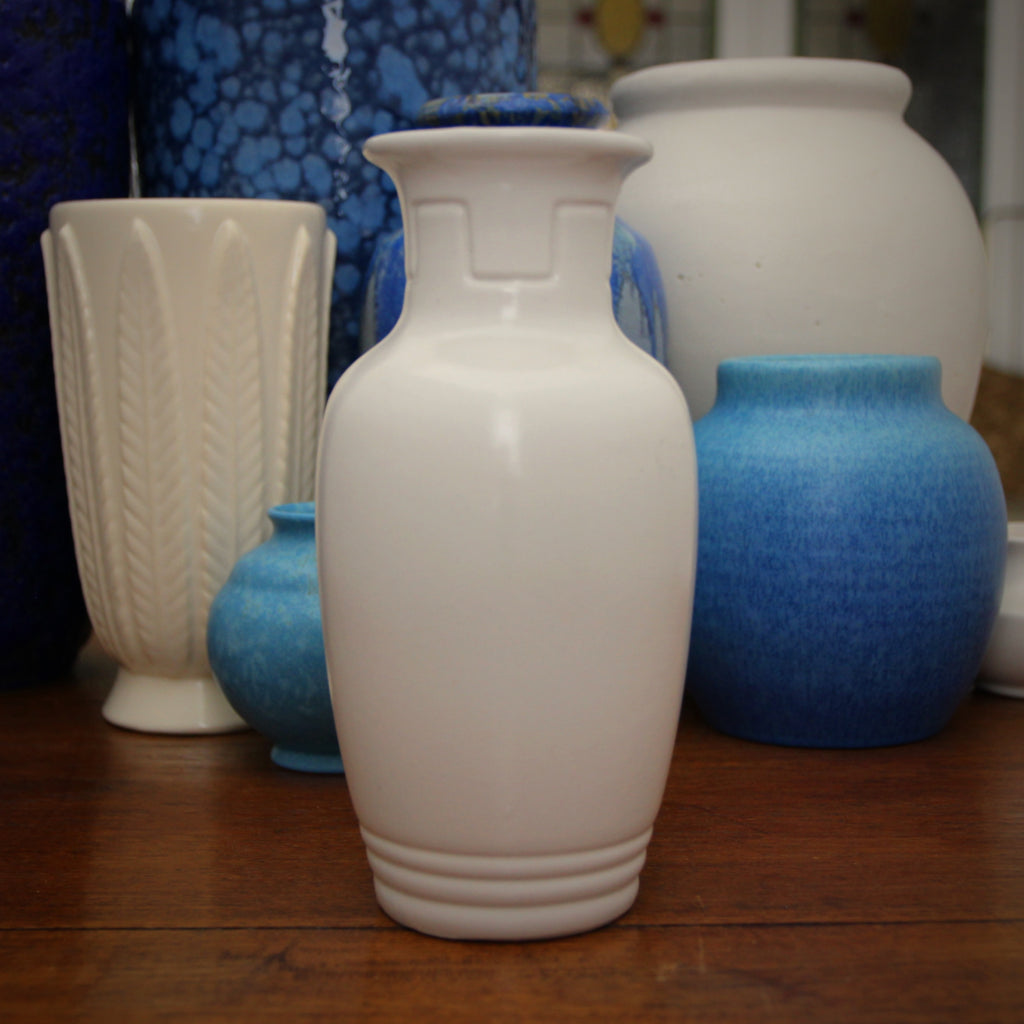
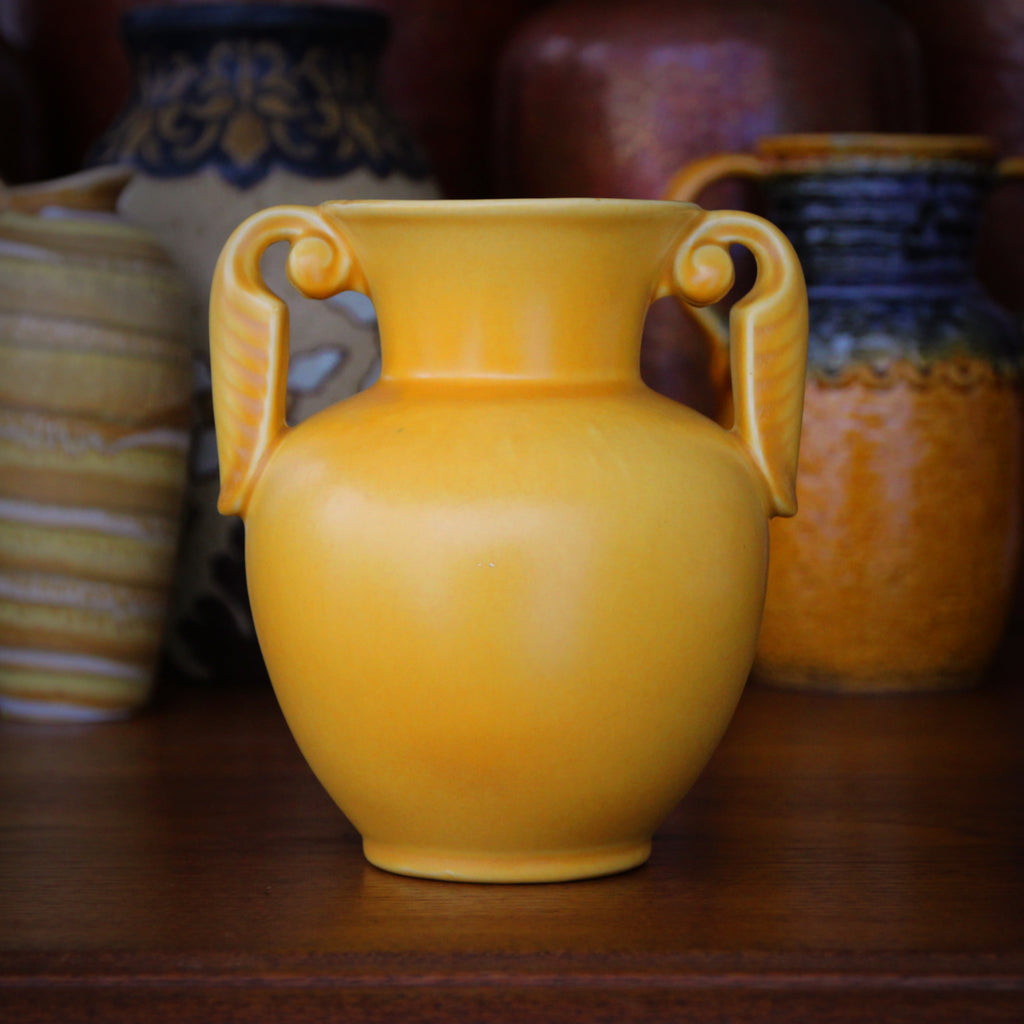
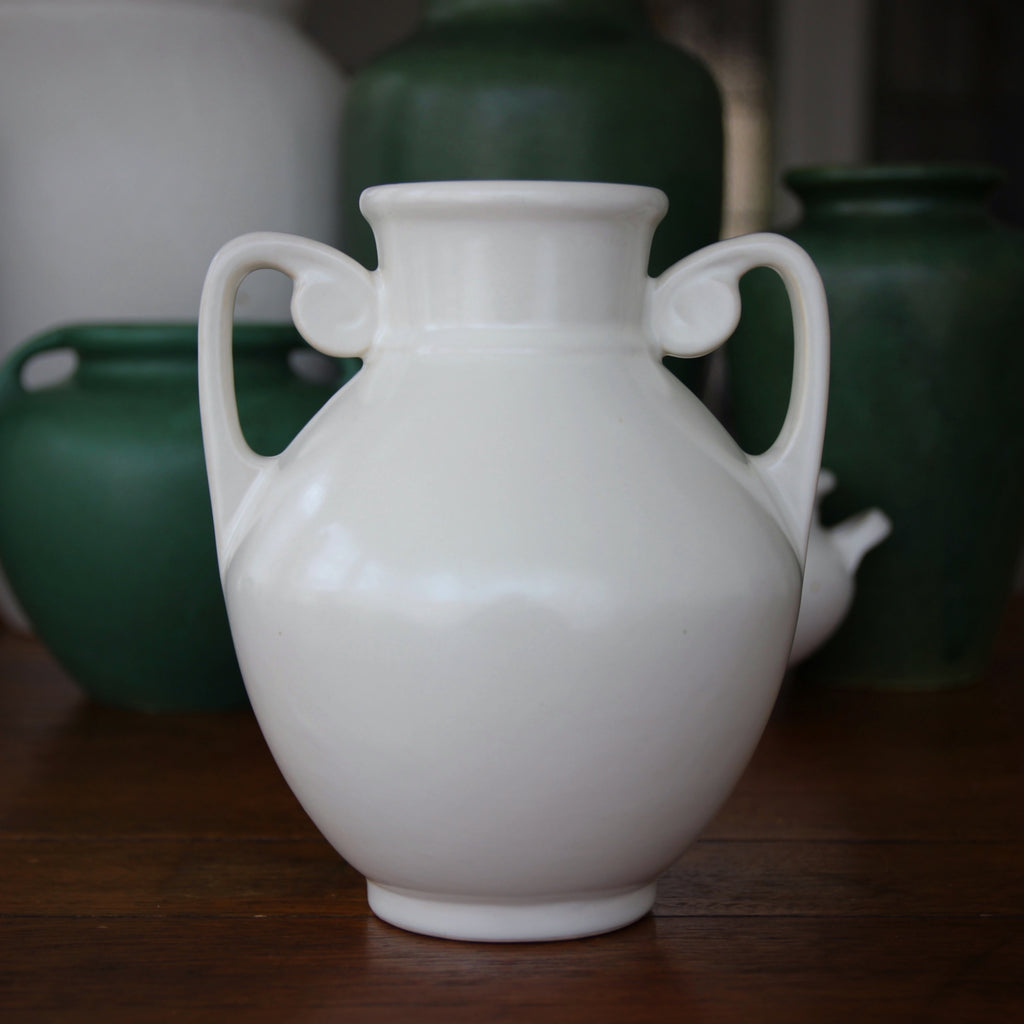
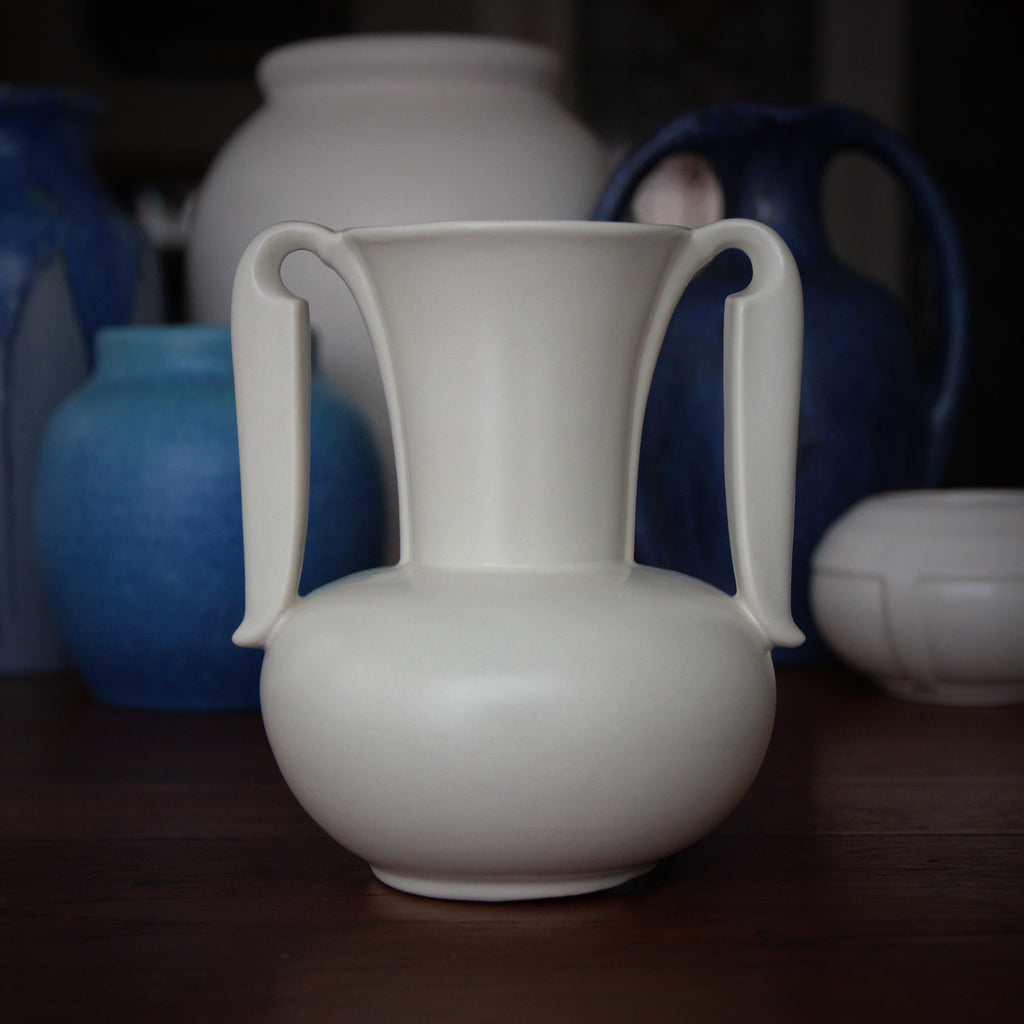
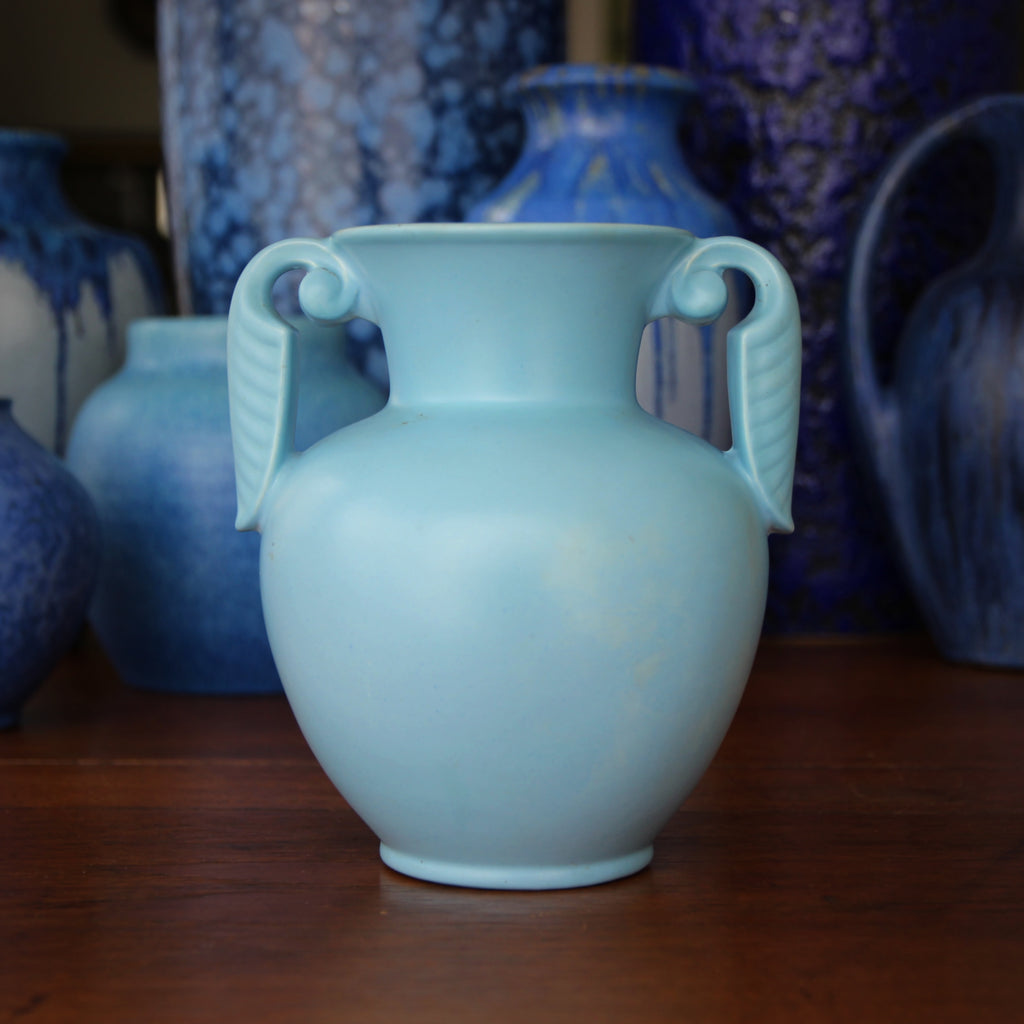
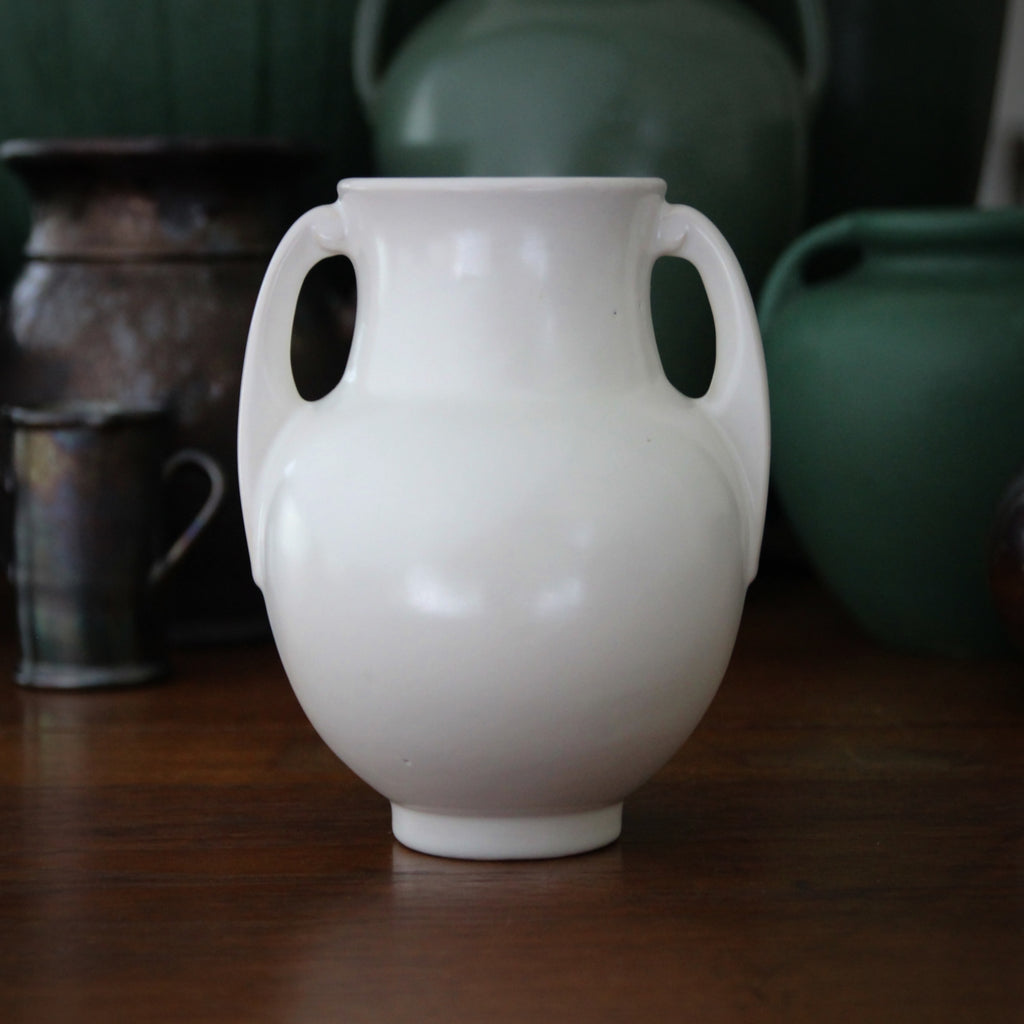
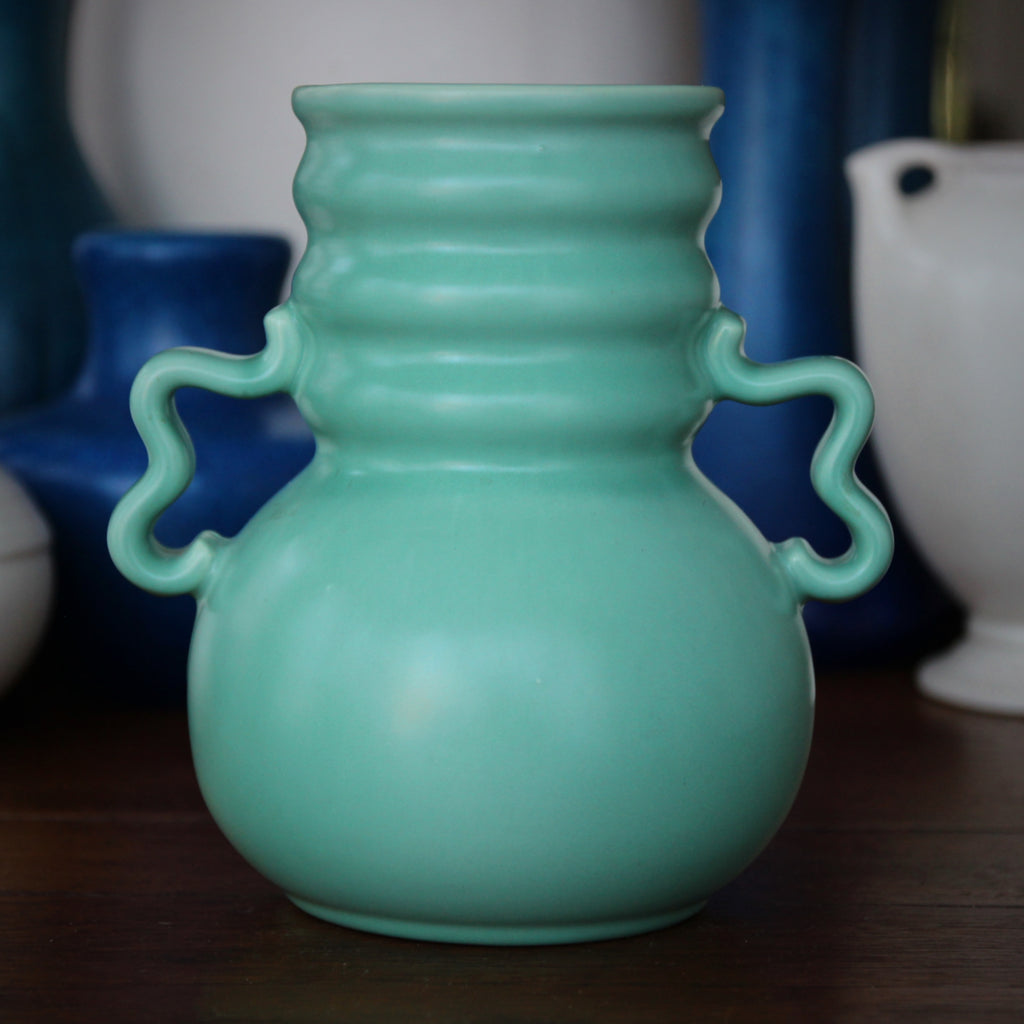
Classical Antiquity has provided so many timeless design ideas, many of which still look perfect nearly 2000 years later. This vase, for example, made in Roseville, Ohio during the Art Deco 1930's, was inspired by a Classical Greek urn. The two handles, certainly a part of the original Classical aesthetic, have been updated with slight Art Nouveau "whiplash" energy—making the vase as fresh and attractive as ever. Of course, the clean satin white glazing also contributes to a crisp, modern aesthetic. Click on the photo above to learn more about it. Though our Greenwich Village store is now permanently closed, LEO Design is still alive and well! Please visit our on-line store where we continue to sell Handsome Gifts (www.LEOdesignNYC.com). We also can be...
Traditionally, red glazes have always been the most "temperamental" for potters to control. Small changes in the glaze mixture, kiln temperature or firing time could alter the final coloration of a piece. For centuries, the Chinese had been creating beautiful "oxblood" ceramics, despite very primitive technology. Their kilns were essentially earthen mounds, fired with wood, with windows and vents which could be opened or closed to control the temperature. Despite these hard-to-control conditions, the Chinese had been been able to produce red glazes from the 1400's (and possibly the 900's). Early oxblood ceramic vessels were used for religious purposes and have sometimes been called "sacrificial ware." In the 1700's, when trade with Europe was well underway, there was...
Though Old Man Winter is well behind us, the Spring, thus far, has been unpredictable indeed. Days in the mid-70's are followed by nights in the 20's (and dustings of snow). My wardrobe—not to mention my spring bulbs—are confused by the inconsistency. But the Earth's axis continues its progressive tilt, bringing us closer to the Sun with every passing day.
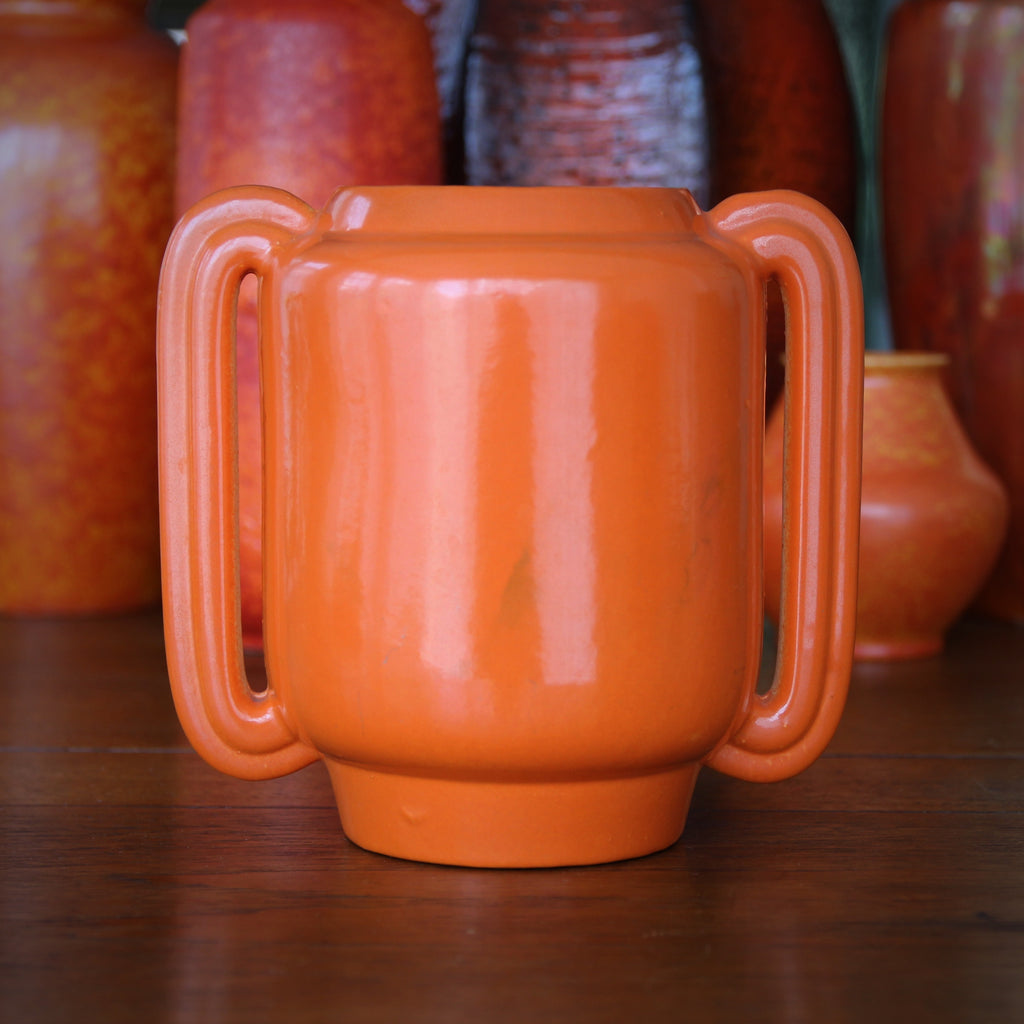
This Art Deco vase, made by Stangl in the 1930's, reminds me of that fiery, life-giving ball in the sky. Though it cannot provide warmth, alas, it will provide a feeling of sunshine—just what we need right now.
Wishing all LEO Design customers a Happy Easter and a Springtime filled with beauty and promise.
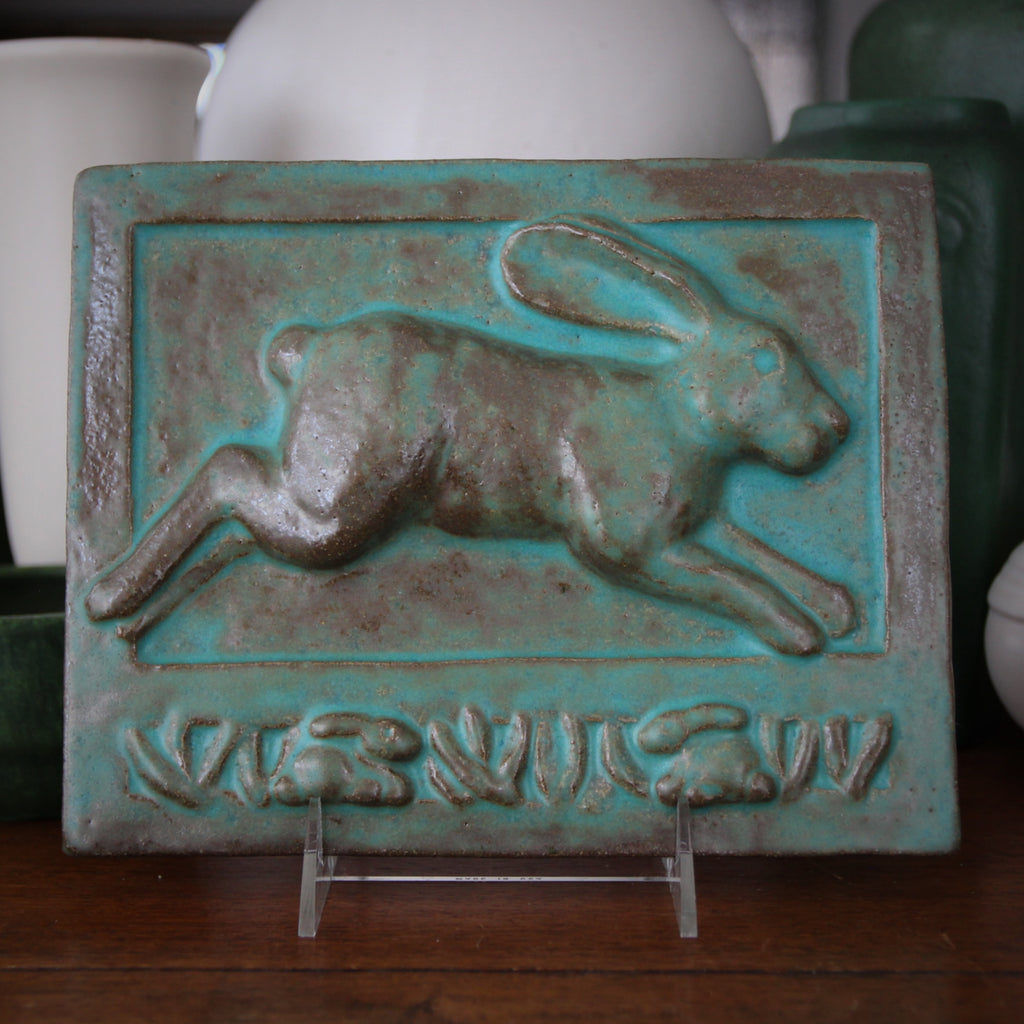
This jolly "Running Rabbit" plaque is sculpted in stoneware, fired and finished with an aqua glaze. It comes with a hanging wire on back.
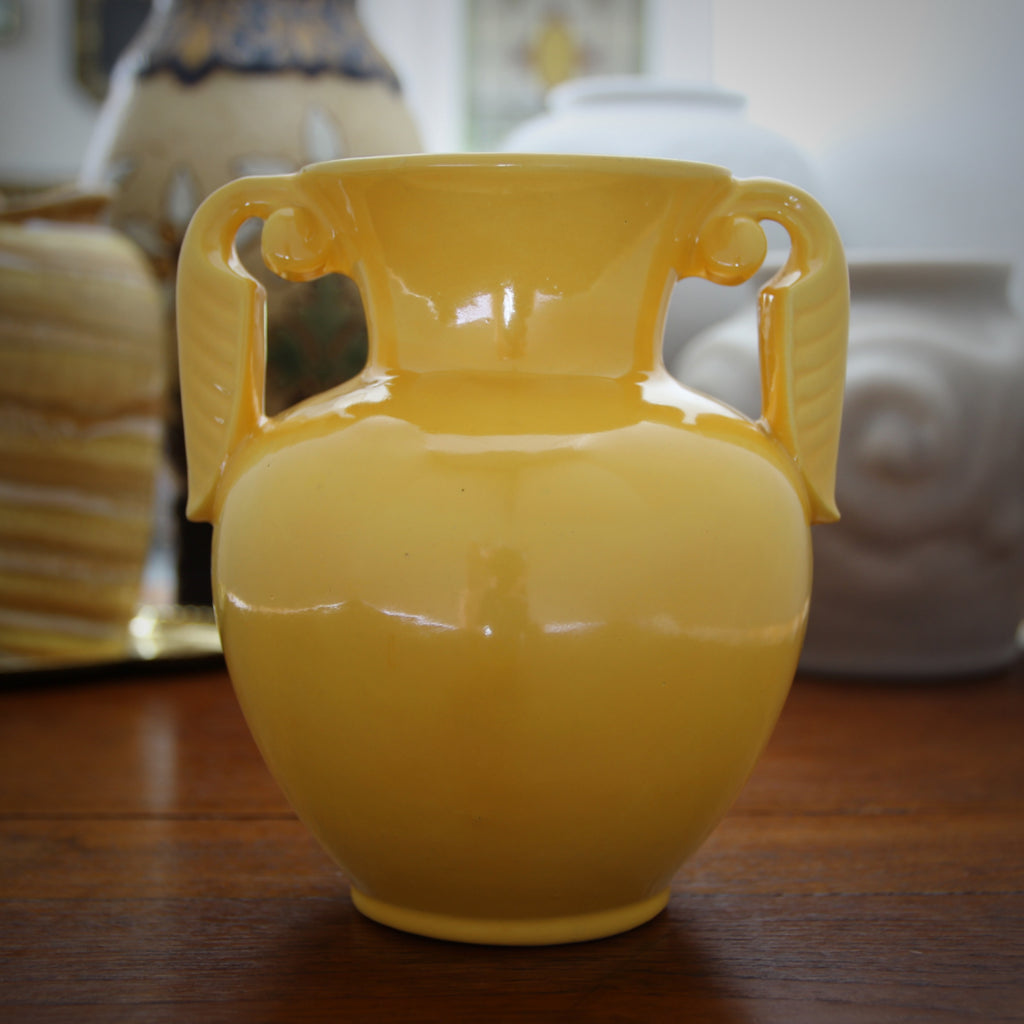
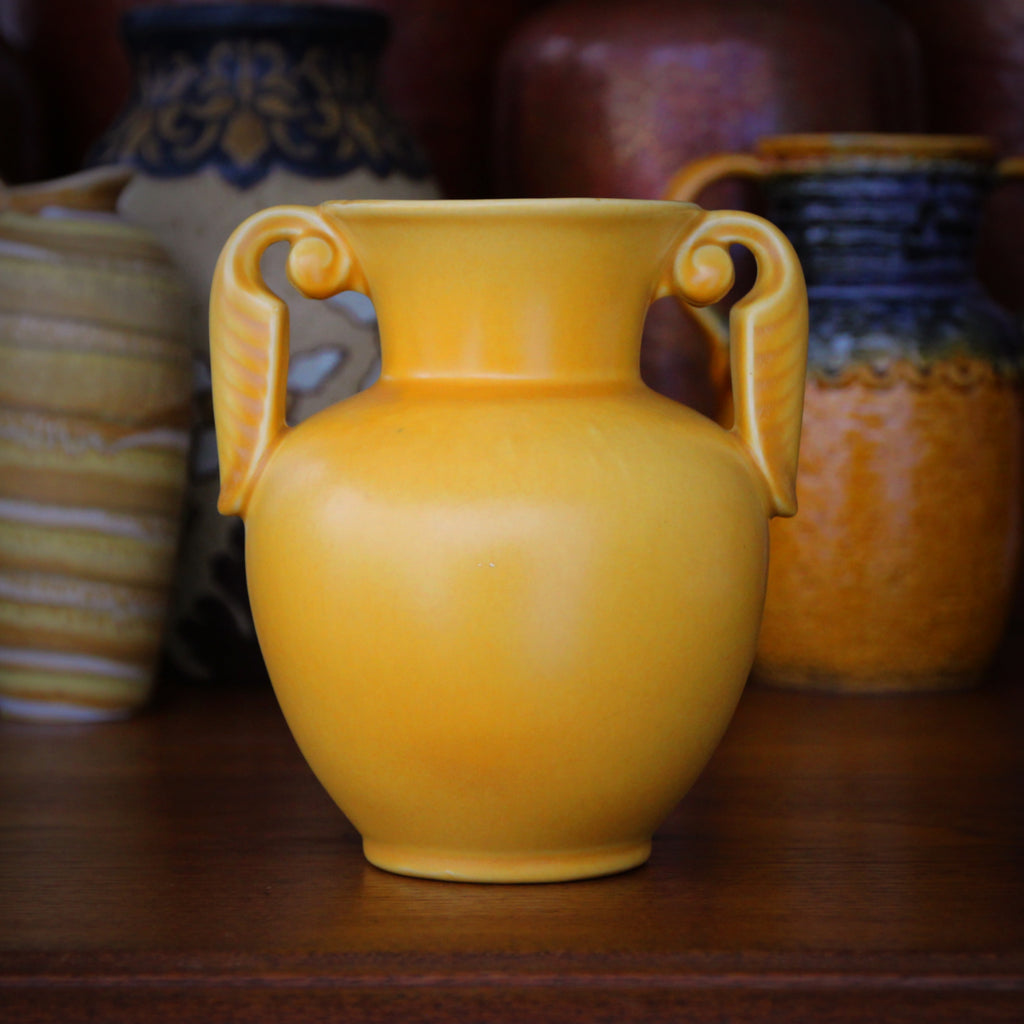
Let's end our procession of Spring Suggestions with this particularly sunny offering: an Art Deco vase glazed in a rich yellow glaze. It was made by Martin Stangl in Trenton, New Jersey in the 1930's. The two "lop eared" handles, atop the urn, seem an Art Deco botanical reference to some earlier, classical time. The glaze is particularly vibrant. If this vase can't bring with it a ray of Spring sunshine, can anything?
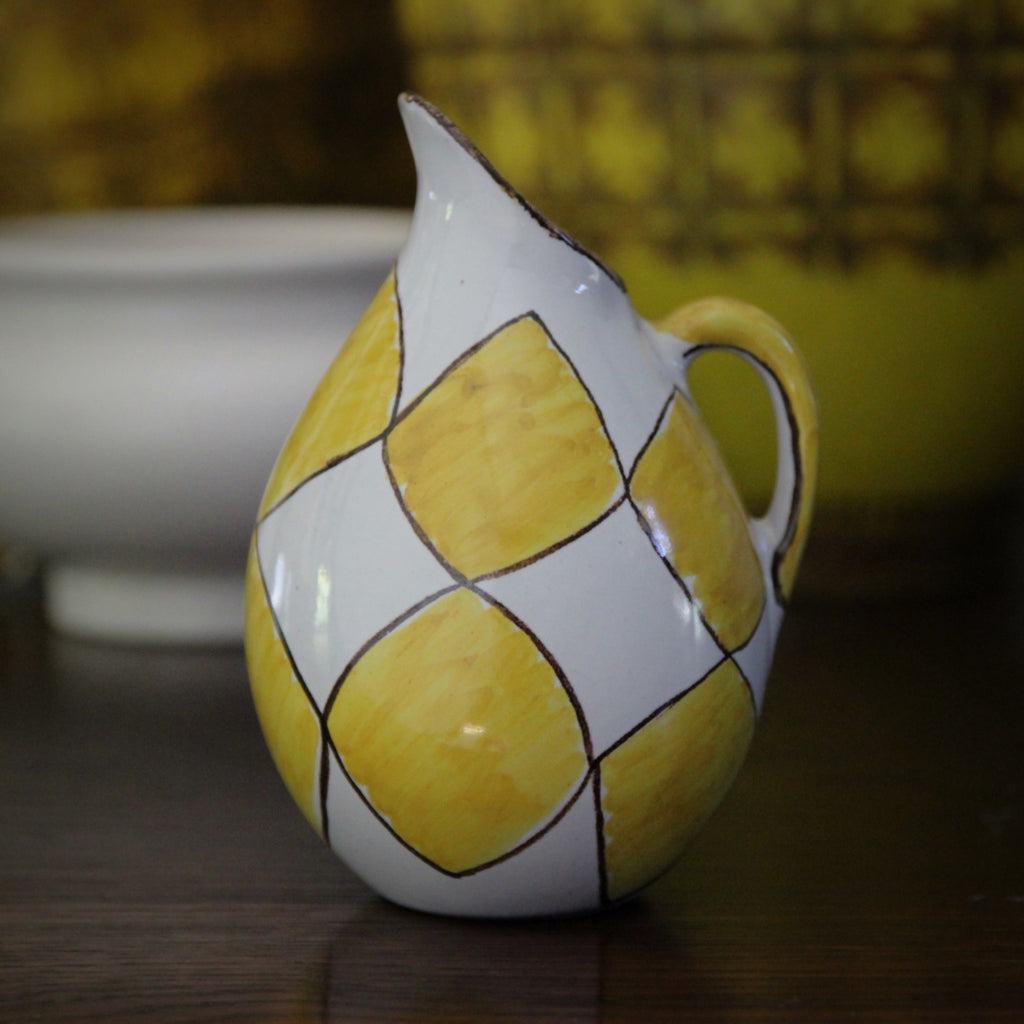
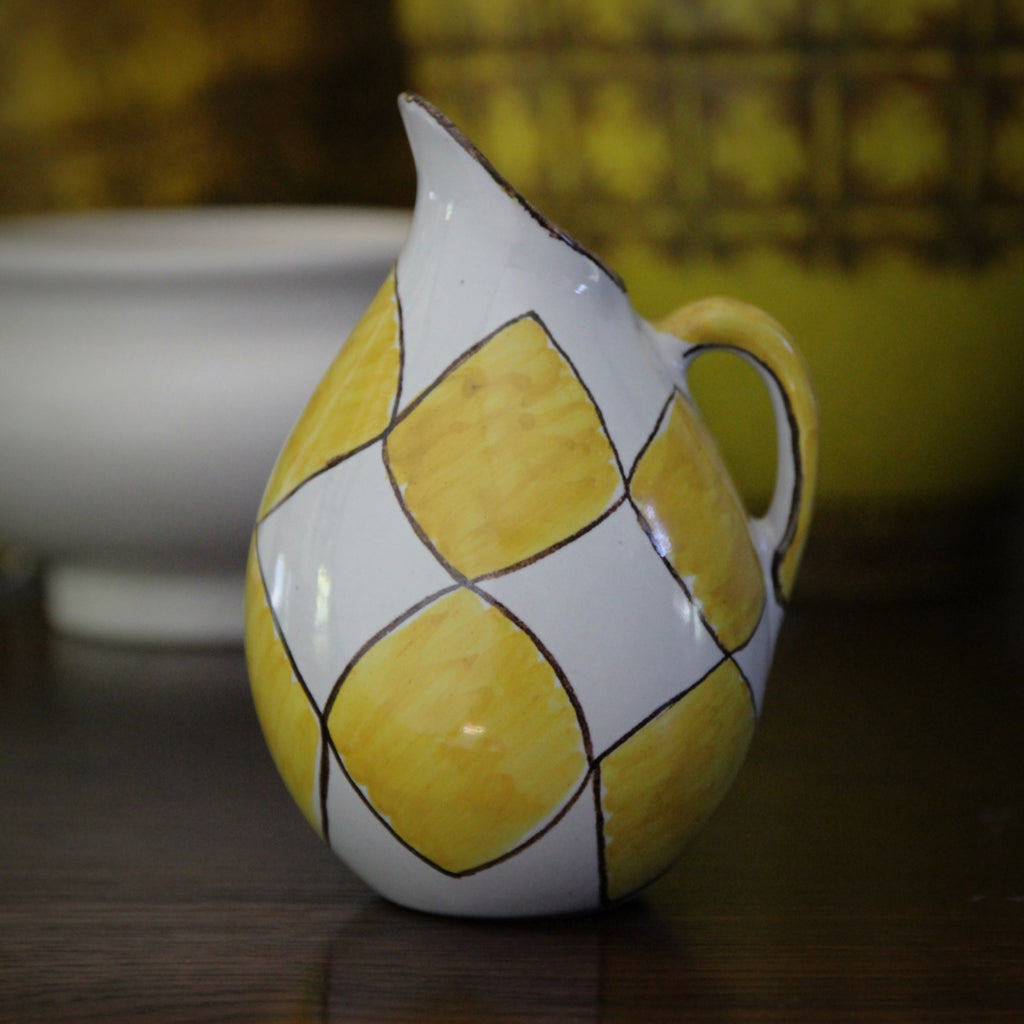
You'd be forgiven if you thought this pitcher is Italian; its hand-painted Harlequin dress looks so much like the costume of Arlechino, one of the character clowns of the Italian Commedia dell'Arte. No, it's German, made by Übelacker in the 1950's. What is clear is the pitcher's strong Springtime sensibility. Wouldn't it be nice to be greeted each morning by this sunny, friendly creamer?
Is there any season more invigorating—more hopeful—than Spring? Early green shoots begin to emerge from their bulbs, long forgotten below. Trees acquire a haze of yellow or light green as buds begin to form along their twigs. And a frisson of delight passes through the body when one realizes "Perhaps I don't have to wear a jacket today..." Despite nighttime temperatures in the 20's, Spring is here—having arrived today, 20 March, at 5:37 am Eastern Time.
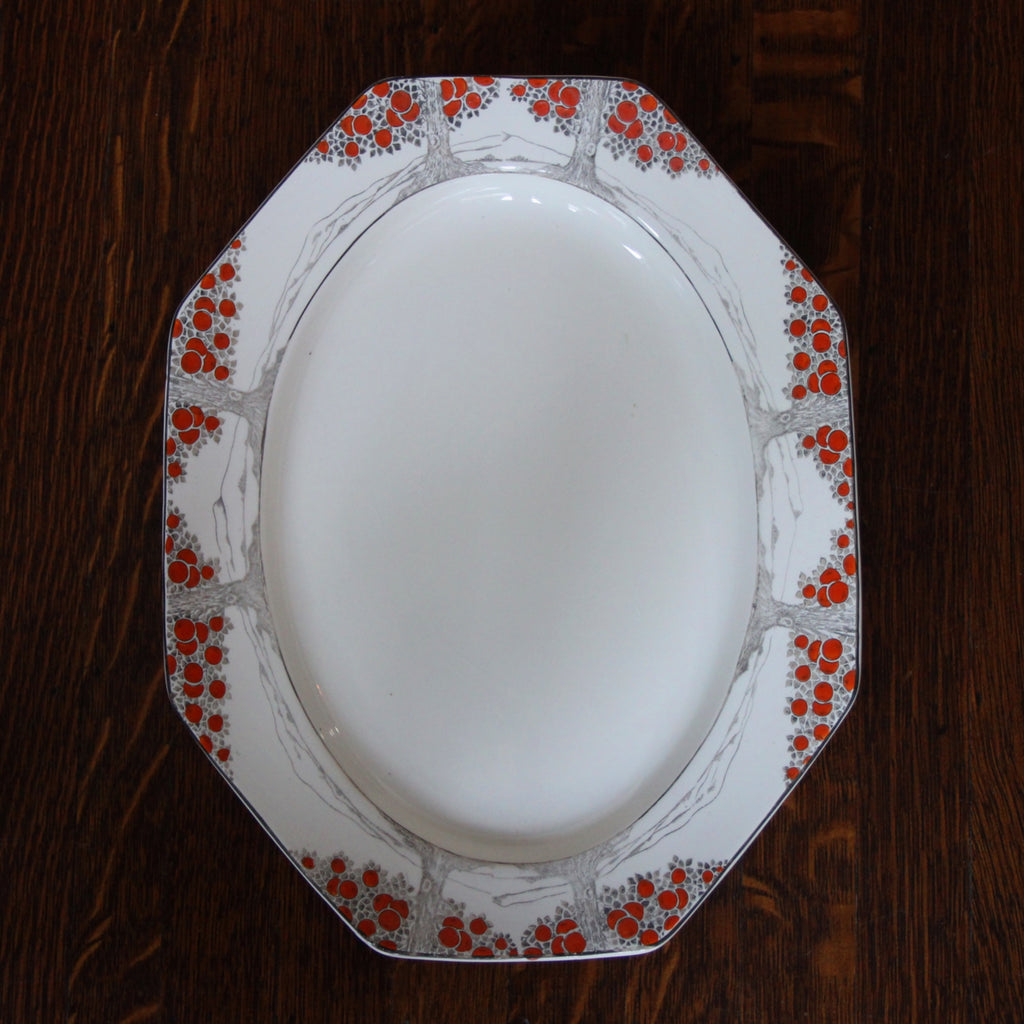
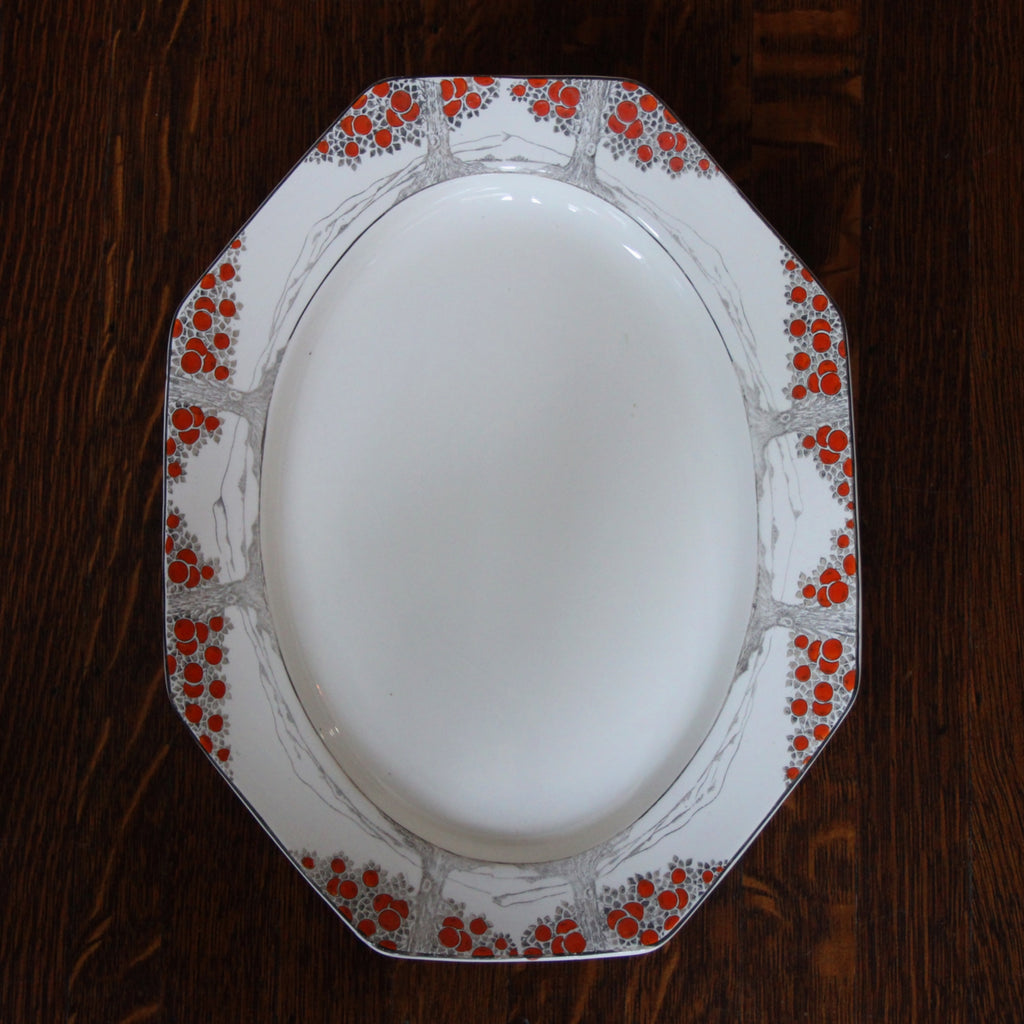
Hand-painted trees, heavy with ripe oranges, surround the octagonal perimeter of this English Art Deco platter by Norman Keates for Crown Ducal. At the time this platter was made, circa 1925, oranges were still a small luxury in middle class England—thus the decorative embellishment might have promoted a touch of wistful aspiration. Oranges were first cultivated in China; Medieval traders and explorers brought them back to the West where they were grown in temperate (Mediterranean) locales. At the time, however, only the richest of aristocrats could afford to purchase the expensive, imported fruit. In the late Nineteenth Century, when Christmas gift-giving became customary, an orange might be left in the toe of a child's Christmas stocking (and, at this point, oranges...
Felines are the "royalty" of the pet world. They sleep up to 16 hours a day and hunt at night (if they can), sometimes bringing their catch home as an offering to their human consort. There are 38 species of cat worldwide, with all but the "house cat" being wild. But do not let your little puss fool you! Within it's small and silky frame beats the heart of a LEO huntress—and she retains all the instincts of her larger, wilder relatives.
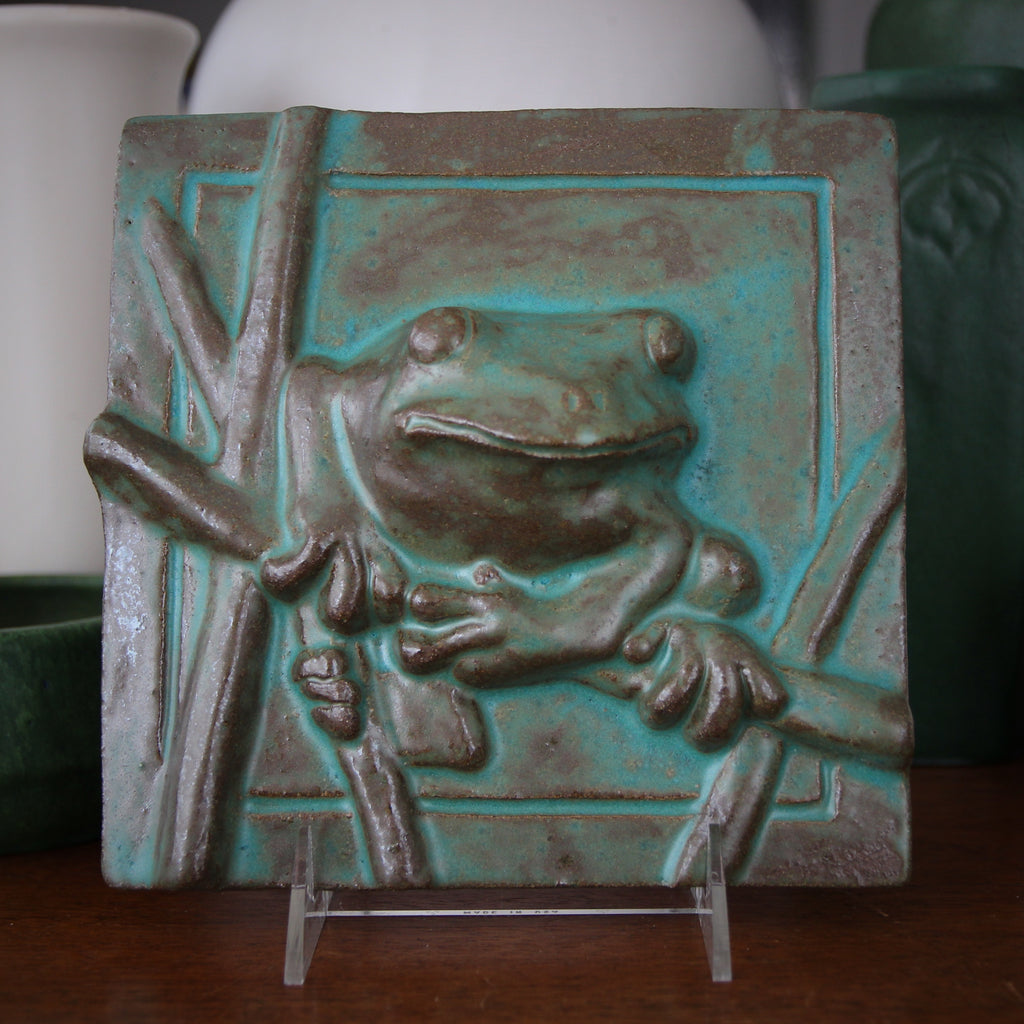
While the squirrels in the frigid Northern Hemisphere are snuggling in their nests, in the Southern Hemisphere, tree frogs are busily scampering in the trees, eating bugs and making the next generation of little climbers. There are approximately 30 varieties of tree frog in the United States—and 600 species in Central and South America. Worldwide, there are approximately 800 species, all related by the climbing structure of their feet. The largest tree frog is about 5 inches long while the smallest comes-in at under one inch long.
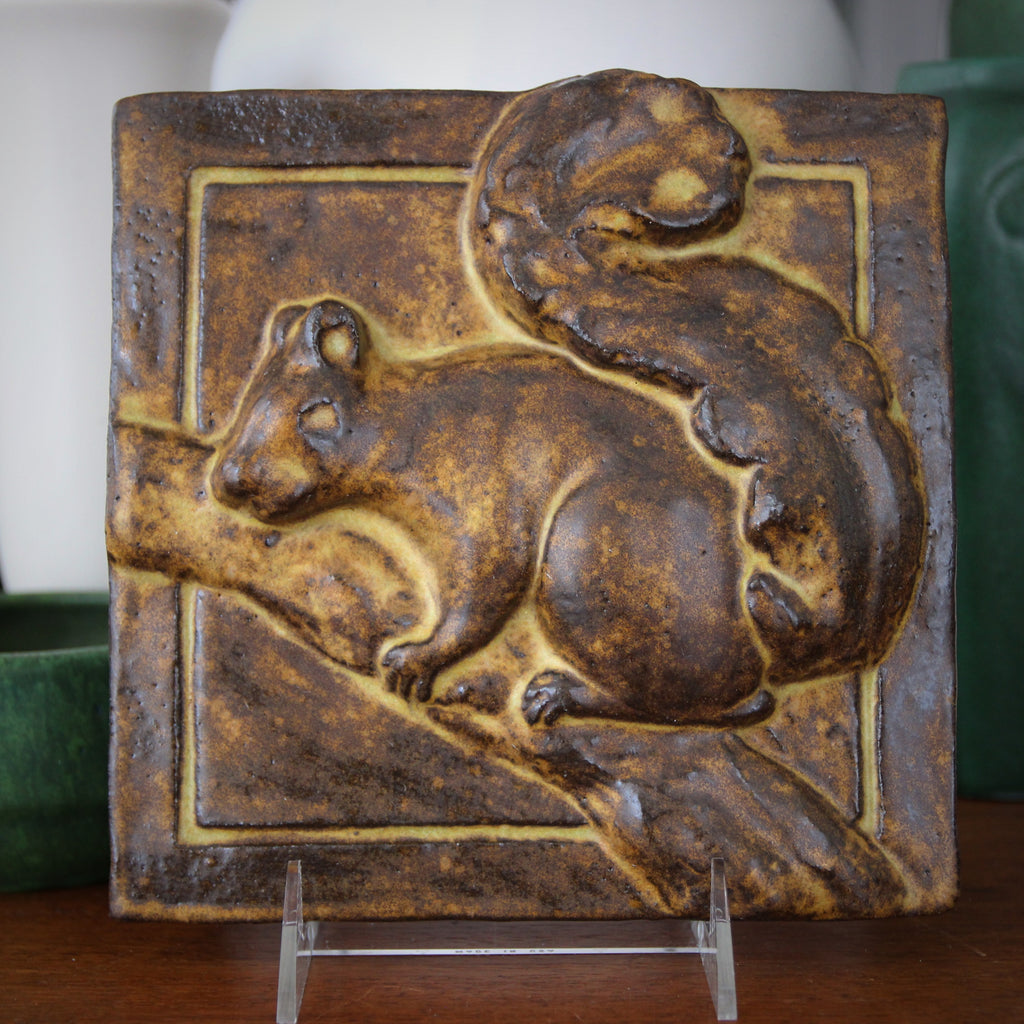
Squirrels do not hibernate. But, when it's bitterly cold, as it is now, they will stay home with their nest companions—entangled in a comfy-warm "communal sleeping ball." This helps them to keep warm during the coldest days of winter. When the temperature rises a bit, they will venture out of the nest, retrieving the food they buried in the earlier seasons. It has been estimated that a squirrel will hide three years worth of food during the summer and fall seasons—ensuring that even those squirrels with terrible memory skills will be able to survive the winter well-fed.
As I've become a more experienced collector, I feel more confident venturing-beyond my previously trod territory. When I find something that I like, yet cannot identify—or I suspect it might even be recently-made—I will give the piece an extra turn or two in-the-hand, asking myself, "Why not?". If the quality is high (and handmade), the design is tasteful, and the piece is priced well, I may add it to the collection despite my uncertainty as to its age or maker. The piece shown here was discovered at an estate sale last week. I was hunting for furniture and came across this in the meantime. It wasn't a lot of money—and something told me that it was good (if not "important"). To learn more...
Here's a little more sun—in this case, sun flowers. I must admit, this vase is a bit of a mystery to me. In my thirty years in the antiques trade, I have only seen two of them (both of which I acquired). I do not know who made it, in what country, or when. The piece exhibits a European sensibility—which may help explain why I have seen it so rarely in America. On the other hand, I bought both of my pieces in the States, an inconclusive suggestion that it might have been made here. My educated guess is that it was made in Europe in the 1910's or 1920's—or in the United States in the 1920's or 1930's. I bought my first...
I long for the sunrise, a new dawn of civility, propriety and a presidential behavior which sets the right example for our citizens and the rest of the world. I despise disruption, criminality and the financial exploitation of one's elected position. I fear that fanatical discontents have found their emperor—who's been described as "their Robert E. Lee"—who is all too willing to play the tyrant (and keep the cashflow a-flowin'). How has America gotten to this point? Or, more pointedly, how has this ideology simmered beneath society's surface without wider acknowledgment, analysis and counter-action? Alas, we are far, as a country, from "pulling together" in a snuggly, affectionate round of Kumbaya. Some of the outgoing president's supporters have threatened a...
In a sometimes fractured world, the New Year is something we all share. Every year I marvel at how the new year sweeps around the globe—completing its circuit in one smooth 24 hour pass. We see fireworks in New Zealand, followed by celebrations in Australia, Eastern Russia, Japan, Hong Kong, South Africa, Eastern Europe, Western Europe, England & Ireland, Brazil, the United States, and, finally, American Samoa (followed by a handful of islands an hour later). The desire to mark the New Year seems universal (or, at least, global). And, for one 24 hour day, we all share the same focus. In France, one says Bonne Année! This French Art Nouveau vase once welcomed a new period in the decorative arts. Perhaps it can signify...
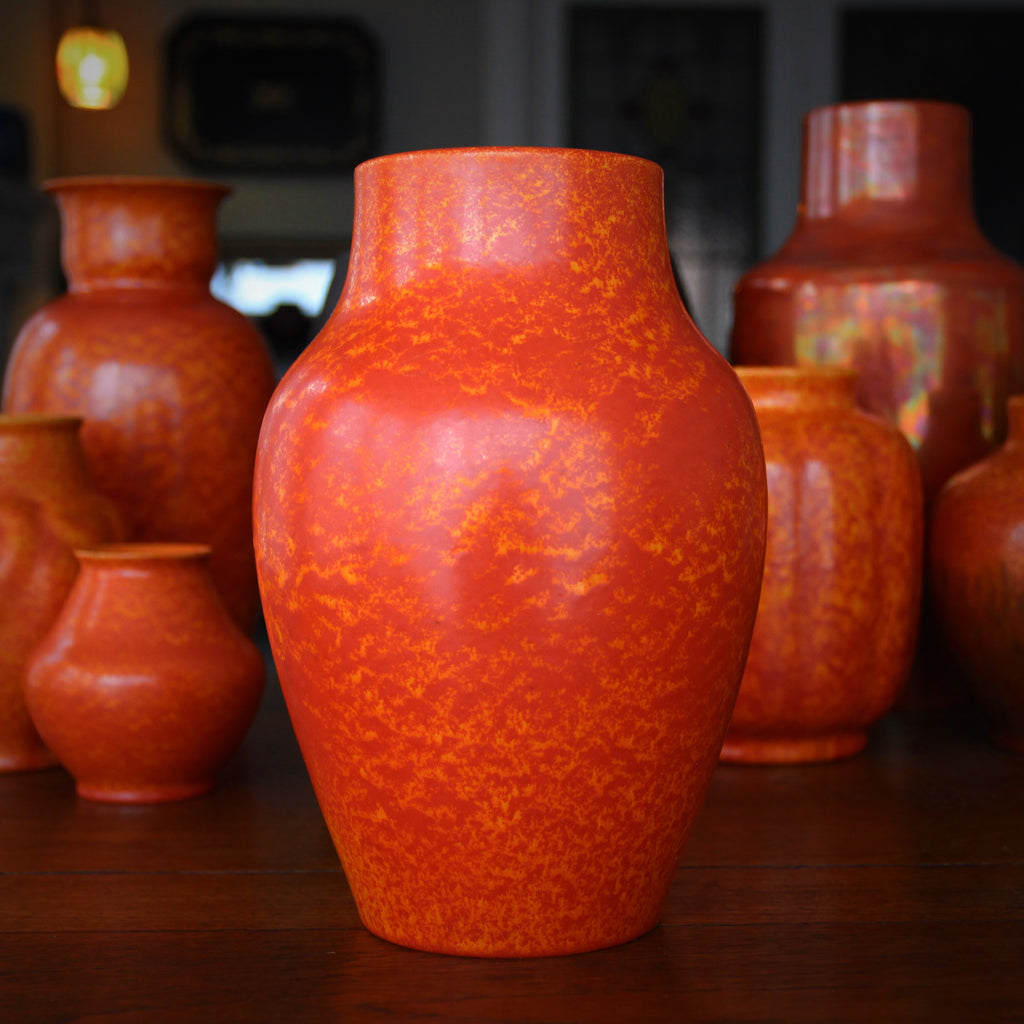
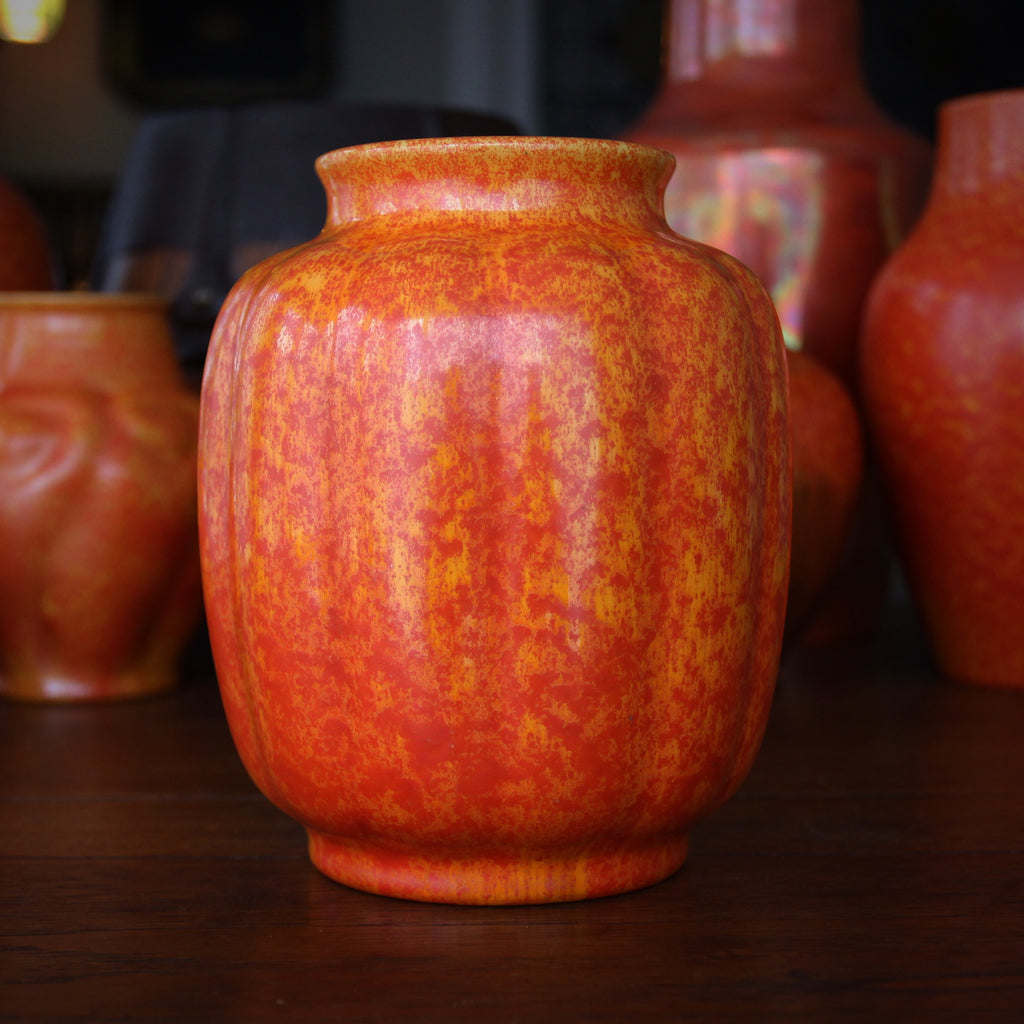
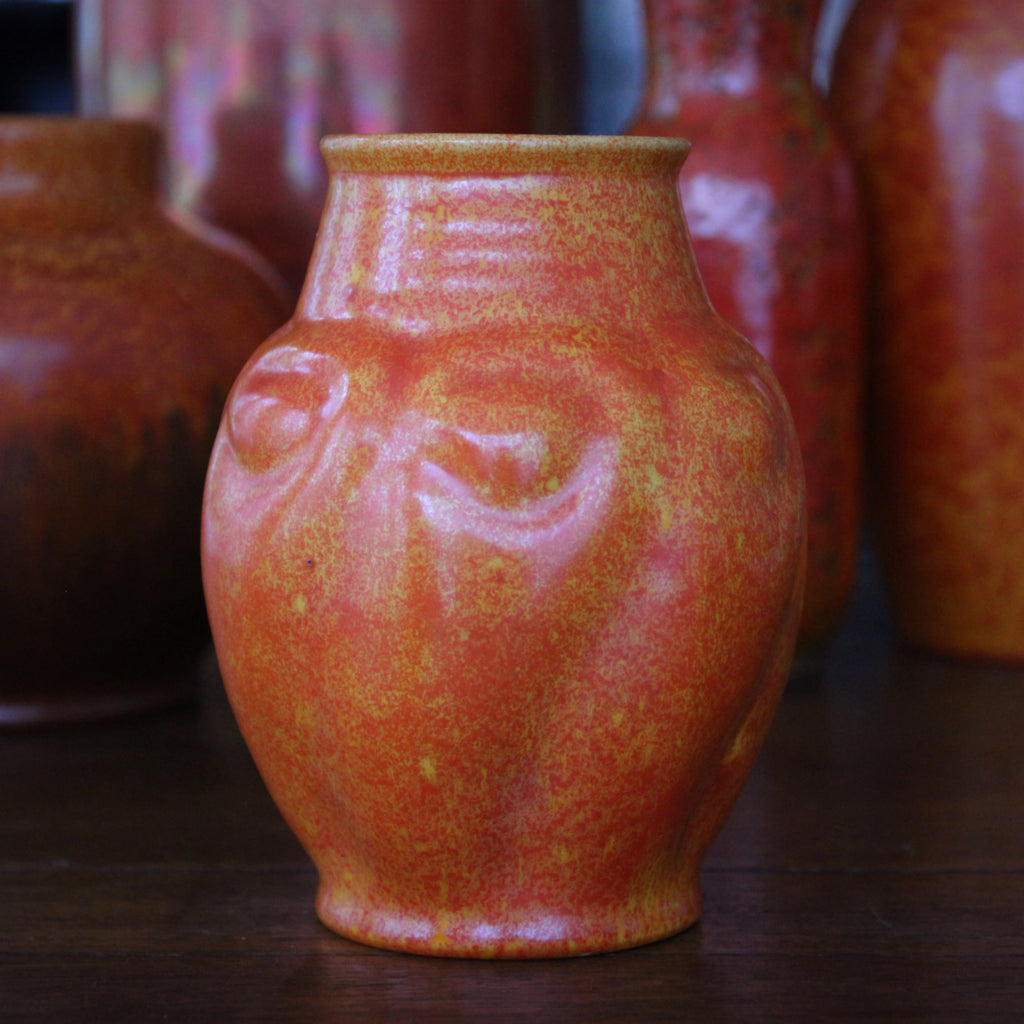
2021 is here . . . can you feel things getting better? The days are getting longer. A Covid vaccine is ready for injection (if only it would be distributed). And new leadership is making plans to move our country in a new and better direction. It's as though the sun has emerged—after four years of darkness and bitter cold. This vase, made in England in the 1920's or 1930's, boasts a "molten" glaze of oranges and yellows—seemingly boiling on the vertically-ribbed walls of this gourd-form vase. It reminds me of the surface of the Sun, where swirls of molten magma radiate their energy to the Earth below. While the Sun holds the power to sustain life or kill it,...
Who's ready for a fresh start? Wishing you a clean sweep—a year which exceeds your every expectation—and a year of health, contentment and rest.
Happy New Year!
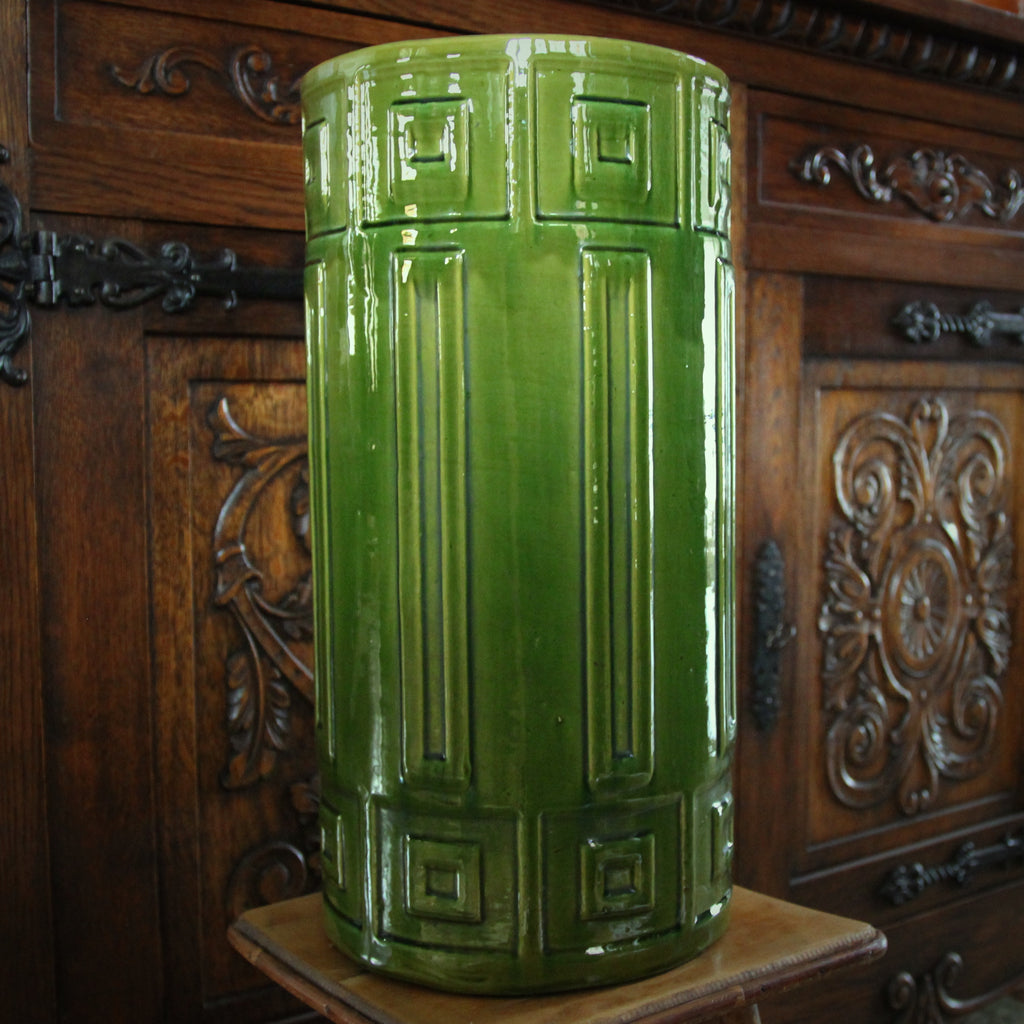
A most handsome holding-place for your umbrella or walking stick! Bold graphic bas relief will bring period architectural detail to your entry hall. It's made of ceramic "yellow ware" finished with a high-fired pea green "majolica" glazing. Made in the 1920's, possibly by Roseville. It will greet your guests with confident style. Click on the photo above to learn more about it.
Jealousy supposedly leaves its victim "green with envy." A clever image and turn-of-phrase, yes, but this green vase has no reason to be envious. Two glazes—a spring green and an aqueous blue—are dappled over the sculpted form of this English Art Deco vase, made in the 1930's. Incised "fiddleheads" sway and curl along the shoulders of the piece, lending just a touch of Art Nouveau embellishment. To my eye, the wonderful and complex glazing captures that ephemeral moment when the seasons straddle both spring and summer. The tender yellow is gone, but the hearty green has not yet taken its place. Click on the photo above to learn more about this interesting and handsome English vase. Though our Greenwich Village...
Abingdon Sanitary Manufacturing Company, in Knoxville, Illinois, was founded in 1908 and remains in business to this day. Their initial business was making plumbing fixtures—sinks, toilets, urinals, water fountains—and their exceptional quality made them the gold standard for the industry. They used a dense, heavy white clay (some of it imported from England) which created very durable and watertight fixtures with beautifully smooth surfaces. In 1928, they became the first manufacturer to produce colored fixtures. In 1933, they were chosen to produce all the plumbing fixtures for the World's Fair in Chicago.
One more day! Hanukkah begins tomorrow night!
Blue, silver and white, the classic colors of Hanukkah. I have always loved this color combination. It's clean. It's wintery. And it's a sophisticated alternative to the classic red and green which is associated with Christmas. For me, it's become a "holiday palette cleanser," so to speak. So from where (and when) do the Hanukkah colors derive?
Evocative of the flaming ball of fire in the summer's sky, the swirling "molten" orange and yellow glazes on this English Art Deco vase seemingly throb with heat. Sculpted "fiddleheads" (or are they solar flares?) encircle the shoulders of the vase, adding additional movement to the piece. It was made by Pilkington Royal Lancastrian in the Thirties—though it does seem to reflect both the Arts & Crafts and the Art Deco aesthetics. Click on the photo above to learn more about it.
Although winter is still three weeks away, one wouldn't know that by looking outside my door! I was greeted this morning with four inches of snow and a 28º chill. Neither the cold nor the snow stopped all day long. Already I'm asking myself, "How am I going to make it through the winter (once it comes)?" Today is the First of December—a month whose birthstone is the turquoise. Turquoise has been prized for thousands of years—first by the Egyptians, then the Chinese and the Persians, later the Aztecs, and eventually the Native Americans of the Southwest United States. The name derives from the French word for "Turks"—for it was through Turkey that the first turquoise came to Europe from...
I have always liked matte white pottery and keep a personal collection myself—on the wide windowsill over my kitchen sink. The simplicity of color contributes a fresh and clean look without appearing industrial or sterile. And the form of each piece can be appreciated clearly, without the optical effects (or distraction) which darker colors sometimes contribute. When assembling a white ceramics grouping, some people are sticklers for maintaining the purity of one particular shade of white—be it cool, warm, bluish, pinkish, or yellowish. I appreciate this discipline, but am a little more relaxed about my personal grouping. I find that, once you have enough pieces, a "palette" of whites can look wonderful together (within a controlled range). For example, if you...
Today is Black Friday, the so-called "Biggest Shopping Day of the Holiday Season" (more about this later). My first "professional" Black Friday was in 1985 as a 22 year old, brand new department manager at G. Fox Department Store in Hartford, Connecticut. The tables on my "pad" (retail speak for the carpeted area that defines the boundaries of a department) were piled-high with sweaters and poly-knit turtlenecks—all marked down from $28 to "the magic price point" of $19.99. It was a whirlwind season for this recent college graduate. I spent my time just getting through the day: helping old ladies find their sizes, filling-in new merchandise, keeping the cash registers humming, and marking-down new items as panicked buyers (in the...
Wishing you a bountiful harvest and hoping you have much to be thankful for.
Despite the challenges of "these times," I am grateful for numerous blessings—large and small—which grace my life: my home, my family, friends and customers.
Thank you for being a part of my many blessings!
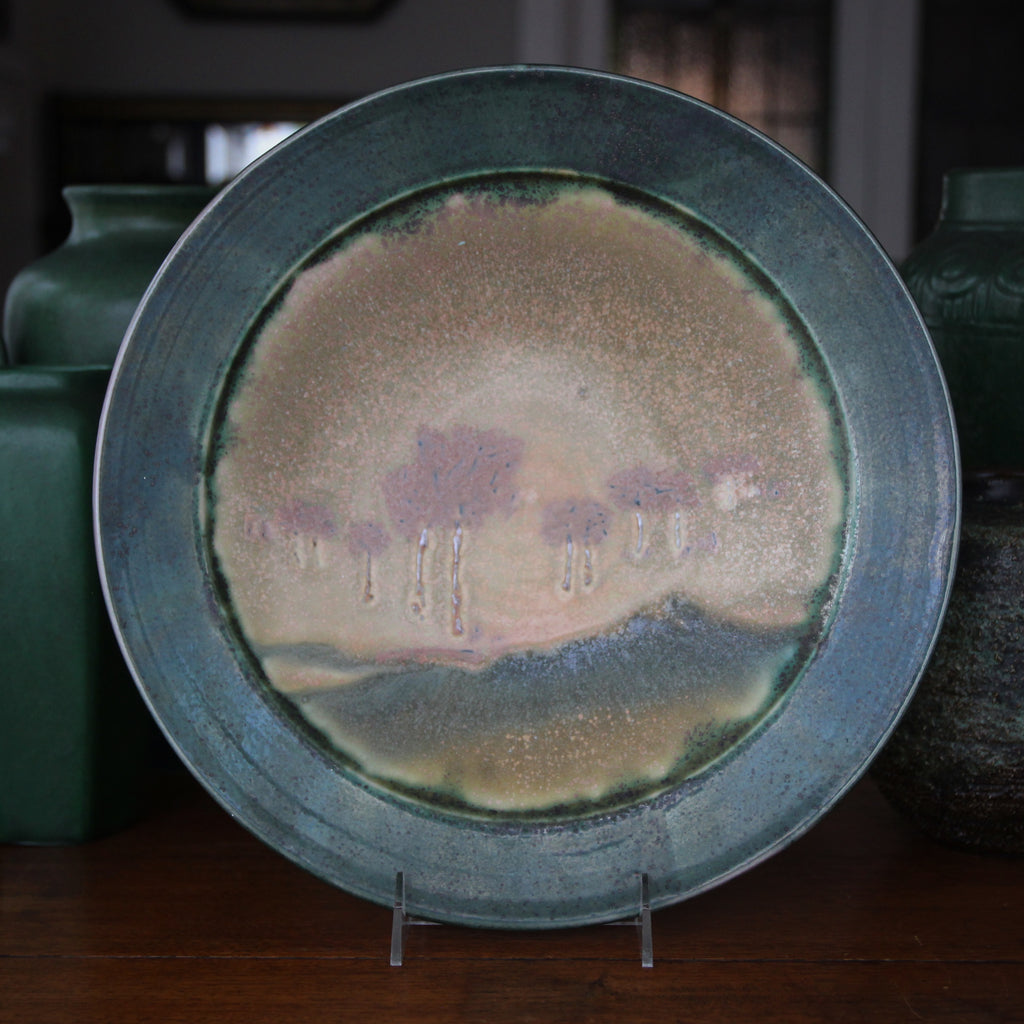
A stand of trees punctuates the misty, hand-painted landscape on this Arts & Crafts style stoneware plate—framed with a crystalline, dark green glazed border. It is signed indistinctly and appears to be the work of a talented artist in the somewhat recent past (the last 40 years?). While it's probably not an antique, it has wonderful style and great glazing. Until I ship it, I'll be keeping it on my Stickley coffee table—surrounded by green Arts & Crafts "siblings," all about 100 years older.
This little ceramic pup is begging, "Pretty Please!" He knows that there will be a presidential inauguration just two months from today! Frozen in anticipation, he's waiting to bark with glee when his candidate sails-through. But expect a howl if his vote is overturned.
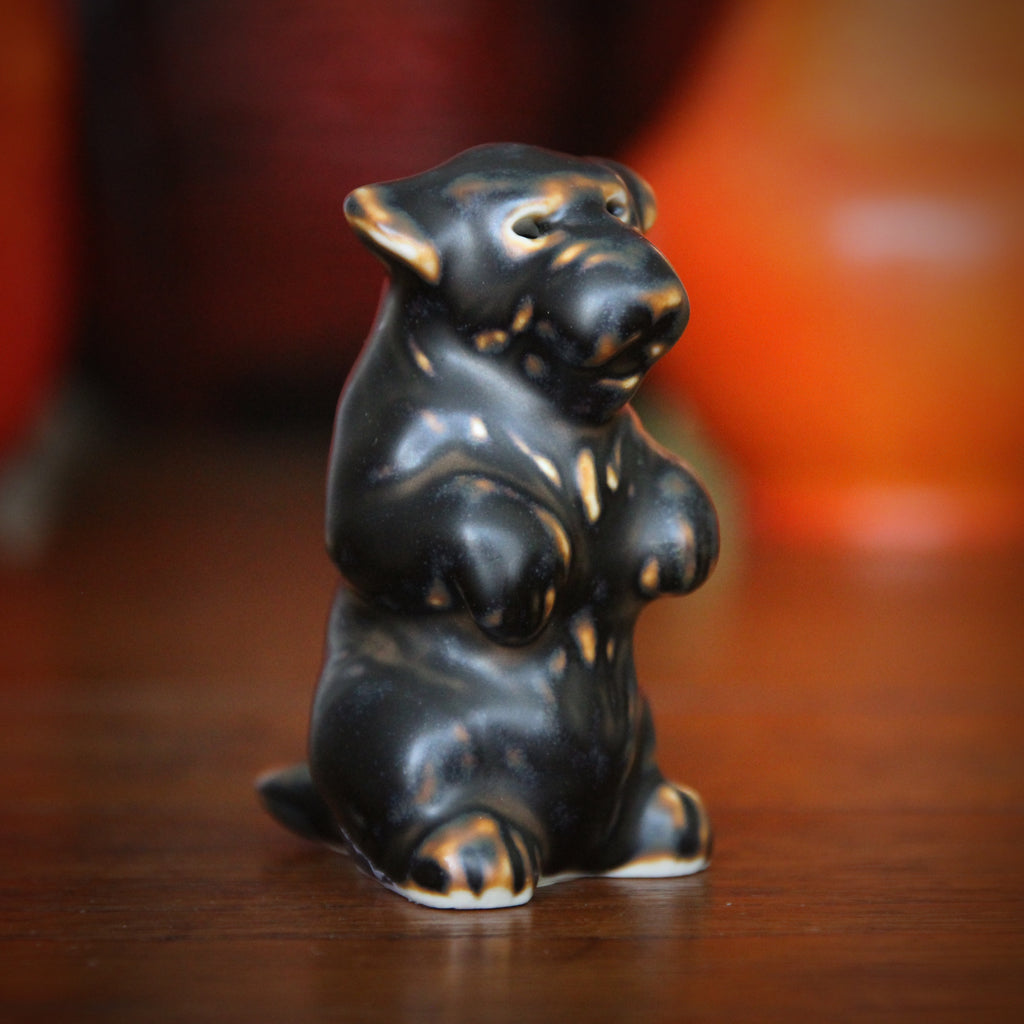
This little terrier was modeled by Danish sculptor Knud Kyhn for Royal Copenhagen. This pup, bearing a date mark of 1980, was designed years earlier. Click on the photo above to learn more about it.
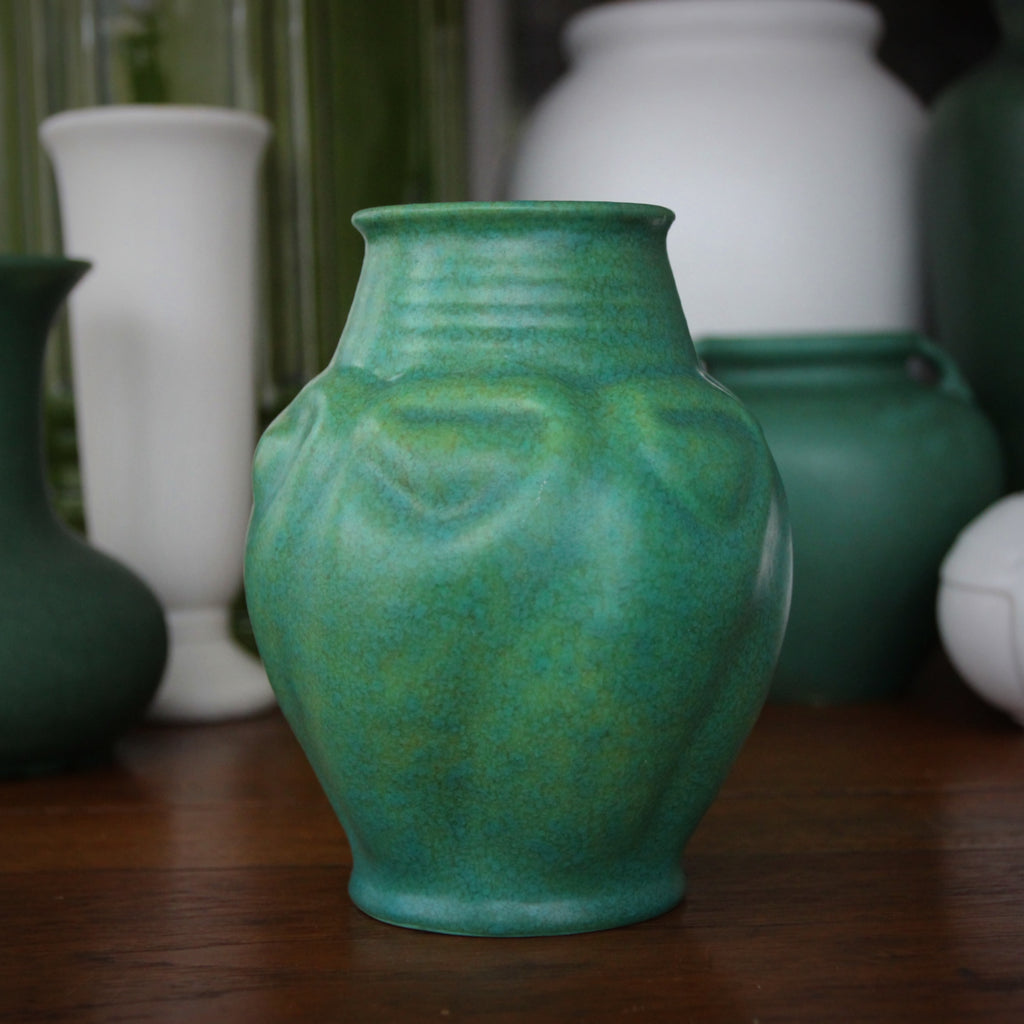
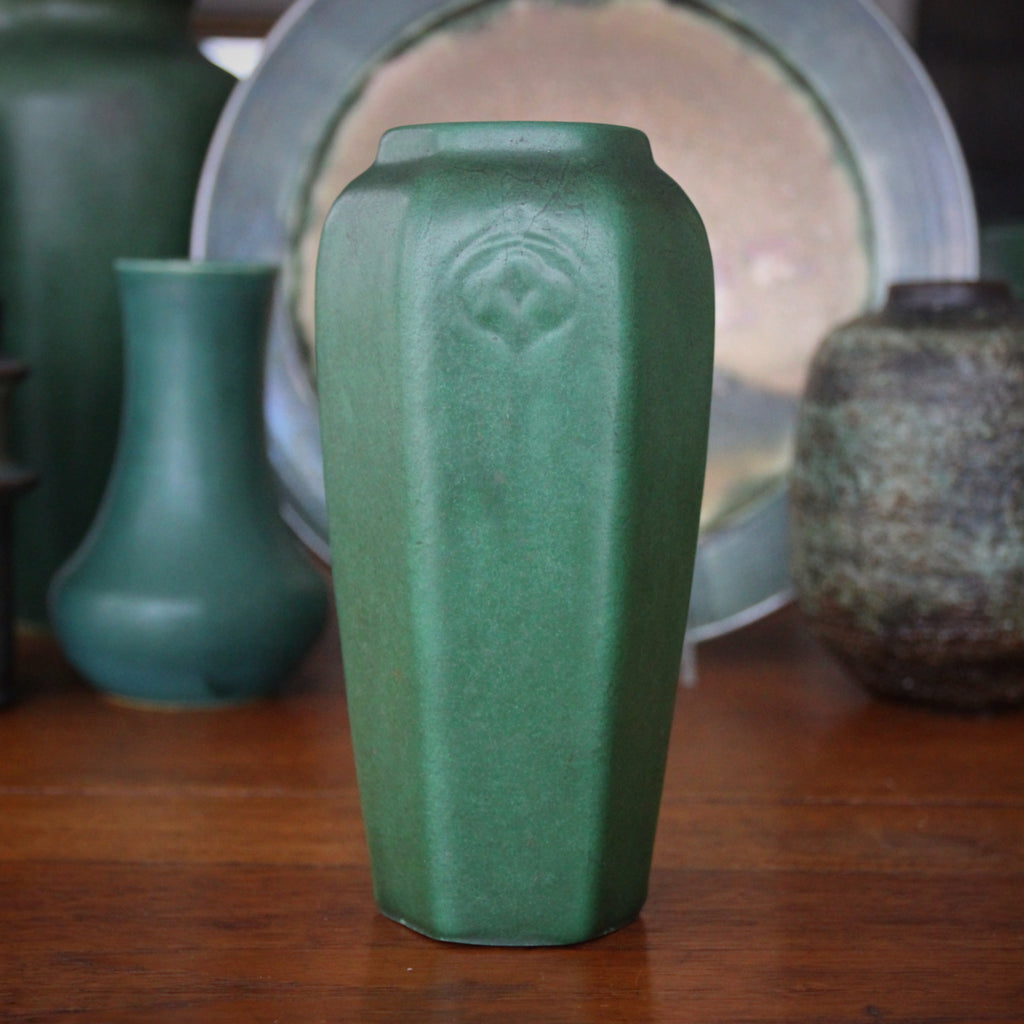
After months of campaigning (65 months, by my count), what could be more refreshing—more palette cleansing—than a nice fresh, green piece of Arts & Crafts pottery? And here it is. Made by Weller in the early Twentieth Century, it boasts that classic American Arts & Crafts matte green glaze—natural, calming, restorative. What could be more delightful right now? Think of it as a nice crisp salad after two weeks of buffets and dessert tables. Click on the photo above to learn more about it.
Fire burn and cauldron bubble!
Hallowe’en Greetings, One and All!
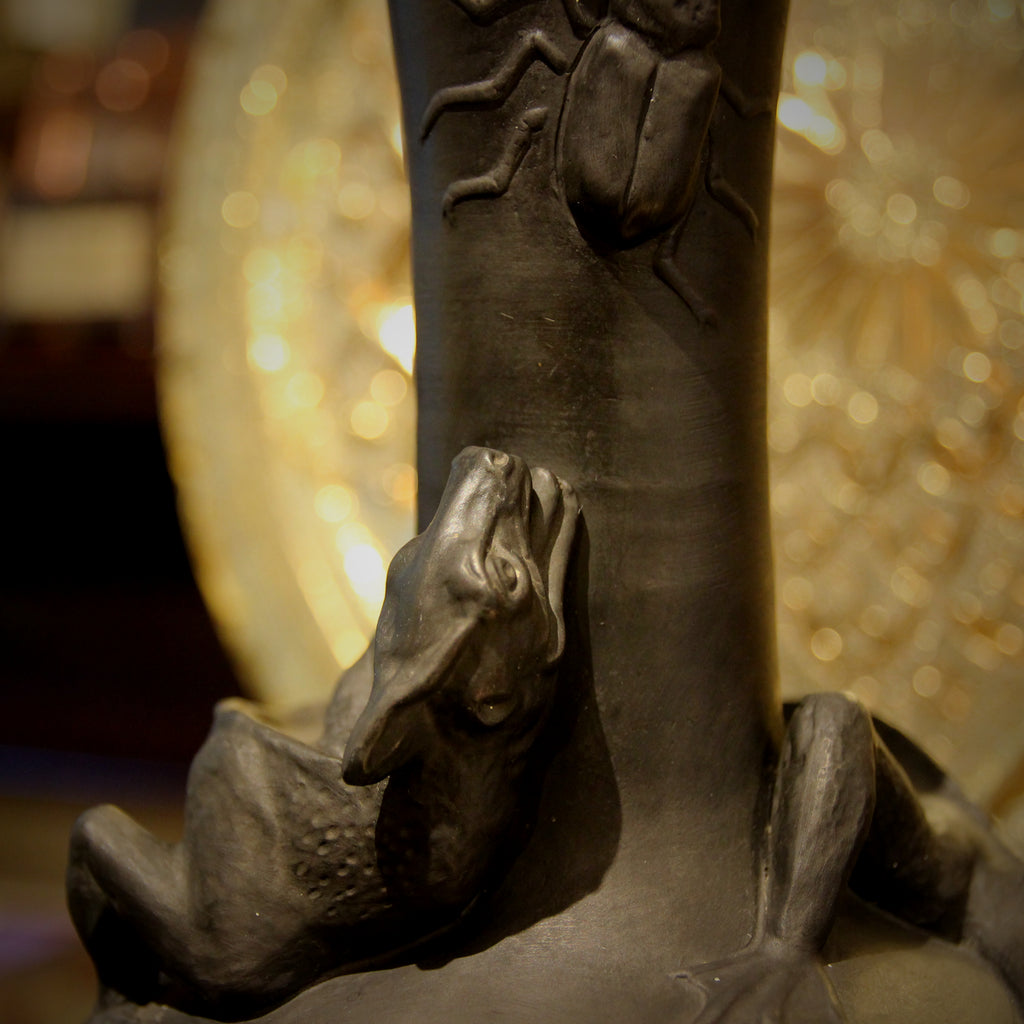
Above, a winged dragon tracks his crunchy prey on this Danish Art Nouveau vase by Ipsen. Please click on the photo above to learn more about this piece.
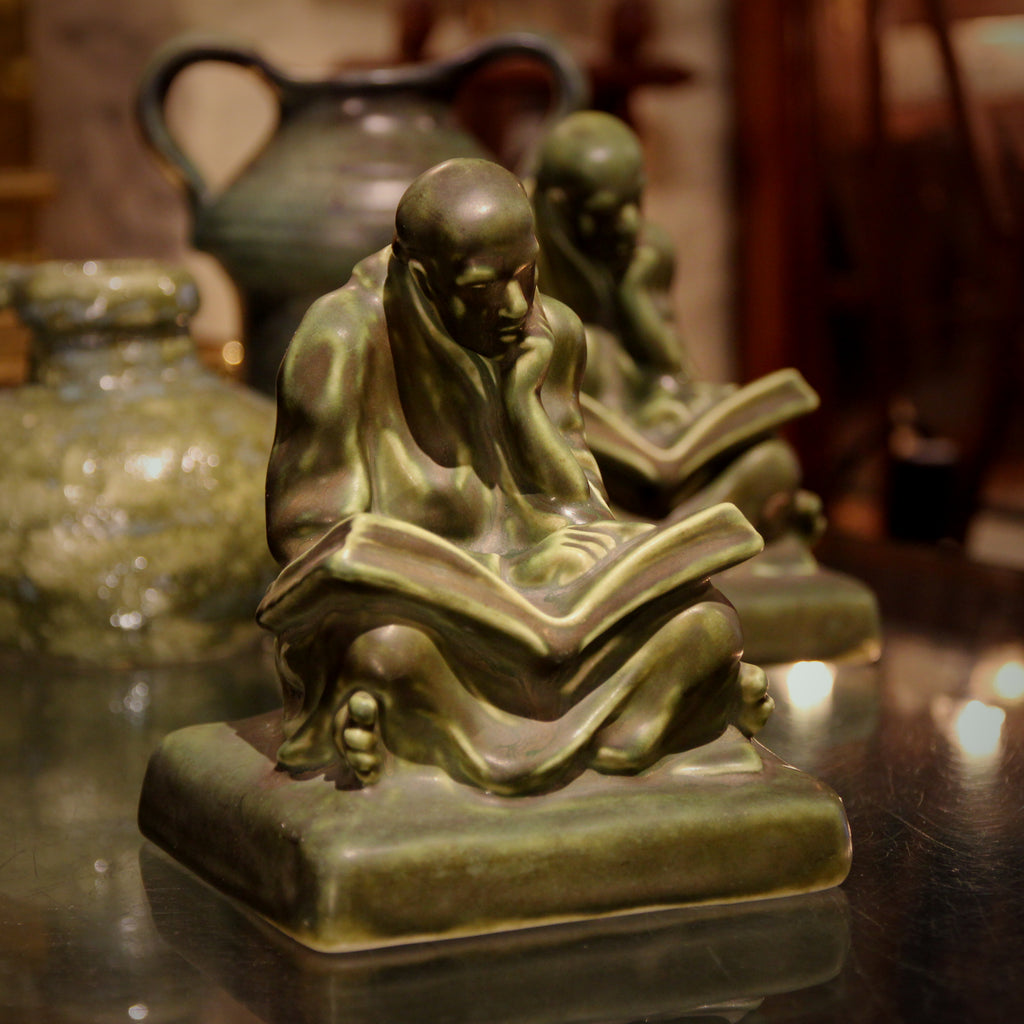
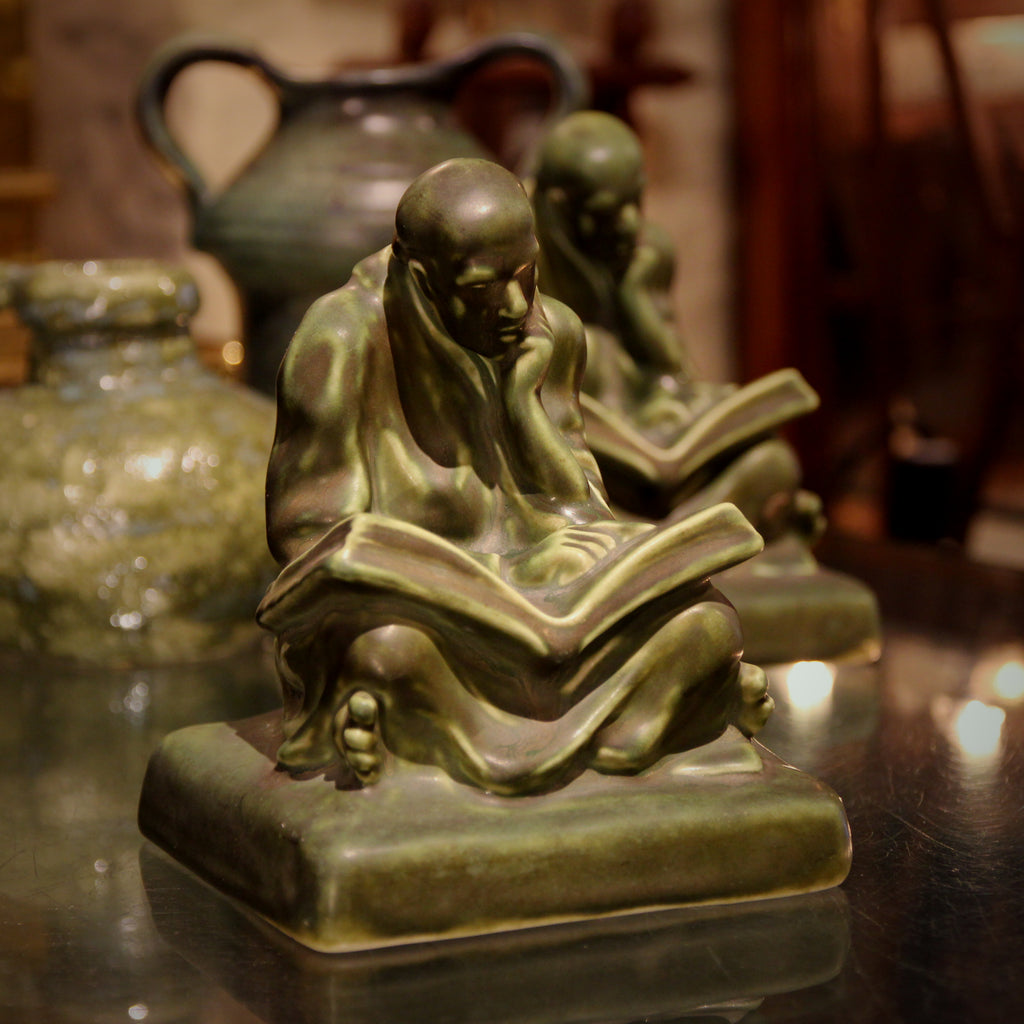
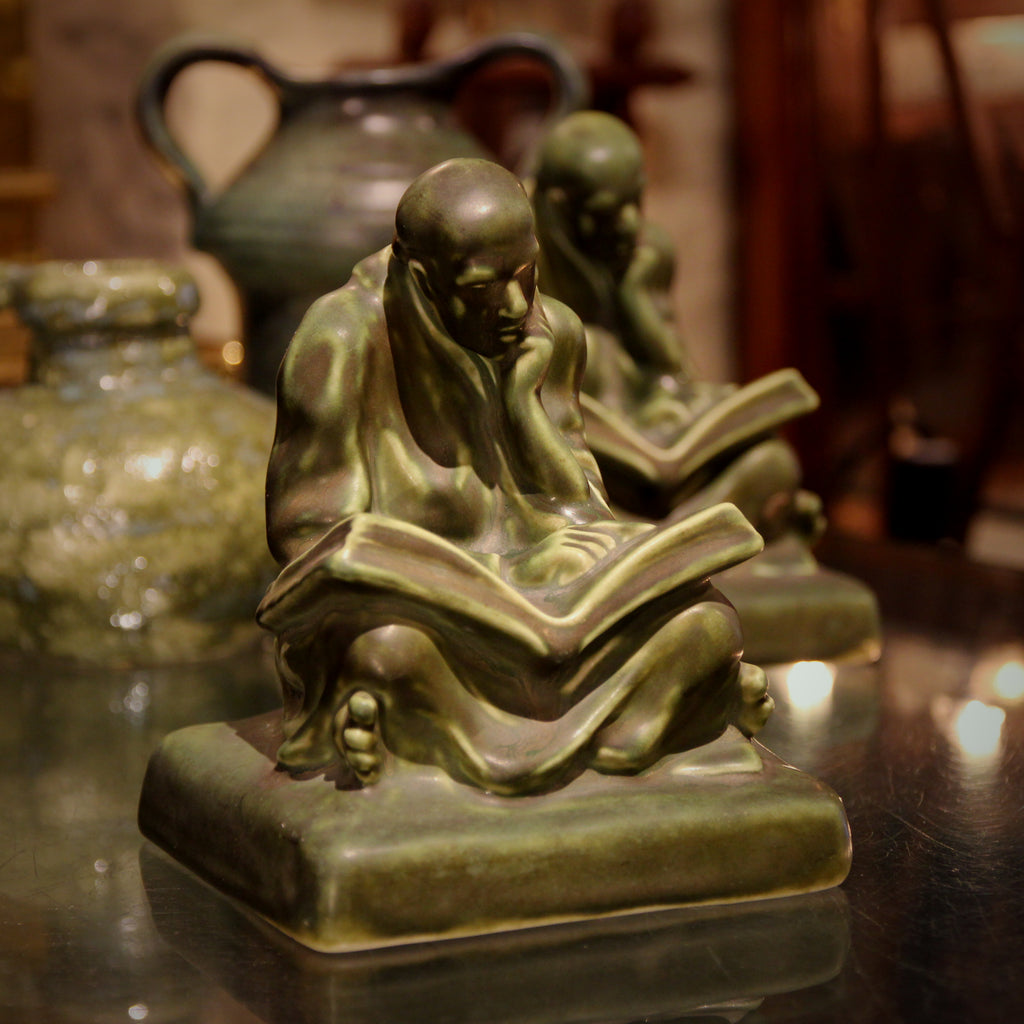
Knowledge is power. And those who have the knowledge are most likely to become powerful. For millennia, the best transmission of knowledge was through books. Oral storytelling, on the other hand, has always been subject to the accurate recall of the listeners and the agendas of a line of subsequent storytellers. The written word, on the other hand, allowed knowledge to be recorded in a way that was less likely to be changed over time (as long as the original manuscripts survived, and raises a different issue). The problem was, very few people were literate. Reading and writing were the domain of the highly educated—poets, clerics and scribes. For this reason, the display of books (and images of people reading)...
Welcome, October, and your birthstone the Tourmaline. Today we know October as the tenth month of the "modern" Julian and Gregorian calendars. But it wasn't always this way. In the period of the Roman Empire (which straddled the lifetime of Christ), October was the eighth month—made apparent by October's root word, "Octo" (which means "Eight"). Interestingly, in France, Octobre is sometimes abbreviated as "8bre." October's birthstone, the Tourmaline, is a semi-precious gemstone, a "crystalline boron silicate mineral." It can be infused with traces of a wide variety of different metallic elements—each of which results in a different color possibility. Thus, tourmaline can be mined in many different colors: black, brown, and every color of the rainbow (red through violet) and even bi-colored variations....
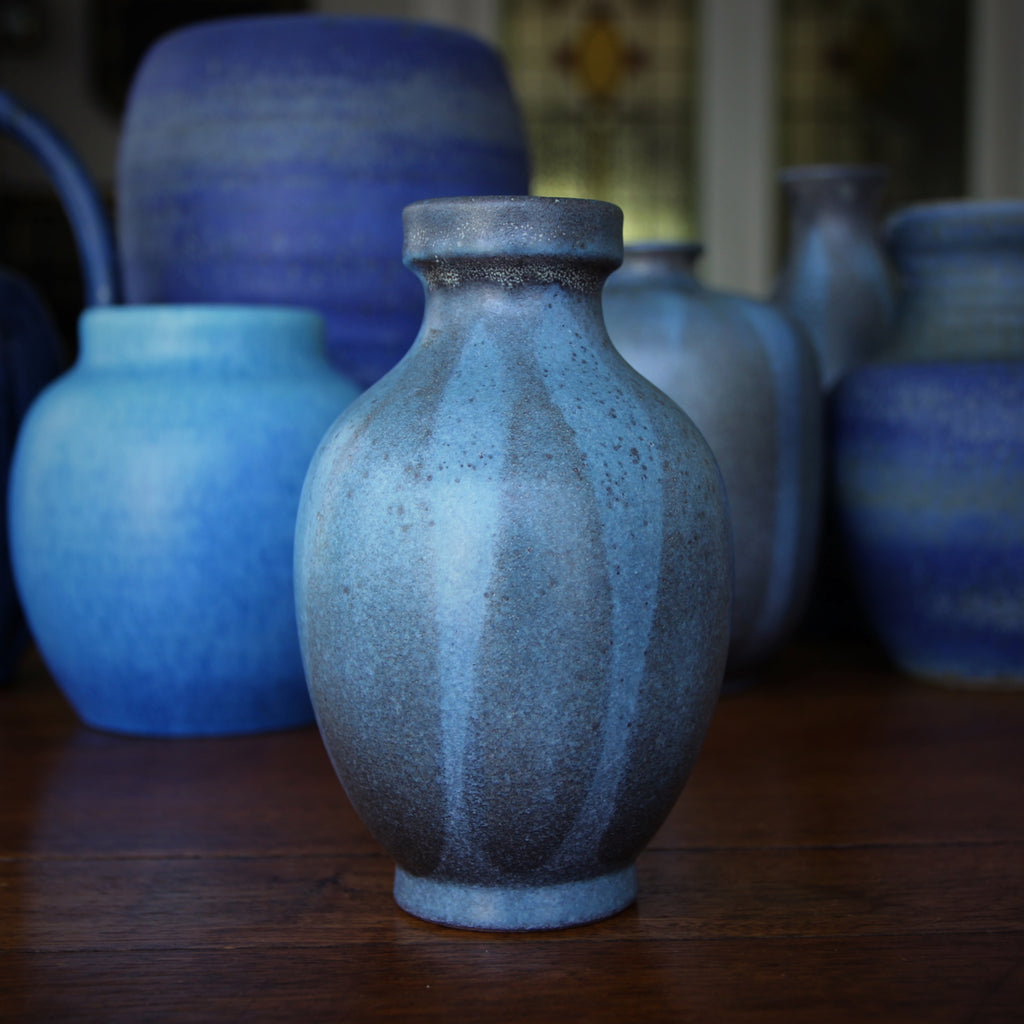
September is here—and, along with it, the Sapphire birthstone! Sapphires are one of the four "cardinal" gemstones. And, while it can come in a variety of colors (or be bi-colored), it is best known for its deep, pure, saturated blue coloration. It is a variety of the "Corundum" family and achieves its heavenly blue coloration from the presence of aluminum oxide in the stone. A red sapphire is called a ruby. From the Middle Ages, sapphires symbolized loyalty and trust; people would wear sapphires as a talisman to protect against danger or other harm. Italian superstition tells us that sapphires will protect the wearer from eye disease and melancholy. Besides being September's birthstone, a 45th wedding anniversary is called...
"Summer afternoon— summer afternoon; to me those have always been the two most beautiful words in the English language." - Henry James Is there anything more soul-satisfying than a gentle summer afternoon? The light, the color, the smell of freshly-mown grass, the breeze! For just a moment, the calendar stops its forward march; life is suspended—if only for a short while. Summer begins today, 20 June; it is also the longest day of the year. This Art Deco vase, made in England by Pilkington Royal Lancastrian, carries with it a perpetual summer mien. The underglaze bas relief—Art Deco graphic diamonds—shows through the jade-speckled turquoise glazing. Made in the Thirties, you can learn more about it by clicking on...
Loving thoughts, a special blessing and loads of appreciation to all our mothers—and all those who have "mothered" us in the past. Few roles in life have the potential to be so important as a mom. And few roles in life are simultaneously as difficult, worrying and, ultimately, rewarding. Thanks to all the mothers who have nurtured us, nourished us and sculpted our lives. Though our Greenwich Village store is now permanently closed, LEO Design is still alive and well! Please visit our on-line store where we continue to sell Handsome Gifts (www.LEOdesignNYC.com). We also can be found in Pittsburgh's historic "Strip District" at Mahla & Co. Antiques (www.mahlaantiques.com) or in Canonsburg, Pennsylvania at The Antique Center of Strabane (www.antiquecenterofstrabane.com). Or call to arrange to...
23 April is World Book Day—a day devoted to the promotion of reading, publishing, book collecting and copyright protection. This date was first marked by Catalan booksellers who, in 1923, wanted a way to commemorate the burial date of national literary giant Miguel de Cervantes. Interestingly, William Shakespeare also died on 23 April (according […]
A fresh grove of fruited orange trees encircles this English Art Deco platter designed by Norman Keates for Crown Ducal. Handsomely hand-decorated, it will bring a breeze of Spring fresh to your breakfast or luncheon table. Please click on the photo above to learn more about it.
Though our Greenwich Village store is now permanently closed, LEO Design is still alive and well! Please visit our on-line store where we continue to sell Handsome Gifts (www.LEOdesignNYC.com).
We also can be found in Pittsburgh's historic "Strip District" at Mahla & Co. Antiques (www.mahlaantiques.com) or in Canonsburg, Pennsylvania at The Antique Center of Strabane (www.antiquecenterofstrabane.com).
Or call to arrange to visit our Pittsburgh showroom (by private appointment only). 917-446-4248
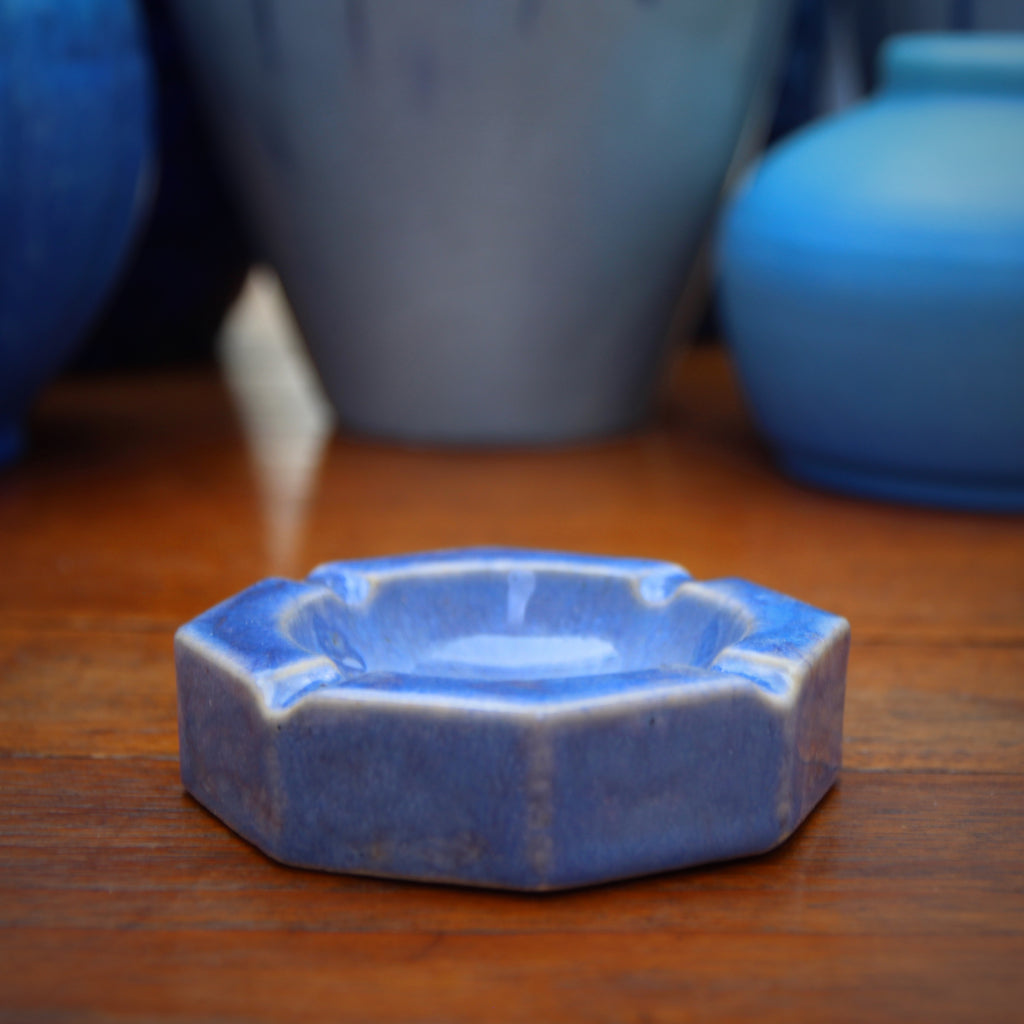
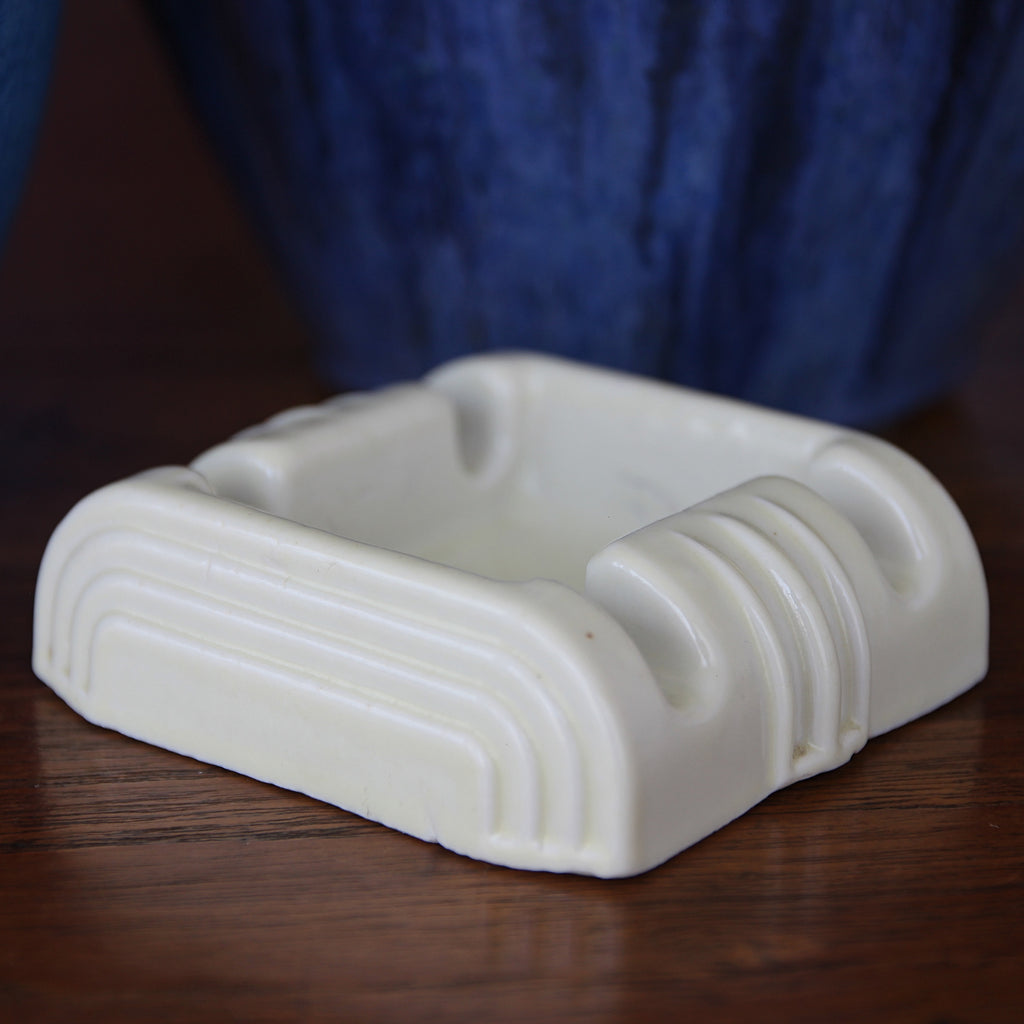
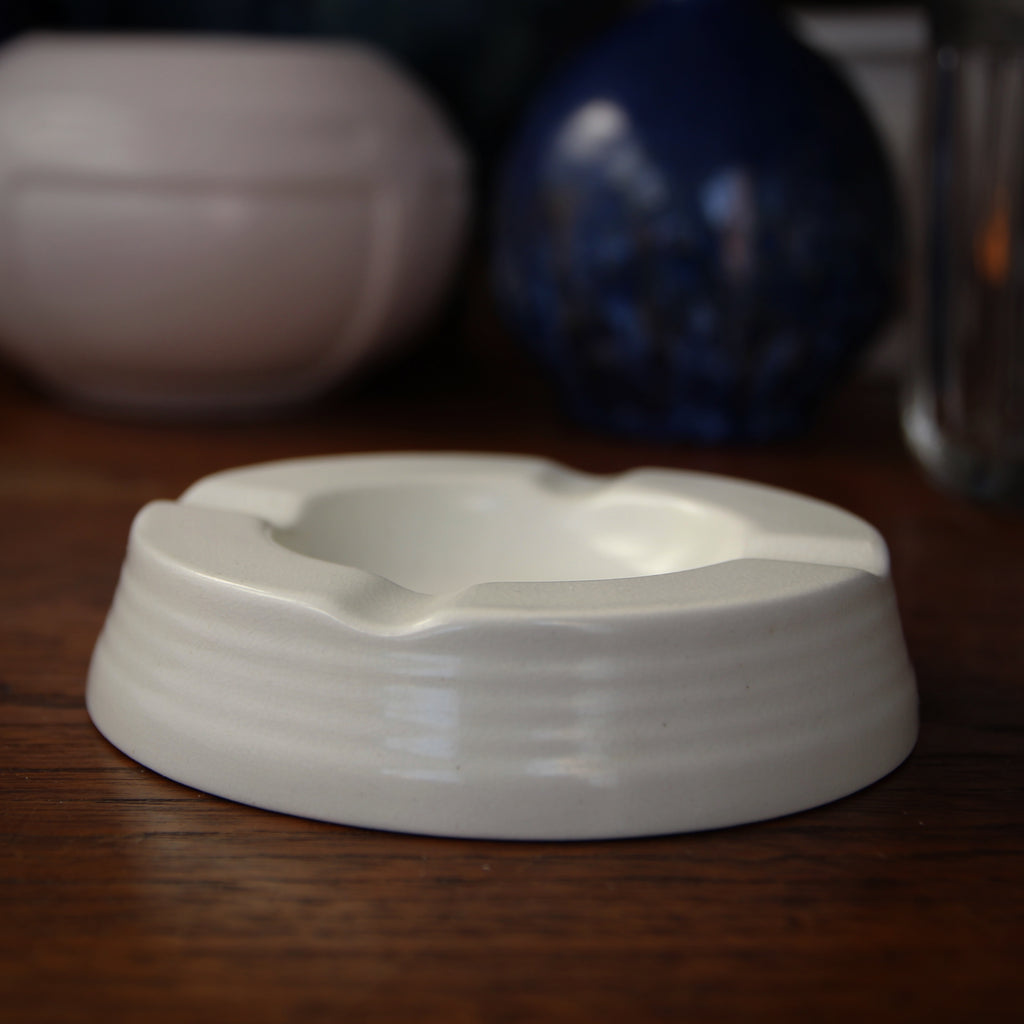
Though I (very much) dislike smoking, I love the accoutrements of lighting-up. So, when I came across it, I just had to grab this English Art Deco ashtray made by Keith Murray for Wedgwood. Employing his signature ribbing, Murray has lifted a commonplace item into the sublime. And it's perfectly finished with a satiny white glaze. Please click on the photo above to learn more about it. Though our Greenwich Village store is now permanently closed, LEO Design is still alive and well! Please visit our on-line store where we continue to sell Handsome Gifts (www.LEOdesignNYC.com). We also can be found in Pittsburgh's historic "Strip District" at Mahla & Co. Antiques (www.mahlaantiques.com) or in Canonsburg, Pennsylvania at The Antique Center of Strabane (www.antiquecenterofstrabane.com). Or call to...
With sunny days before us, what could be more appropriate than this hand-painted "Harlequin" pitcher? Perfect for maple syrup or a little milk for one's tea, this cheery little jug was made by Übelacker (West Germany) in the 1950's. It really provides a bit of sunshine on an otherwise grey day. Click on the photo above to learn more about it. Though our Greenwich Village store is now permanently closed, LEO Design is still alive and well! Please visit our on-line store where we continue to sell Handsome Gifts (www.LEOdesignNYC.com). We also can be found in Pittsburgh's historic "Strip District" at Mahla & Co. Antiques (www.mahlaantiques.com) or in Canonsburg, Pennsylvania at The Antique Center of Strabane (www.antiquecenterofstrabane.com). Or call to arrange to visit our Pittsburgh...
Today is Easter Monday, also called "Bright Monday" in Eastern Orthodox (and Byzantine Rite Catholic) churches. It marks the second day of Eastertide and, for some religious groups, the start of a week's worth of special liturgies. Many countries celebrate the day as a national holiday, usually those with a large Christian population and history. In some countries, the day takes-on a unique spin, like in Germany where families head for the fields and hold Easter egg races. In Egypt, people have outdoor picnics where they eat fermented mullet. And in Ireland, on Easter Monday the people commemorate the beginning of the Easter Rising of 1916 when Irish revolutionaries stood-up to their British colonizers in a suppressed attempt to achieve...
Today is Palm Sunday, the Sunday before Easter, when Christians commemorate Jesus's entry into Jerusalem—followed by His Passion and His death. It is an important day for Christian believers and marks the start of "Holy Week" which includes the "Triduum" (Holy Thursday, Good Friday, Holy Saturday) followed by Easter Sunday. At Palm Sunday services, congregants hold-aloft blessed palms (fronds or branches) which demonstrate one of the ironies of the day. In ancient times, palms represented victory or triumph as well as peace and everlasting life. Palm branches were laid before Jesus as he rode (a donkey) into the the Holy City. He was greeted as the Messiah, only to be disowned, rejected, and killed a few days later. Even his...
I love this color. Neither a pastel nor a jewel tone, it occupies a sweet spot in my recollection of the sublime Art Deco color palette. This vase was made by Stangl (Flemington, NJ) in the 1930's. Its voluptuous Art Deco shape is dressed in the soothing aqueous color. While this color appears pleasingly decorative, it was also used in more-industrial applications. I've seen tool cabinets and machine shop equipment (from the Thirties) finished in this hue. I also recall that my boyhood dentist (in the Mid-Sixties) had steel cabinets (and a matching chair/lamp/spitoon unit) in this deep aqua. Its fresh confidence certainly reminds me of Spring. Click on the photo above to learn more about it. Though our Greenwich...
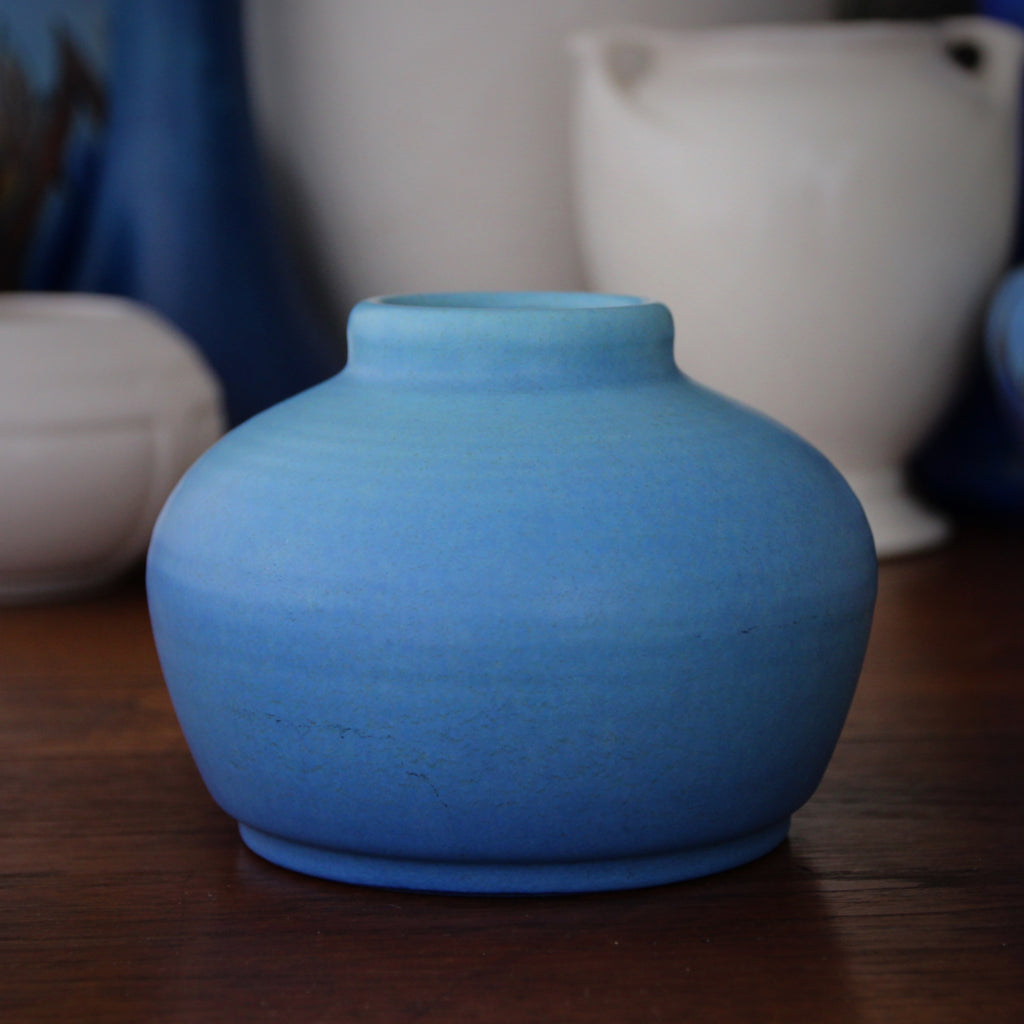
The Robins are already back! And, before long, they will be laying their beautiful blue eggs—another sign that Spring is here. This vase, hand-thrown by Edward Thomas Radford for Pilkington Royal Lancastrian, is dressed in a handsome Robin's Egg Blue glaze. Made in England in the 1920's or 1930's, it will bring the promise of new life into your home. Click on the photo above to learn more about it. Though our Greenwich Village store is now permanently closed, LEO Design is still alive and well! Please visit our on-line store where we continue to sell Handsome Gifts (www.LEOdesignNYC.com). We also can be found in Pittsburgh's historic "Strip District" at Mahla & Co. Antiques (www.mahlaantiques.com) or in Canonsburg, Pennsylvania at The Antique Center of...
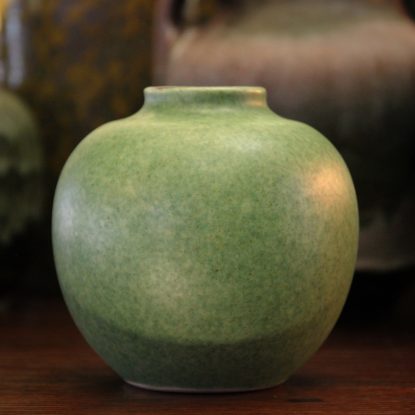
These days, when I venture out of the house—either to pull some weeds in my garden or walk little Benji around the block—I am reminded that Spring is already here. It gets warmer every day. The twilight is a little later. The daffodils have blossomed and the rose leaves are beginning to bud. Let's try to forget The Virus for a few moments and take a little pleasure in the fact that renewal, rebirth, rejuvenation is happening all around us. This West German vase by Bay is a step in a happy direction. With its dappled, apple green glazing, it reminds me of a fresh, crisp Granny Smith apple. And what is more promising than anything in soft green? Like the...
Hardly a day goes by that I do not pine for my little shop in Greenwich Village—or, at least, wistfully remember being a part of the bloodstream of that wonderful neighborhood. Yet, knowing the hardship that New York's (and every other city's) merchants are enduring right now, I consider myself blessed to be disentangled from the long tally of monthly expenses that a brick-and-mortar shopkeeper must shoulder: rent, payroll, utilities, insurance, banking fees, repairs. And—oh!—let's not forget the cost of acquiring new merchandise. With most small businesses (in the best of times) barely held-together with the "glue" of the owner's free labor, coming-out of this dormancy will be very difficult for most mom and pop merchants. And this sector is only...
We welcome the Spring with this sunny vase, hand-crafted and hand-painted in France in the 1920's or 1930's. It was made by the small French pottery workshop "Lachanal" which is best known for it's Persian-inspired turquoise blue glazes. This vase is aesthetically atypical and is marked "Piece Unique" (and signed by the artist, whom I have not identified). It seems to be a "one-off" experimental creation. The body of the vase is reminiscent of the shape, texture and color of a lemon (which, wistfully, reminds me of a trip to Sorrento last Spring). Over the yellow lies an intriguing, hand-painted "caramel" glaze—a spiky grid which (in a leap) reminds me of the longitude and latitude lines of the Earth. Today...
"Ireland Forever!" Happy Saint Patrick's Day! Saint Patrick—spelled Pádraig in Irish—was born to a Christian family in "Roman Britain" in 387 AD. At the time, the island of Britain was nearly-totally occupied by Roman forces. Though his father was a deacon, Patrick was not religious or particularly faithful. As he wrote in his autobiographical Confessio, as a young teenager he was abducted by pirates and sold into slavery in Ireland. He was made a shepherd and had plenty of time alone (with the sheep) to pray and contemplate his faith. He grew in his love of God, despite Ireland's hostility to the Christian faith (which was populated with Druids and Pagans). At the age of 20, he had a dream that...
Bacchus is the Roman name of the demi-god, also known as “Dionysus” by the Greeks. His father was Zeus and his mother was the human female, Semele. Bacchus was the god of wine-making, theatre and merriment, but also of sexual frenzy, ecstasy and extravagance. He would be accompanied on his wild, “Bacchanalian” benders by The […]
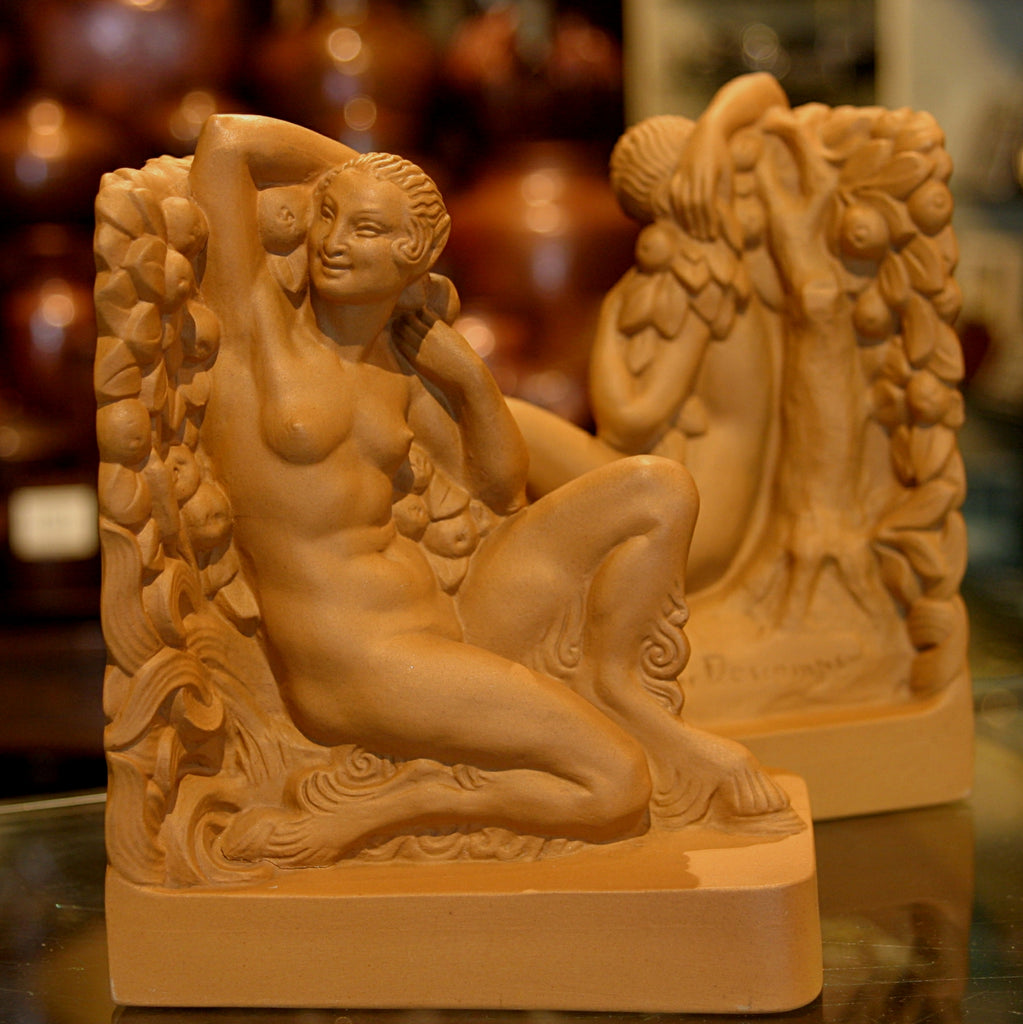
It's Mardi Gras! Fat Tuesday! And, NO, I am not implying that these buxom beauties are fat! On the contrary, they represent the artistically-idealized female figure for most of the last four thousand years. These "Satyresses" (female Satyrs) convey the (extreme) Bacchanalian character of the last day before Lent. In Catholic households, Mardi Gras is the opportunity to eat-up and get rid of all meat, fats, sweets, alcohol and other gustatory indulgences before the proscribed Lenten abstemiousness begins the next day (Ash Wednesday).
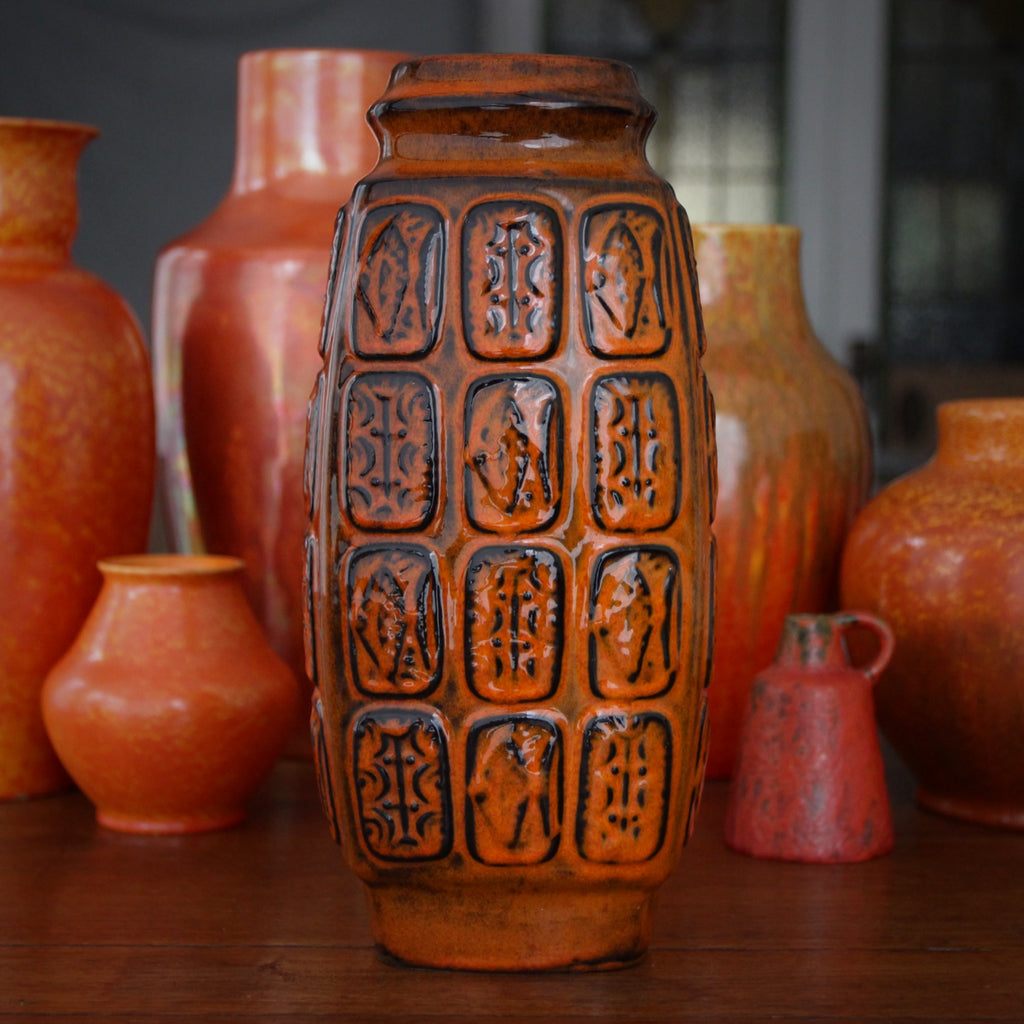
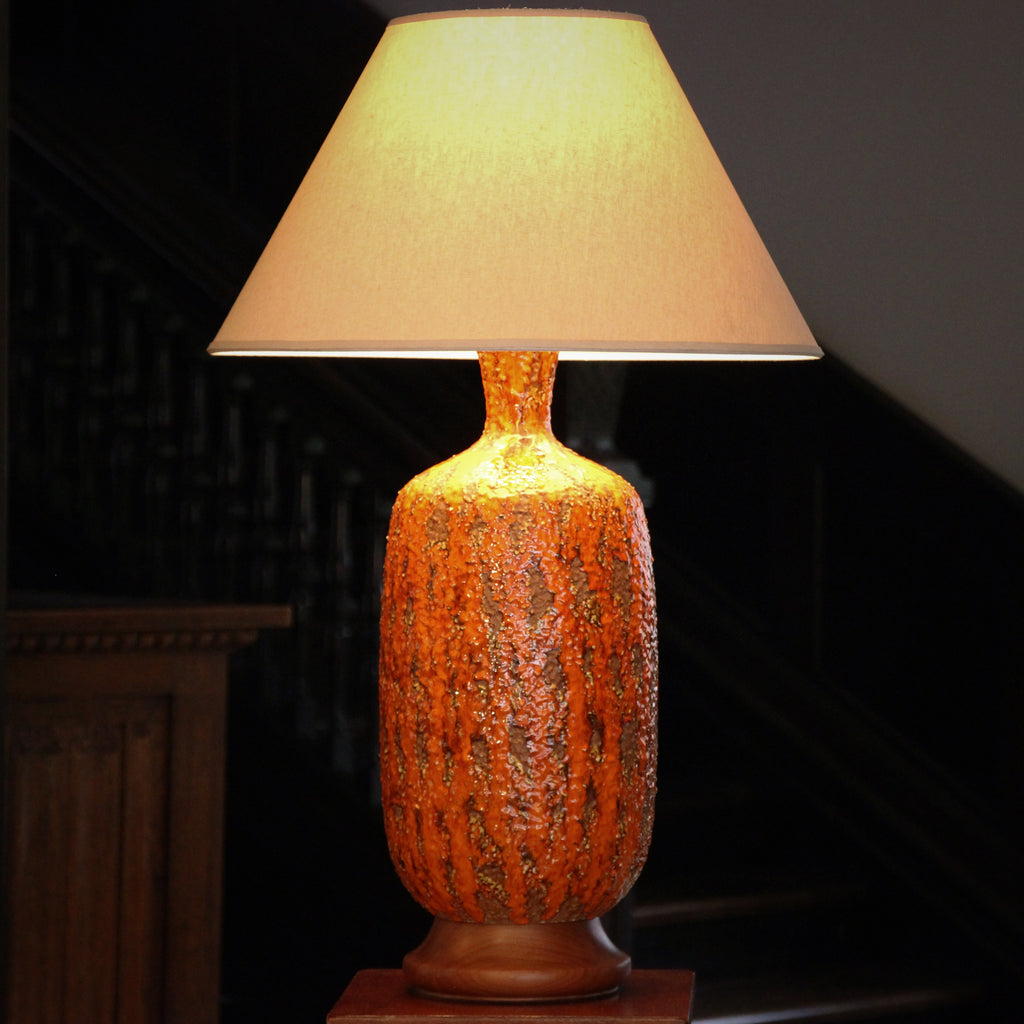
Even when turned-off, this lamp seems to radiate light and warmth. The ceramic lamp, dressed in a highly-textured orange glaze, screams Mid-Century Modern. It was made in the 1960's or 1970's and you can learn more about it by clicking on the photo above.
More lighting tomorrow.
Though our Greenwich Village store is now permanently closed, LEO Design is still alive and well! Please visit our on-line store where we continue to sell Handsome Gifts (www.LEOdesignNYC.com).
We also can be found in Pittsburgh's historic "Strip District" at Mahla & Co. Antiques (www.mahlaantiques.com) or in Canonsburg, Pennsylvania at The Antique Center of Strabane (www.antiquecenterofstrabane.com).
Or call to arrange to visit our Pittsburgh showroom (by private appointment only). 917-446-4248
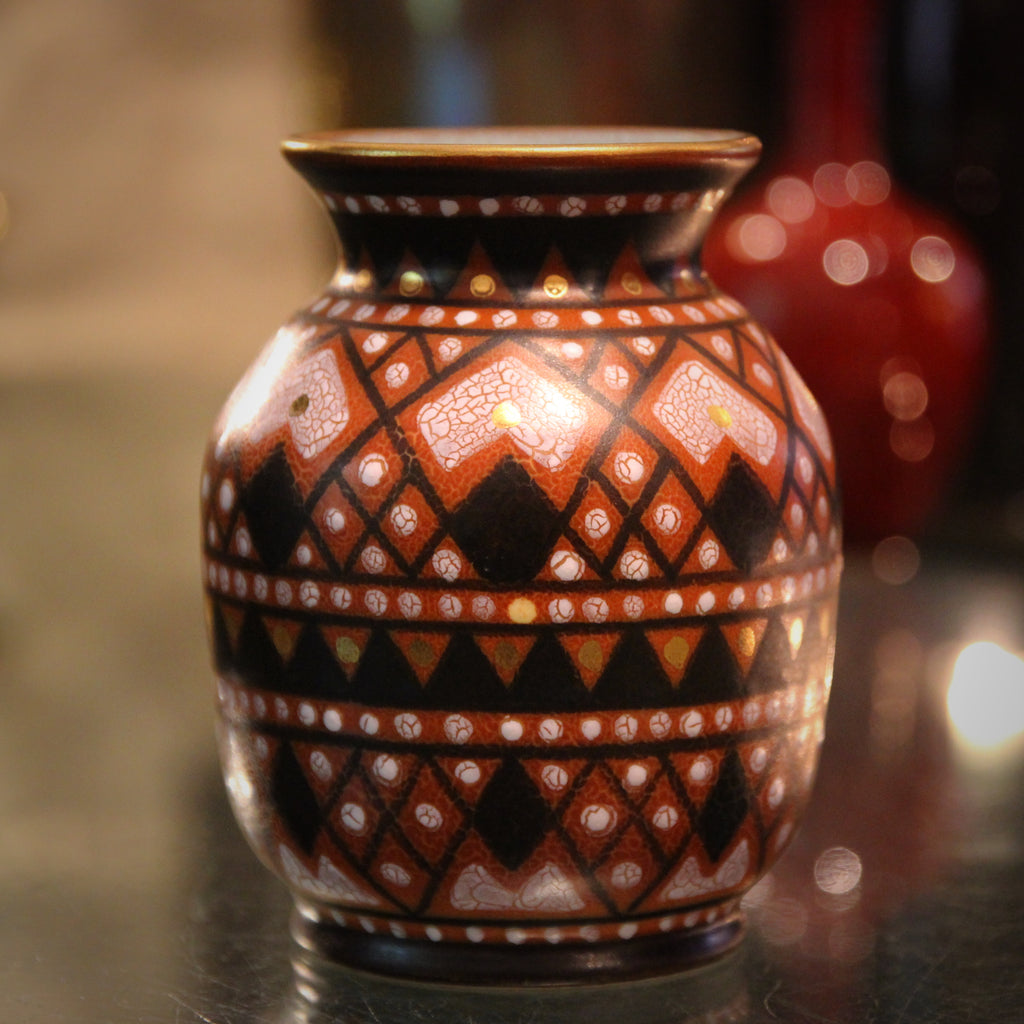
Let's end our little parade of Valentine's Day gift ideas with this special beauty, a Gouda Dutch vase from the Twenties or Thirties, hand-painted with a bold black, red, white and gold folk art graphic. Reminiscent of embroidery or a Northern European textile pattern, it would make a thoughtful and handsome gift for any Valentine with great taste. Click on the photo above to learn more about it. Though our Greenwich Village store is now permanently closed, LEO Design is still alive and well! Please visit our on-line store where we continue to sell Handsome Gifts (www.LEOdesignNYC.com). We also can be found in Pittsburgh's historic "Strip District" at Mahla & Co. Antiques (www.mahlaantiques.com) or in Canonsburg, Pennsylvania at The Antique Center of Strabane (www.antiquecenterofstrabane.com)....
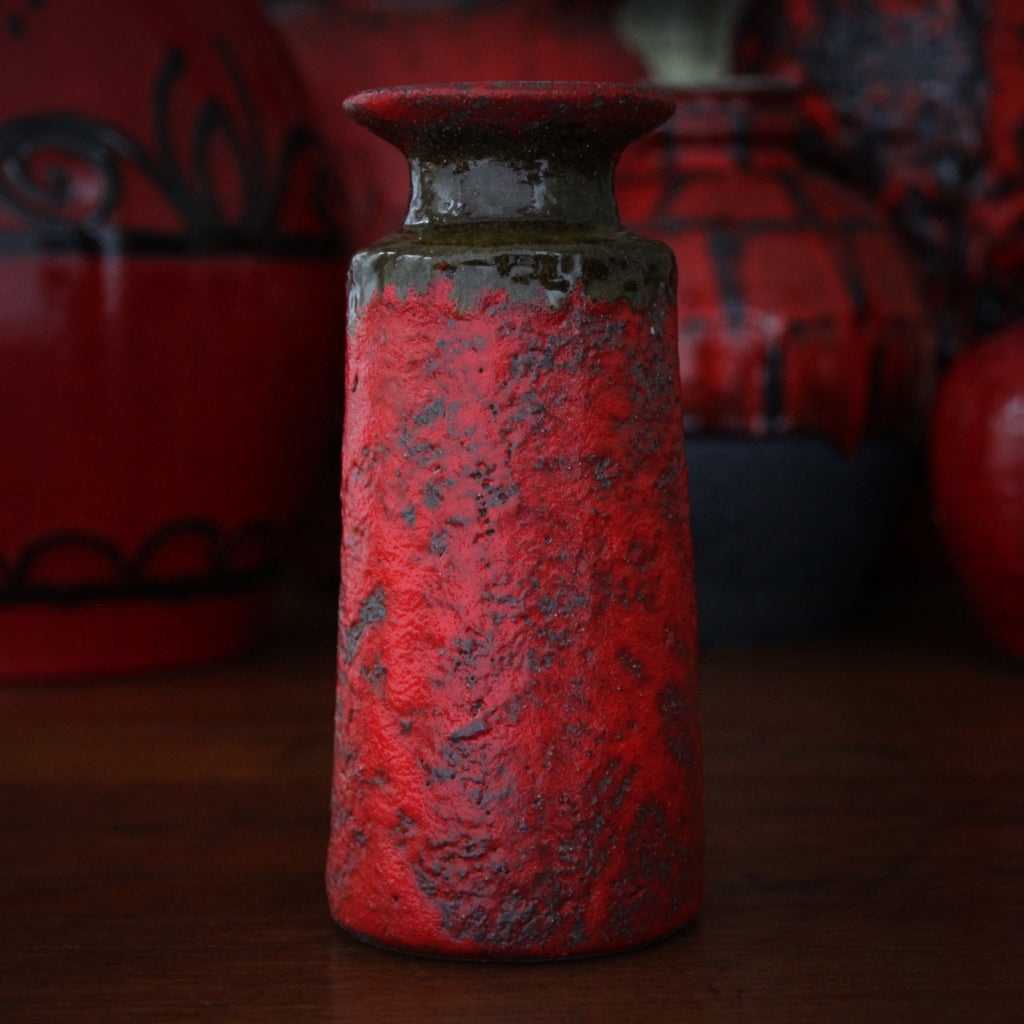
A crusty, matte red glaze clings to the tapered form of this European Modernist vase, made in the 1960's or 1970's. Beautiful as part of a collection, or equally handsome standing on its own on your bookshelf, coffee table or mantelpiece. Click on the photo above to learn more about it. More Valentine's Day gift ideas tomorrow. Though our Greenwich Village store is now permanently closed, LEO Design is still alive and well! Please visit our on-line store where we continue to sell Handsome Gifts (www.LEOdesignNYC.com). We also can be found in Pittsburgh's historic "Strip District" at Mahla & Co. Antiques (www.mahlaantiques.com) or in Canonsburg, Pennsylvania at The Antique Center of Strabane (www.antiquecenterofstrabane.com). Or call to arrange to visit our Pittsburgh showroom (by private appointment only)....