

Tradition holds that, on this day in 1455, Johannes Gutenberg completed his original copy of the "Gutenberg Bible," printed on Europe's first printing press using moveable, metal type. Gutenberg's technological advancement inaugurated Europe's "Age of Books"—and it ignited a rapid spread of learning and knowledge in the West. Gutenberg's invention is amongst the most important tech advancements in the world. It is responsible for an incalculable leap in human advancement. The Gutenberg Bible—even today—is considered a beautiful book, a work of art.
Gutenberg lived in Mainz, Germany—about 20 miles southwest of Frankfurt (long and still a center of books and publishing). He printed the Latin Vulgate version which St. Jerome had translated in the late 300's AD (from Old Testament Hebrew and New Testament Greek). He printed either 158 or 180 copies of the Bible (depending on which source you believe). Of these copies, only 21 complete books are known to exist. Needless to say, these complete bibles are extremely valuable and rarely appear at auction.
Gutenberg created 290 different, original "master type" characters (which included upper case letters, lower case letters, punctuation marks, and other special symbols) which were then duplicated as multiples in lead. This lead type was sorted and stored in the shallow trays of a "type case" (some in the upper case, some in the lower case). The type was pulled, character-by-character, and fitted into a "chase" (a frame which locked the lead pieces in place) which became the printing surface. All 168 (or 180) copies (of one sheet) were printed as a run, after which the type was cleaned of ink, released from the chase, sorted and returned to the type case for storage and reuse. Gutenberg developed a new oil-based ink (actually, a varnish) because the water-based inks (which scribes had used for handwriting) would not print crisply with the new technology).
In the Gutenberg Bible, each large sheet of paper was printed with four pages (two on one side, two on the reverse) and later folded in half. Because of the way pages were bound, any two pages printed simultaneously (side-by-side) were rarely consecutive in the finished book. Such layout had to be carefully engineered (and printed) so that the folded pages would end-up in the correct placement for binding. About 75% of the first run of Gutenberg Bibles was printed on paper; the other 25% was printed on vellum (usually treated, flattened calfskin).
Because the pages of the Bible were being printed in non-consecutive order—printing from the outer ends of each section and working inwards—engineering the line spacing could be difficult. As a concession to fitting-in all the lines, the earliest printed pages had 40 lines apiece, which grew to 41 or 42 lines as the print job progressed (in order to make everything fit). This was accomplished by reducing the spacing between lines, rather than altering the established, uniform page margins.
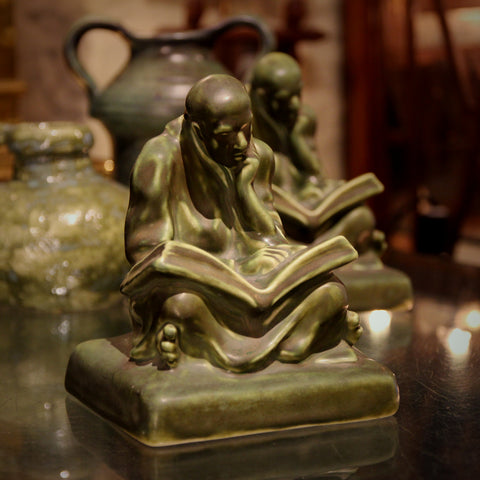
The American Arts & Crafts ceramics bookends, shown above, were made by Cowan Pottery (Lakewood, Ohio) in the 1910's. They depict a scholar-monk, hard at work, and are dressed in a beautiful mossy, matte green glazing. They'd make a wonderful gift for a graduating scholar, a cleric, or anyone who loves the printed word. Click on the photo above to learn more about these handsome bookends.
Though our Greenwich Village store is now permanently closed, LEO Design is still alive and well! Please visit our on-line store where we continue to sell Handsome Gifts (www.LEOdesignNYC.com).
To arrange a visit our Pittsburgh showroom (by private appointment only), please call 917-446-4248.